
Spain's media shift against Pedro Sánchez sparks speculation
Spanish outlets that supported PM Sánchez now criticize him, fueling theories of a firewall or economic adjustment.
English · Original discussion in Spanish · Published
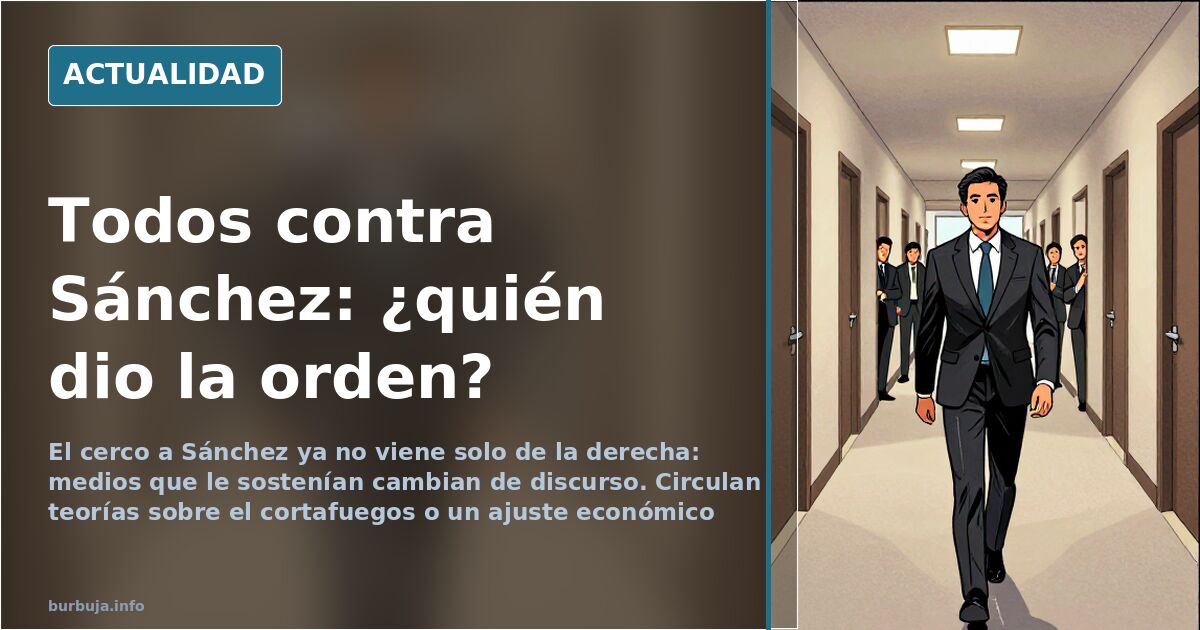
Why the media siege on Sánchez changed suddenly
A waiting room scene illustrates the shift, according to one account. Pensioners who vote PP or PSOE, regular TV viewers, reportedly turned the president and his circle into a single-issue obsession about corruption. These are not typical far-right supporters, but the target audience of media that until recently backed him with distortions. Suddenly, those same outlets changed their narrative. Political editor Pepa Bueno is out. The pressure no longer comes only from the right: it comes from within.
The question raised is not whether Sánchez is a burden. That was known from day one, when he allied with Podemos after promising not to. The mystery is why now, all at once, and why outlets that long covered up cases like ERE, 11M, Puyol, or Valencia floods decided to cut ties precisely now.
A firewall before scandal detonates
The most repeated hypothesis is a political firewall. If a major scandal is imminent, it would be better for Sánchez to be out of power, replaced by a leader able to distance himself without dragging down the party structure. The tactic involves leaking information gradually, hoping he resigns. Critics say he cares more about power than money, describing him as a pathological narcissist who won't leave easily.
Some argue the operation stems from high-level geopolitical calculations. A PM flirting with China, pro-Palestinian, and calling Israeli leaders genocidal may annoy certain interests. NATO and Brussels have been mentioned, along with frugal countries fed up with Spanish spending, which might impose austerity. For this, a politically weakened leader facing legal issues is undesirable; someone more compliant is preferred.
PP as scapegoat for upcoming adjustments
Economic logic suggests Spain’s debt issuance threatens payroll and pension payments, yet press silence persists because the government pays them. When cuts arrive, it would suit opponents if the conservative People’s Party (PP) were in Moncloa to take the blame. The plan might involve letting Sánchez stay one or two years until public memory fades, then forcing a motion of censure for democratic dignity. Pension hikes tied to inflation plus two points would ensure loyal votes despite corruption concerns.
Not everyone accepts the punishment narrative. Some see the conflict between Sánchez and Prisa Group as an internal six-month war over party survival. Others suggest a covert grand coalition where PP supports centrist PSOE governments and vice versa. The lesser evil would be a Sánchez unable to legislate, specifically raise taxes. Twenty years like that, they joke, wouldn’t be bad.
Army, Segarro, and conspiracy theories
At the spectrum’s edge, theories mix intelligence services, monarchies, and coups. Claims include generals on alert, ultimatums for treason arrests, Segarro Gladio operations, or Mossad involvement via Socialist International. These lack proof, similar to foreign links alleged in 23F or 11M. Their informational value is nil, but they reflect the climate: when official narratives sustancia ilegal, conspiracies fill the void.
Verifiable facts are mundane. US bombers are already at Torrejón Air Base, and the PM has remained silent, according to sources. Anti-Sánchez front-page intensity likely will decrease soon. Unresolved scandals remain. This is where analysis stalls: nobody knows who gave orders, but everyone agrees someone did.
Miscellaneous data points
A waiting room scene illustrates the shift, according to one account. Pensioners who vote PP or PSOE, regular TV viewers, reportedly turned the president and his circle into a single-issue obsession about corruption. These are not typical far-right supporters, but the target audience of media that until recently backed him with distortions. Suddenly, those same outlets changed their narrative. Political editor Pepa Bueno is out. The pressure no longer comes only from the right: it comes from within.
The question raised is not whether Sánchez is a burden. That was known from day one, when he allied with Podemos after promising not to. The mystery is why now, all at once, and why outlets that long covered up cases like ERE, 11M, Puyol, or Valencia floods decided to cut ties precisely now.
A firewall before scandal detonates
The most repeated hypothesis is a political firewall. If a major scandal is imminent, it would be better for Sánchez to be out of power, replaced by a leader able to distance himself without dragging down the party structure. The tactic involves leaking information gradually, hoping he resigns. Critics say he cares more about power than money, describing him as a pathological narcissist who won't leave easily.
Some argue the operation stems from high-level geopolitical calculations. A PM flirting with China, pro-Palestinian, and calling Israeli leaders genocidal may annoy certain interests. NATO and Brussels have been mentioned, along with frugal countries fed up with Spanish spending, which might impose austerity. For this, a politically weakened leader facing legal issues is undesirable; someone more compliant is preferred.
PP as scapegoat for upcoming adjustments
Economic logic suggests Spain’s debt issuance threatens payroll and pension payments, yet press silence persists because the government pays them. When cuts arrive, it would suit opponents if the conservative People’s Party (PP) were in Moncloa to take the blame. The plan might involve letting Sánchez stay one or two years until public memory fades, then forcing a motion of censure for democratic dignity. Pension hikes tied to inflation plus two points would ensure loyal votes despite corruption concerns.
Not everyone accepts the punishment narrative. Some see the conflict between Sánchez and Prisa Group as an internal six-month war over party survival. Others suggest a covert grand coalition where PP supports centrist PSOE governments and vice versa. The lesser evil would be a Sánchez unable to legislate, specifically raise taxes. Twenty years like that, they joke, wouldn’t be bad.
Army, Segarro, and conspiracy theories
At the spectrum’s edge, theories mix intelligence services, monarchies, and coups. Claims include generals on alert, ultimatums for treason arrests, Segarro Gladio operations, or Mossad involvement via Socialist International. These lack proof, similar to foreign links alleged in 23F or 11M. Their informational value is nil, but they reflect the climate: when official narratives sustancia ilegal, conspiracies fill the void.
Verifiable facts are mundane. US bombers are already at Torrejón Air Base, and the PM has remained silent, according to sources. Anti-Sánchez front-page intensity likely will decrease soon. Unresolved scandals remain. This is where analysis stalls: nobody knows who gave orders, but everyone agrees someone did.
Miscellaneous data points
- Political editor Pepa Bueno exits publicly.
- Central UCO unit has monitored surroundings since 2020.
- US bombers stationed at Torrejón.
- Planned pension increase: CPI plus two points retroactively.
Also available in: Deutsch
Summary of a discussion on Burbuja.info - Foro de economía, actualidad y política., translated from Spanish and reviewed before publication. Read the full discussion (122 replies).
More summaries
-
Profile of PSOE voters: most don't work, many are pensioners, loyal to Sánchez
A CIS survey shows 45.5% of PSOE voters don't work and 35.4% receive a pension. We analyse the data.
-
Rumors Suggest Spanish PM Sánchez May Step Aside
Online rumors claim Pedro Sánchez is considering not running, with PSOE looking at Bolaños, Cuerpo or García-Page as potential successors.
-
Spain PM considers delaying elections to 2027 amid weak polls
Sources close to the Spanish government are weighing postponing general elections until 2027 due to the PSOE's poor electoral standing.
-
Ivà, Makinavaja Creator, Dies at 52 in 1993 Car Crash
Ivà, creator of Makinavaja and El Jueves, died in a 1993 car crash at 52 with a blood alcohol level over 2.00.
-
China Blames Mossad for Ceuta Migration Crisis
Chinese intelligence links Morocco and Israel to the Ceuta border crisis, citing hybrid warfare motives related to Spain's stance on Palestine.
-
Tourist splashed with water after asking for horse hydration
A tourist asks for water for a horse and gets sprayed in the face. Viral video sparks debate on activism limits.