
Spain's 400,000 politicians figure that adds up nowhere, even among skeptics
The 400,000 politicians figure circulating since the 15M movement would include unpaid mayors and councillors, according to one forum user. Another argues that those who make a living…
English · Original discussion in Spanish · Published
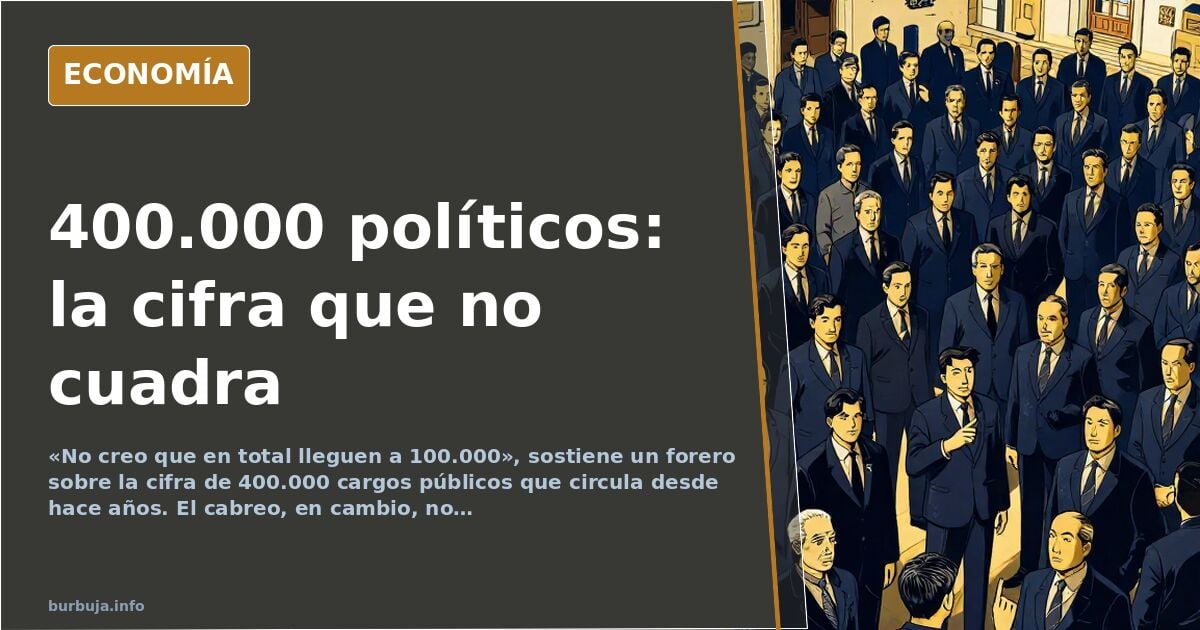
The 400,000 politicians calculation that nobody can back up
How many politicians and public officials are there in Spain? The figure that has been circulating since the 15M era — around 400,000 — resurfaces every time public spending is debated. But the very skepticism of those who use it is starting to undermine it. A calculation that included small-town mayors and unpaid councillors cannot be compared with the number of civil servants or healthcare workers. And that is where the problem begins.
Where the 400,000 public officials figure comes from
The 400,000 politicians figure is not new. It dates back to the 15M years, when a count was made adding up all elected and similar positions: from the Prime Minister down to the last councillor of a town of 200 inhabitants. That method includes people who are not paid for their role or who combine it with their regular job. A part-time village mayor is not a professional politician, yet in the overall count they weigh the same as a minister.
The debate flared up again trinc a message comparing the number of politicians with that of nurses, nursing assistants or orderlies. The response was not long in coming: if we count everyone paid from the public purse, the figure skyrockets. But one forum user points out that the real number of people who live off politics — with a public salary — is around 70,000. The rest would be advisers, appointed positions and personal staff.
The problem of mixing elected officials with political appointees
Here lies the crux of the matter. One thing is an elected position — mayor, councillor, member of parliament — and quite another the army of advisers, directorates general, observatories and assorted sinecures that proliferate in the administration. The 400,000 figure mixes both categories without any breakdown, which turns it into a weapon more than a useful piece of data.
Some argue that, even accepting that figure, the problem is real: too many people in unnecessary positions. Others reply that the number is impossible to sustain and that, at most, professional politicians and advisers together might reach 100,000. That figure would already be outrageous, but it is far from the 400,000 repeated like a mantra.
Public spending and the axe that never falls
The background to the debate is not just how many there are, but how much they cost and why cuts are never made there. The comparison with the number of useful civil servants — doctors, nurses, orderlies — is inevitable. While the debate over surplus politicians drags on, healthcare and education are being cut. That is the grievance running through the discontent.
The most radical proposal on offer is to cut taxes to zero and fund essential services privately. It is an extreme position, but it reflects the weariness of part of the electorate. Politicians and dispensable civil servants should just go home is the summary of that anger.
What nobody clarifies: the real breakdown of political spending
Neither those defending the figure nor those questioning it provide a full breakdown. There is no official document detailing how many appointed positions exist in Spain, what they are paid and what they actually do. That opacity is the perfect breeding ground for the 400,000 figure to keep circulating.
Meanwhile, the conversation drifts elsewhere: from the need for aircraft carriers and domestically produced nuclear bombs to whether the engineers and surgeons arriving through Ceuta balance the scales. Ironically or not, the debate loses its way without ever answering the original question.
Conclusion: the figure that cannot be sustained but lives on
In the end, the key question is not whether it is 400,000 or 100,000, but why there is no public, accessible register of all political and similar positions. Without that breakdown, any figure is an act of faith. And in economics, faith is frowned upon.
Also available in: Deutsch
Summary of a discussion on Burbuja.info - Foro de economía, actualidad y política., translated from Spanish and reviewed before publication. Read the full discussion (21 replies).
More summaries
-
Vox demands more staff, reigniting Spain's public spending debate
Vox calls for more doctors and police, sparking debate on public spending and civil servants in Spain.
-
Spain’s EU Presidency Pushes Ethnic Quotas in Public Office
Irene Montero adds ethnic representation in public posts to Spain’s EU agenda, alongside the controversial 'only yes is yes' law.
-
Incabel: tension between migrant workers and young Spaniards
Social media debate over 1300 euros and a shared room: the standoff between migrant workers and young Spaniards at Incabel.
-
ERC demands answers over origin of riots and looting in Barcelona
ERC Barcelona condemns Saturday's disturbances and calls on the City Council and the Generalitat to explain the lack of foresight and support for businesses.
-
Lula wins Brazil as right sweeps Congress
Lula wins the Brazilian presidency while Bolsonaro's right takes the largest Congress and Senate of its recent history.
-
Bomb threat forces Vueling Barcelona-Gran Canaria flight into emergency landing
A Vueling flight from Barcelona to Gran Canaria in Spain made an emergency landing after a bomb threat. The aircraft was moved to a remote area surrounded by security vehicles.