
Incabel: tension between migrant workers and young Spaniards
Social media debate over 1300 euros and a shared room: the standoff between migrant workers and young Spaniards at Incabel.
English · Original discussion in Spanish · Published
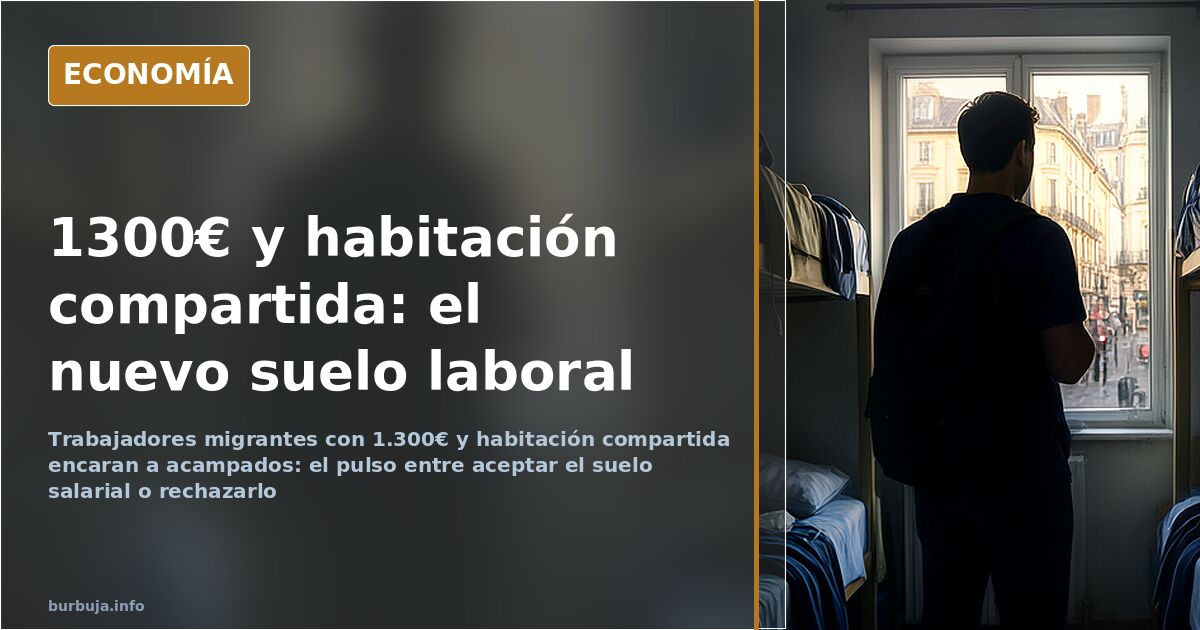
Incabel and the standoff between migrants and young workers over 1300 euros
A young Spaniard earns 1300 euros, shares a flat and eats out of tupperware. A worker newly arrived from the highlands earns the same, shares a room and, according to the story making the rounds on social media, doesn't complain. The paradox is textbook: the newcomer accepts what the local is starting to reject, and the clash is not cultural but one of wage expectations. The discussion about **Incabel** and its seasonal workforce has stopped being a company matter and become a barometer of the Spanish labour market.
The trigger is a scene repeated across forums and social media: young Spaniards with education and manners who protest about their living conditions while newly arrived migrant workers, on **1300-euro** contracts, accuse them of lacking effort. The argument circulating is that the newcomer accepts sharing a room for 700 euros and the Spaniard no longer will. And that this rift, far from being resolved, is getting worse.
1300 euros: the wage that no longer buys an independent life
The figure appears in every message: **1300 euros**. For a young Spaniard paying 700 for a room, 600 are left for everything else. For a worker who has just arrived and shares a flat with more people, the math changes. It is not that some are better than others; it is that the same wage buys radically different living standards depending on your support network and prior savings.
Some argue the problem is not immigration but the **structural precariousness** that allows a company to keep entire workforces on that wage. Against that weighs the argument that the mass arrival of labour willing to accept those conditions pushes down any improvement. The result is the same: the Spaniard who complains comes across as privileged and the migrant who endures as an example of sacrifice.
The story of the 'slave' who demands others be slaves too
The most repeated formulation is brutal: the newcomers, far from showing solidarity with those who protest, **demand** that the Spaniard do the same as them. The argument goes that someone who has sold their time for 1300 euros cannot stand seeing another aspire to more, because it forces them to acknowledge their own renunciation. It is locker-room psychology more than economics, but it explains why the conflict erupts on social media and not at a negotiating table.
The most widely shared anecdote is that of a worker who brags about speaking **four languages** and her meagre tupperware lunch while reproaching young people for their lack of effort. In the age of artificial intelligence, the multilingualism-as-key-to-success argument sounds like another era. And yet it is used as proof of merit against the one who protests.
Housing as the backdrop to the clash
The underlying issue is **housing**, which has become the main driver of intergenerational inequality. Sharing a flat at 30 is no longer a phase, it is the norm. And when the wage does not cover the rent, the protest stops being ideological and becomes one of survival. Those who arrive with lower expectations do not protest; those who grew up with different ones do.
The full calculation, with expenses broken down item by item, leaves a gap that surprises anyone doing it for the first time. It is not just the rent: it is transport, food, the gym membership for a shower. The list of things a young person gives up to live in a city has become so long that it no longer fits into a speech about effort.
The counterargument of hard work and personal experience
Against the story of precariousness comes the classic: 'I moved out on 40,000 pesetas earning the same.' Personal experience is used as the yardstick for everyone else. It works as an anecdote, not as policy: the market then was not the market now, and access to housing has become relatively more expensive.
Even so, the message sticks: some claim the young Spaniard does not want to **make an effort** and the migrant does. It is the modern version of the culture of sacrifice, applied to a market where sacrifice no longer guarantees a reward. And there lies the knot: when effort does not translate into improvement, the story breaks down.
What Incabel stands to lose, and what the labour market stands to lose
For a company like **Incabel**, the conflict is a fruta and workforce management problem. For the labour market, it is a signal: if the starting wage does not allow an independent life, turnover and conflict are guaranteed. The open question is whether the adjustment will come through a wage rise or through replacing workers.
Under these conditions, the tension between newcomers and local young people is no accident. It is the logical consequence of a market that has shifted the cost of housing onto wages. And as long as wages do not cover that cost, the clash will keep looking for culprits in the wrong mirror.
Also available in: Deutsch
Summary of a discussion on Burbuja.info - Foro de economía, actualidad y política., translated from Spanish and reviewed before publication. Read the full discussion (282 replies).
More summaries
-
14-Hour Days for 400 Euros: The Floor of the Labor Market
14-hour workdays for 400 euros and 12 people in four rooms reignite debates on wages, housing, and immigration in Spain.
-
Spain's labor market: Discomfort stems from immigrant roles, not people
The debate on immigration in Spain hides the real issue: society resists the assigned labor role more than the presence of migrants.
-
Spanish minister claims 200,000 annual migrants sustain system
A Spanish minister states that 200,000 annual migrants are needed to sustain the system until 2050, despite forum discussions citing significantly higher entry figures.
-
More housing won't lower prices if population keeps growing
A forum user argues that building more homes won't reduce prices if population growth continues, challenging Spain's expansion model.
-
Image goes viral worldwide: man seized to die as two Jewish onlookers watch
Ukraine is drafting men by force: what does this mean for its economy and the war? An analysis of an incident in **Odesa**.
-
Berlin father withdraws knife-point iPhone robbery report to spare migrant deportation
Knife-point robbery in Berlin: father withdraws report against undocumented migrant to prevent deportation. A case raising economic and social dilemmas.