
Bomb threat forces Vueling Barcelona-Gran Canaria flight into emergency landing
A Vueling flight from Barcelona to Gran Canaria in Spain made an emergency landing after a bomb threat. The aircraft was moved to a remote area surrounded by security vehicles.
English · Original discussion in Spanish · Published
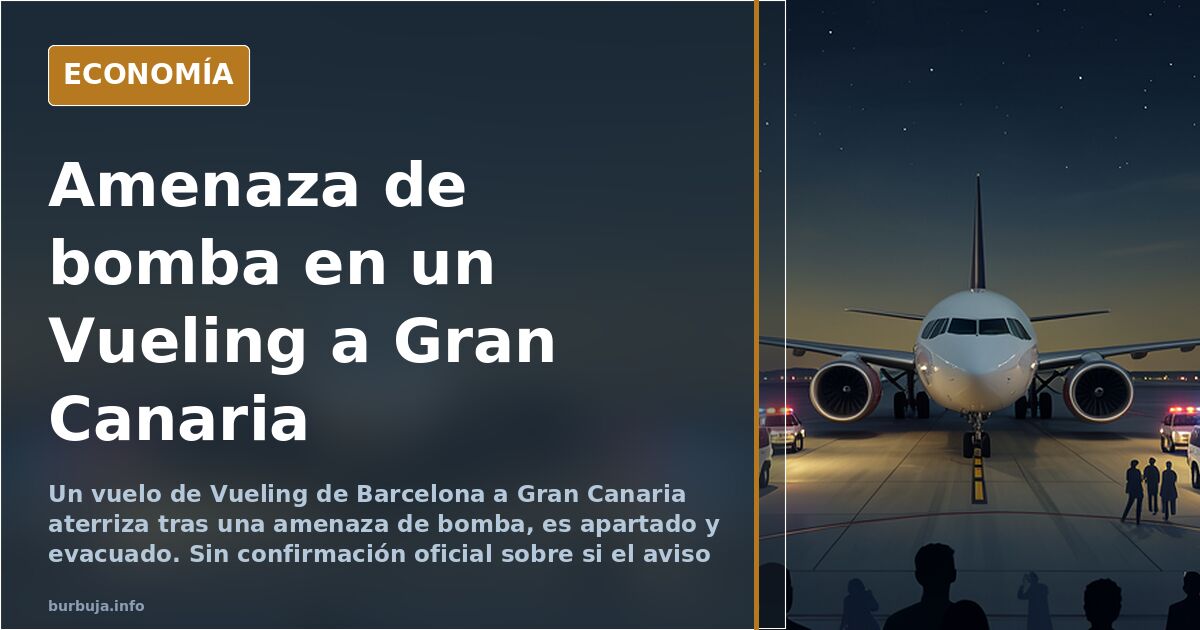
Bomb threat on Vueling flight: emergency landing in Gran Canaria
What happens when a commercial aircraft receives a bomb threat mid-flight? The protocol is activated, the plane makes an emergency landing and the security services are mobilized. That is what peine, according to initial reports, to a Vueling flight on the Barcelona-Gran Canaria route. The story was first reported by the Canary Islands' public television, which showed the aircraft in a remote area of the airport, surrounded by security vehicles and with the passengers evacuated. That is all that is known so far. The rest is an open case.
Confusion surrounds this type of incident. An aircraft that declares an emergency does not necessarily have to divert: if the destination airport is the same one, the emergency is used to get priority in the descent and on the runway. It is the nuance that separates an emergency landing from a diversion, and in this case the plane landed at its intended destination, Gran Canaria. The bomb threat has not, for now, been confirmed as real.
What is known about the bomb threat on the Vueling flight?
The bomb threat triggered the security protocol at Gran Canaria airport. The aircraft was parked in a remote area, with the passengers off the plane, while the interior was inspected for explosives. This is the standard procedure for a threat of this kind: it is not just about evacuating, but about ruling out a real device.
The information available is fragmentary. There is no official confirmation about the origin of the threat or whether any suspicious object was found. In cases like this, a false alarm is common, but caution is mandatory until the inspection work is complete. The story, therefore, is still developing.
Emergency landing without a diversion: the key to understanding the operation
The flight was on the Barcelona-Gran Canaria route and landed in Gran Canaria. The apparent contradiction —an emergency and a final destination— is explained by aviation mechanics: declaring an emergency allows the aircraft to skip the holding queue and get priority in the descent. It is not a diversion, it is a priority.
That detail dismantles the reading that the plane had to land somewhere else. The aircraft reached its destination, but it did so with the emergency protocol activated. The difference matters: a diversion means changing airports; an emergency with priority means staying on course but with preference over the rest of air traffic.
The false alarm and the social climate: from a scare to the chaos theory
The news of the bomb threat coincided with a climate of social tension in Spain. In the public conversation, the aviation incident was mixed with a string of conflicts: the situation in Ceuta, the housing protests, the boycotts of political rallies, street disturbances in several cities, the counterterrorism alert and a general strike called for November 11. Some messages interpreted the bomb threat as one more piece of that puzzle. It is a hypothesis, not a fact.
The association between an isolated aviation incident and an alleged escalation of chaos has no support in the available data. The bomb threat, until confirmed, is a probable false alarm. The accumulation of social conflicts is real, but connecting them to the flight is speculation.
What happens now with the plane and the passengers?
The passengers were evacuated and the aircraft remained in the custody of the security services. The search operation can take hours. If no explosive is found, the plane is declared safe and normality resumes. If one is found, another protocol is activated. Until the inspection work is complete, there is no conclusion.
The case is a reminder that airport security works with rigid protocols, but also with a margin of uncertainty. A bomb threat is one of the most delicate situations: it forces an evacuation, a search and a wait. For now, the story is the scare and the deployment. The outcome, when it comes, will be another story.
In the end, the question that remains is the usual one: how many false alarms does it take before we stop looking at the sky with suspicion? The answer, like the plane, is up in the air.
Also available in: Deutsch
Summary of a discussion on Burbuja.info - Foro de economía, actualidad y política., translated from Spanish and reviewed before publication. Read the full discussion (15 replies).
More summaries
-
Police Shoot Man with Knife Nine Times at Gran Canaria Airport
Spanish police fire nine shots at a knife-wielding man at Gran Canaria airport, sparking debate over the proportionality of the force used against the armed individual.
-
Woman Arrested in Gran Canaria Over €2,500 Hotel Fraud
Police arrested a woman at Gran Canaria airport for allegedly defrauding a hotel of €2,500. Experts debate whether this constitutes fraud or civil debt.
-
Spanish PM's Falcon makes emergency landing in Turkey
The emergency landing of the Spanish presidential Falcon in Turkey sparks conspiracy theories on Burbuja.info. Technical failure or political maneuver? Find out.
-
Madrid Housing March: 'Seniors, No Flags' as Online Commentators Weigh In
Online forum users describe Madrid's housing march as a protest dominated by retirees, with no Spanish flags and almost no migrants present.
-
ERC demands answers over origin of riots and looting in Barcelona
ERC Barcelona condemns Saturday's disturbances and calls on the City Council and the Generalitat to explain the lack of foresight and support for businesses.
-
Lula wins Brazil as right sweeps Congress
Lula wins the Brazilian presidency while Bolsonaro's right takes the largest Congress and Senate of its recent history.