
Spain: Where Neighborly Mood Swings Without Warning
Precarity, anxiety meds, envy, and harsh schedules explain Spain's reported mental health crisis.
English · Original discussion in Spanish · Published
Why Mental Instability Is Rising in Spain
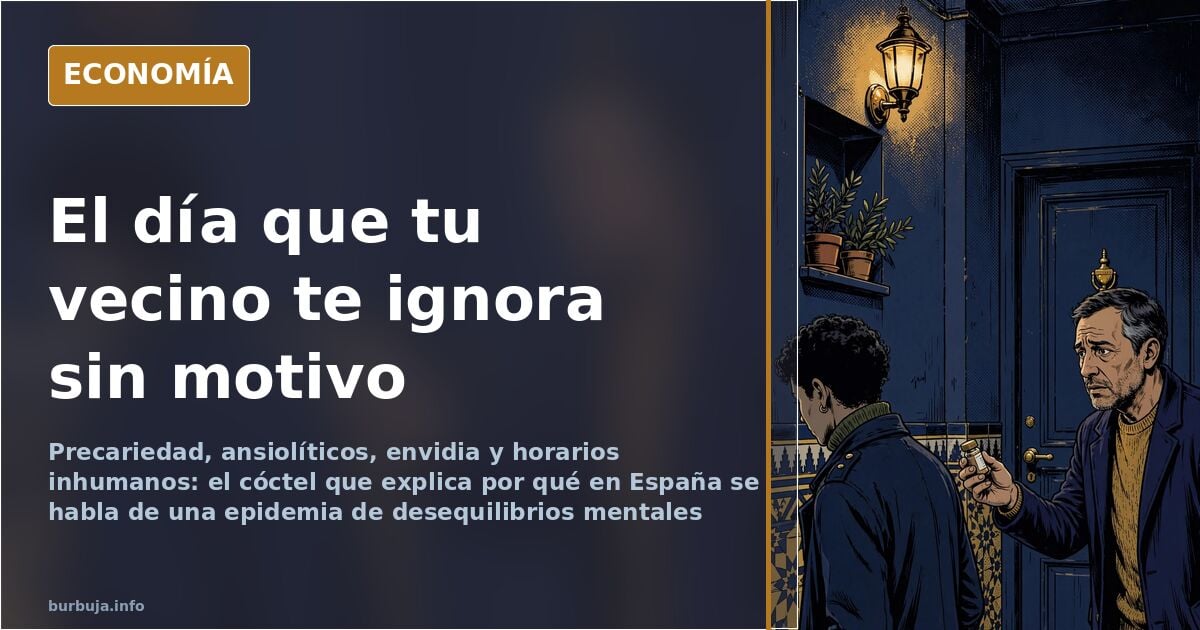
Spain is described as a psychiatric ward on a biblical scale. The analysis opens with this stark image: people who are friendly one day and cold or ignoring you the next, without apparent reason. The recurring diagnosis isn't psychological but structural: job precarity, low wages, constant uncertainty, and a social life permeated by the use of anxiolytics, alcohol, and narcotics. The lingering question is whether the imbalance is individual or if the environment itself makes its inhabitants sick.
Pill Consumption as a Social Thermometer
The first explanation offered is pharmacological. It points to national consumption of antidepressants and anxiolytics, combined with energy drinks and stimulants, as the most direct answer. The hypothesis suggests that at the slightest sign of a bad night, fatigue, or workload, people resort to pills recommended by acquaintances, which doctors prescribe "like candy."
Some go further, arguing that these medications have side effects matching the symptoms they aim to treat. The cycle would be: discomfort, pill, rebound effect, more pills. This loop could explain the abrupt mood swings described: people who seem excessively open one day and don't return a greeting the next.
Schedules, Noise, and Housing: Exhaustion as the Norm
Another line of analysis highlights environmental factors. It mentions inhuman schedules, late meals, television until three in the morning, and thin walls where conversations and noises are heard all night. The conclusion is that sleeping is impossible in Spain, and exhaustion accumulates. Added to this are the ugly aesthetics of cities, tolerance for noise, and incivility.
Housing issues appear as a multiplier. Constantly changing jobs and homes generates uncertainty described as incompatible with mental stability. The question raised is how to raise a child in such a context. The underlying calculation—how much it really costs to maintain a stable life with precarious salaries—is the kind of math everyone does at home, rarely adding up.
Envy as a Psychosocial Risk Factor
A third block focuses on culture. It mentions envy and a supposed Cain-like culture of wishing ill upon others as traits poisoning relationships. It describes a workplace environment where those who don't join the boss's inner circle or laugh at the opportunist's jokes are marked. Those who just work and leave are seen as odd.
A specific case is recounted: a department negotiates rotating shifts with management, and two days later other departments protest because some finish earlier. The experiment is reversed. The takeaway is that envy acts as a downward leveller, and this mechanism, applied to the whole country, produces collective derangement.
Loneliness, Divorce, and the Affective Market
The fourth focus is relational. It cites sentimental breakup rates between 50% and 70%, non-chosen male loneliness, and difficulties in building lasting bonds. The thesis is that without stable support networks, distress becomes chronic. There is talk of lonely men paying alimony and friends turned into adversaries.
International comparisons are used to nuance the diagnosis. It is argued that similar or worse behaviors are found in France, the Netherlands, or Romania: superficial education turning hostile when there is nothing to gain, violence linked to alcohol consumption. The conclusion is that the phenomenon is not exclusively Spanish, though it manifests here with particular intensity.
Mobile Phones and Daily Alienation
Special mention goes to the phone. It is pointed out as the biggest current drug, with people absorbed in screens while walking down the street. Alienation is described as the common denominator: absence of lasting bonds to trust and find refuge in. Comparisons with other countries highlight that here, additionally, a permanent sense of banter is demanded at work, tiring those who don't play along.
The overarching summary is a sum: legal and illegal drugs, envy, precarity, high taxes, unemployment, and a housing market that expels. Each factor alone might be manageable. Together, according to this reading, they produce the picture.
With these elements, the most reasonable prediction is that psychotropic drug consumption will continue to rise unless the material conditions feeding it change. However, linear forecasts should be viewed with skepticism: if anything characterizes this country, it is the capacity to endure far more than any model would predict.
Spain is described as a psychiatric ward on a biblical scale. The analysis opens with this stark image: people who are friendly one day and cold or ignoring you the next, without apparent reason. The recurring diagnosis isn't psychological but structural: job precarity, low wages, constant uncertainty, and a social life permeated by the use of anxiolytics, alcohol, and narcotics. The lingering question is whether the imbalance is individual or if the environment itself makes its inhabitants sick.
Pill Consumption as a Social Thermometer
The first explanation offered is pharmacological. It points to national consumption of antidepressants and anxiolytics, combined with energy drinks and stimulants, as the most direct answer. The hypothesis suggests that at the slightest sign of a bad night, fatigue, or workload, people resort to pills recommended by acquaintances, which doctors prescribe "like candy."
Some go further, arguing that these medications have side effects matching the symptoms they aim to treat. The cycle would be: discomfort, pill, rebound effect, more pills. This loop could explain the abrupt mood swings described: people who seem excessively open one day and don't return a greeting the next.
Schedules, Noise, and Housing: Exhaustion as the Norm
Another line of analysis highlights environmental factors. It mentions inhuman schedules, late meals, television until three in the morning, and thin walls where conversations and noises are heard all night. The conclusion is that sleeping is impossible in Spain, and exhaustion accumulates. Added to this are the ugly aesthetics of cities, tolerance for noise, and incivility.
Housing issues appear as a multiplier. Constantly changing jobs and homes generates uncertainty described as incompatible with mental stability. The question raised is how to raise a child in such a context. The underlying calculation—how much it really costs to maintain a stable life with precarious salaries—is the kind of math everyone does at home, rarely adding up.
Envy as a Psychosocial Risk Factor
A third block focuses on culture. It mentions envy and a supposed Cain-like culture of wishing ill upon others as traits poisoning relationships. It describes a workplace environment where those who don't join the boss's inner circle or laugh at the opportunist's jokes are marked. Those who just work and leave are seen as odd.
A specific case is recounted: a department negotiates rotating shifts with management, and two days later other departments protest because some finish earlier. The experiment is reversed. The takeaway is that envy acts as a downward leveller, and this mechanism, applied to the whole country, produces collective derangement.
Loneliness, Divorce, and the Affective Market
The fourth focus is relational. It cites sentimental breakup rates between 50% and 70%, non-chosen male loneliness, and difficulties in building lasting bonds. The thesis is that without stable support networks, distress becomes chronic. There is talk of lonely men paying alimony and friends turned into adversaries.
International comparisons are used to nuance the diagnosis. It is argued that similar or worse behaviors are found in France, the Netherlands, or Romania: superficial education turning hostile when there is nothing to gain, violence linked to alcohol consumption. The conclusion is that the phenomenon is not exclusively Spanish, though it manifests here with particular intensity.
Mobile Phones and Daily Alienation
Special mention goes to the phone. It is pointed out as the biggest current drug, with people absorbed in screens while walking down the street. Alienation is described as the common denominator: absence of lasting bonds to trust and find refuge in. Comparisons with other countries highlight that here, additionally, a permanent sense of banter is demanded at work, tiring those who don't play along.
The overarching summary is a sum: legal and illegal drugs, envy, precarity, high taxes, unemployment, and a housing market that expels. Each factor alone might be manageable. Together, according to this reading, they produce the picture.
With these elements, the most reasonable prediction is that psychotropic drug consumption will continue to rise unless the material conditions feeding it change. However, linear forecasts should be viewed with skepticism: if anything characterizes this country, it is the capacity to endure far more than any model would predict.
Summary of a discussion on Burbuja.info - Foro de economía, actualidad y política., translated from Spanish and reviewed before publication. Read the full discussion (170 replies).
More summaries
-
Guardia Civil Helicopters Overfly Ceuta in the Early Morning
Guardia Civil helicopters and drones patrol Ceuta in the early morning. Flight tracking suggests a deployment without an official statement.
-
Spain: Protests in Gata de Gorgos over David's murder and police handling
Residents of Gata de Gorgos, Spain, protest the killing of David amid criticism of the Guardia Civil for protecting squatters while a key witness fled threats.
-
Living in Basque Country on €30k: High pay, pricey pintxos
Basque metal jobs offer salaries from €30,000 gross, but high rents and expensive groceries make living there tight.
-
ECB faces three meetings at 4.25% rates before year-end
The ECB meets with rates at 4.25%, facing a range up to 6% amid energy-driven stagflation that hikes cannot fix.
-
Peio H. Riaño, Público's Culture Head, Accused by Interns
Peio H. Riaño, Culture Head at Spanish daily Público, faces accusations from interns and journalists describing a toxic work environment.
-
Lobo Nómada: €4,000 Monthly Costs, Seeks Help
YouTuber Lobo Nómada admits €4,000 monthly expenses and self-employed fees after leaving the National Police.