
Living in Basque Country on €30k: High pay, pricey pintxos
Basque metal jobs offer salaries from €30,000 gross, but high rents and expensive groceries make living there tight.
English · Original discussion in Spanish · Published
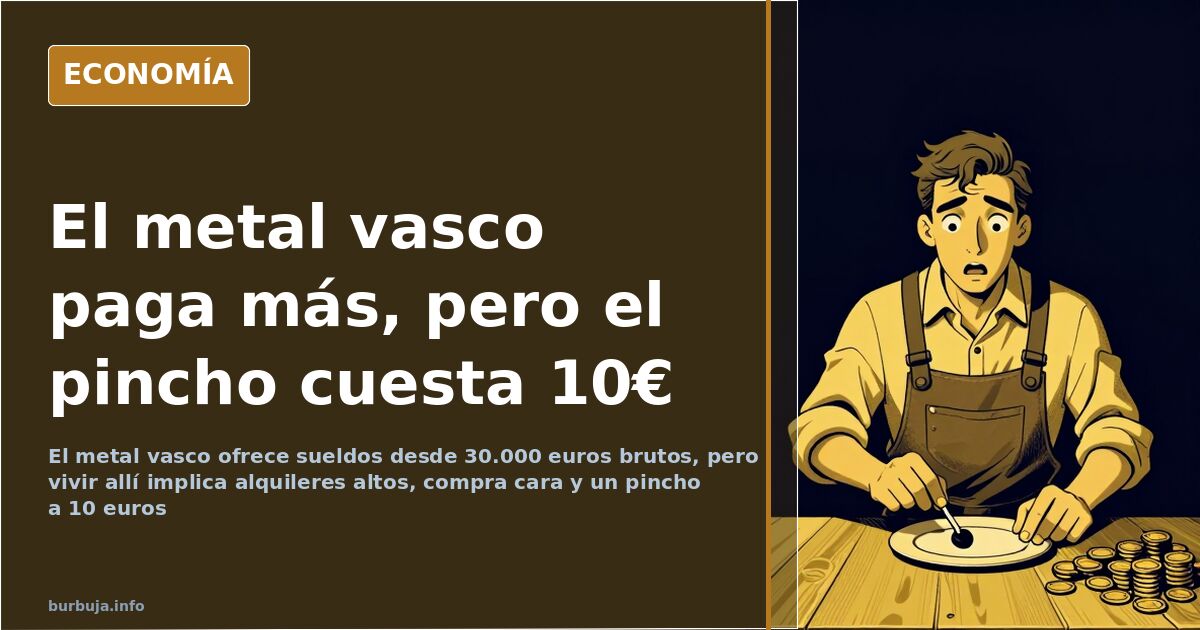
Basque metal sector: Salaries from €30,000 and soaring cost of living
In the metal construction sector, finding offers starting at €30,000 gross in the Basque Country doesn't require much searching. The question is how much of that salary survives rent, grocery bills, and a pintxo (Basque snack) that now costs €10. The starting point is a vocational training student considering leaving Spain, looking for remote terrain and rainy weather, who encounters an industry paying above average. The third point is easy. The other two are not.
How much does it cost to live in the Basque Country with €30,000 gross?
Residents almost always give the same answer: you can live there, but just barely. The warning repeats: apartments and shopping baskets are among the most expensive in the country, and this salary doesn't allow many luxuries if one wants to live alone. "I survive," summarizes someone signing from within.
Comparison with other cities arises naturally. In Valencia, housing costs half as much, it is argued, although the offered salary is considerably lower. The wage differential exists; what is debated is whether it compensates when rent takes the first slice. A complete breakdown of expenses, item by item, leaves a conclusion less brilliant than the offer figure.
Where is industrial employment: Biscay or Gipuzkoa?
The map has two speeds. In Biscay, supply concentrates in industrial estates around Bilbao: Ortuella, Gallarta, Basauri, Amorebieta, the Duranguesado region. In Gipuzkoa, there is more activity, but also higher demand for Basque language skills in companies. Names repeated as good payers are classics of metal and aeronautics: Mercedes in Vitoria, Talgo and Aciturri in Álava, CAF in Beasain, Irizar in Arrasate, ITP and Aernnova.
With previous experience in production, even if in automotive rather than metal, the door isn't closed anywhere. The catch is the usual one: picking the right company. There is no miraculous collective agreement here, just factories that pay well and factories that pay just enough.
Is the dark legend about ETA and Bildu true?
It rains, and nobody disputes that: some warn that weeks can pass without seeing the sun and that climate is the real price of moving. Regarding character, the most repeated description is of people who are dry but keep their word, going their own way.
Politics appears later, and conversation splits there. One current holds that the weight of abertzale left permeates everything—some even anticipate Bildu will govern in months—and that those thinking differently will notice. The opposite response says that is a legend from dark years: the place is calm, conflict-prone neighborhoods are avoided just like in Seville or Madrid, and personal treatment differs little from Castile.
A surprising nuance: several messages claim that in Burgos, Palencia, or Valladolid, people are more reserved than in deep Euskadi. How much is myth and how much concrete experience? It depends on who you ask.
Immigration, the issue creeping into any conversation
The third axis has nothing to do with metal. It is stated that Bilbao has changed a lot in little time and that the presence of migrant population is very visible; in small towns, the phenomenon is described as much smaller. Circulating figures are estimates over coffee, not official statistics.
Another part of the exchange moves to coexistence and labor market: it is argued that the sector has workers willing to physical effort that the average rejects, and the response is that the real problem isn't who arrives, but how expensive rent is for those already there.
On the other side of the border: Iparralde and Biarritz showcase
Comparison between French and Spanish Basque Country appears again and again, almost always with the same image: timber-framed houses versus apartment blocks. The French coast concentrates money, tourism, and high-end properties, while the interior is completely different, more rural and more Basque-speaking.
As a curiosity, someone recalls a cider house where Basque-French customers spoke in Basque with the server, who took advantage to drop comments in Spanish they wouldn't understand. The linguistic border doesn't separate as much as it seems.
The southern mirror
Amidst the exchange appeared the exact reverse of the premise: a young Basque asking about Andalusia, with heat as the only doubt and inverted stereotypes. The parallelism serves a purpose: outbound prejudices are identical to return ones, and neither side recognizes them in themselves.
In the end, the original question remains unresolved. Is it worth moving for €30,000 to a place where a pintxo costs €10, rent squeezes, and rain gives no respite for three straight weeks?
In the metal construction sector, finding offers starting at €30,000 gross in the Basque Country doesn't require much searching. The question is how much of that salary survives rent, grocery bills, and a pintxo (Basque snack) that now costs €10. The starting point is a vocational training student considering leaving Spain, looking for remote terrain and rainy weather, who encounters an industry paying above average. The third point is easy. The other two are not.
How much does it cost to live in the Basque Country with €30,000 gross?
Residents almost always give the same answer: you can live there, but just barely. The warning repeats: apartments and shopping baskets are among the most expensive in the country, and this salary doesn't allow many luxuries if one wants to live alone. "I survive," summarizes someone signing from within.
Comparison with other cities arises naturally. In Valencia, housing costs half as much, it is argued, although the offered salary is considerably lower. The wage differential exists; what is debated is whether it compensates when rent takes the first slice. A complete breakdown of expenses, item by item, leaves a conclusion less brilliant than the offer figure.
Where is industrial employment: Biscay or Gipuzkoa?
The map has two speeds. In Biscay, supply concentrates in industrial estates around Bilbao: Ortuella, Gallarta, Basauri, Amorebieta, the Duranguesado region. In Gipuzkoa, there is more activity, but also higher demand for Basque language skills in companies. Names repeated as good payers are classics of metal and aeronautics: Mercedes in Vitoria, Talgo and Aciturri in Álava, CAF in Beasain, Irizar in Arrasate, ITP and Aernnova.
With previous experience in production, even if in automotive rather than metal, the door isn't closed anywhere. The catch is the usual one: picking the right company. There is no miraculous collective agreement here, just factories that pay well and factories that pay just enough.
Is the dark legend about ETA and Bildu true?
It rains, and nobody disputes that: some warn that weeks can pass without seeing the sun and that climate is the real price of moving. Regarding character, the most repeated description is of people who are dry but keep their word, going their own way.
Politics appears later, and conversation splits there. One current holds that the weight of abertzale left permeates everything—some even anticipate Bildu will govern in months—and that those thinking differently will notice. The opposite response says that is a legend from dark years: the place is calm, conflict-prone neighborhoods are avoided just like in Seville or Madrid, and personal treatment differs little from Castile.
A surprising nuance: several messages claim that in Burgos, Palencia, or Valladolid, people are more reserved than in deep Euskadi. How much is myth and how much concrete experience? It depends on who you ask.
Immigration, the issue creeping into any conversation
The third axis has nothing to do with metal. It is stated that Bilbao has changed a lot in little time and that the presence of migrant population is very visible; in small towns, the phenomenon is described as much smaller. Circulating figures are estimates over coffee, not official statistics.
Another part of the exchange moves to coexistence and labor market: it is argued that the sector has workers willing to physical effort that the average rejects, and the response is that the real problem isn't who arrives, but how expensive rent is for those already there.
On the other side of the border: Iparralde and Biarritz showcase
Comparison between French and Spanish Basque Country appears again and again, almost always with the same image: timber-framed houses versus apartment blocks. The French coast concentrates money, tourism, and high-end properties, while the interior is completely different, more rural and more Basque-speaking.
As a curiosity, someone recalls a cider house where Basque-French customers spoke in Basque with the server, who took advantage to drop comments in Spanish they wouldn't understand. The linguistic border doesn't separate as much as it seems.
The southern mirror
Amidst the exchange appeared the exact reverse of the premise: a young Basque asking about Andalusia, with heat as the only doubt and inverted stereotypes. The parallelism serves a purpose: outbound prejudices are identical to return ones, and neither side recognizes them in themselves.
In the end, the original question remains unresolved. Is it worth moving for €30,000 to a place where a pintxo costs €10, rent squeezes, and rain gives no respite for three straight weeks?
Summary of a discussion on Burbuja.info - Foro de economía, actualidad y política., translated from Spanish and reviewed before publication. Read the full discussion (166 replies).
More summaries
-
PNV wins Basque election, Bildu falls short, Vox wins one seat
The PNV retains power in the 21A Basque election, while Bildu underperforms forecasts. Vox secures its first seat in the Basque Parliament.
-
Basque Identity and Demography in the Basque Country
Analysis of identity tension in Bilbao: migration and Basque culture data after the festivities.
-
Galician regional government to fund driving licenses for legalized migrants
The Xunta will cover the cost of driver's licenses for migrants who have regularized their status: over €1,000 per person, and a growing debate about who should foot the bill.
-
Spanish worker burns warehouse over unlivable wages
A Spanish employee torched toilet paper pallets in his workplace, citing poverty wages. The net minimum wage is €1,068 monthly.
-
Spain rejects war, defends Algerian gas amid IBEX drop
Pedro Sánchez opposes military action as the IBEX falls 1%. Spain relies on Algeria for 34.6% of its gas and the US for 30%, a 96.3% increase.
-
Colombian Trumpist Rep. Angela Vergara’s Son Detained by ICE
Colombian congresswoman who praised ICE deportations sees her son detained for 18 days, sparking debate on hypocrisy and migration costs.