
Texas Defies Biden With Support From 25 Governors
Texas invokes self-defense rights backed by 25 governors, despite a 5-4 Supreme Court ruling against the state. The standoff continues.
English · Original discussion in Spanish · Published
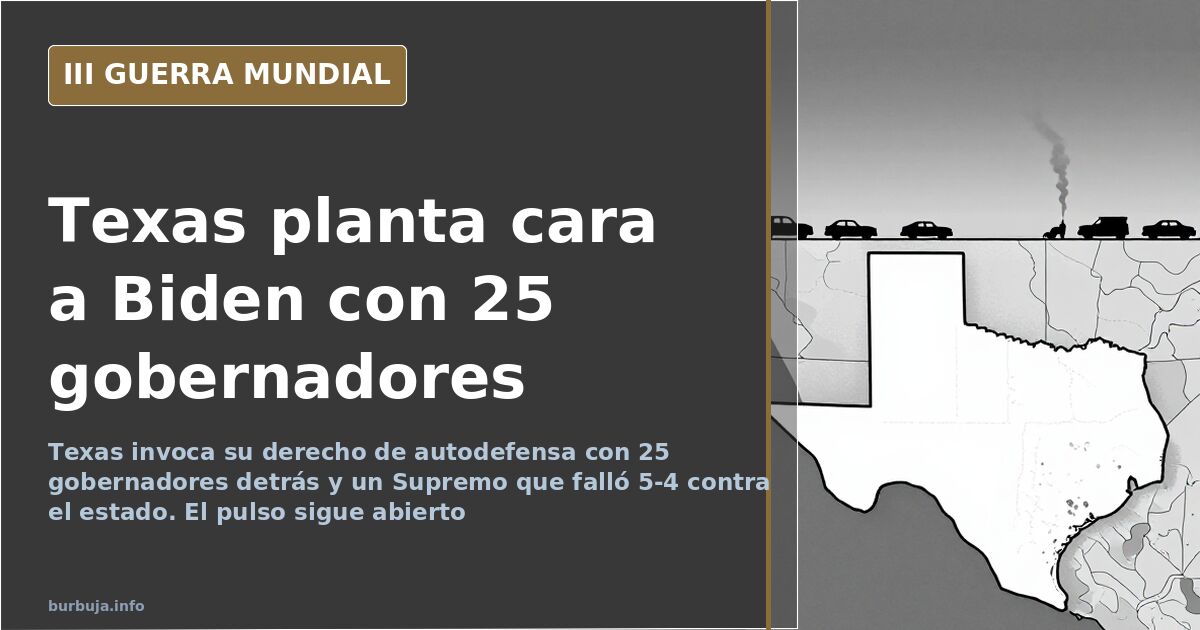
Texas Invokes Self-Defense as 25 Governors Back the Standoff
States do not declare war. They can, however, claim their borders are overwhelmed and assert the right to defend themselves independently. That is what Texas Governor Greg Abbott has done, in a statement asserting “the constitutional right of Texas to self-defense” against the border policies of the Joe Biden administration. The phrase sounds like routine bureaucratic language. It is not: it describes a jurisdictional clash between a state and the federal government that had been simmering for months and has now erupted into public view.
The trigger is control of the border with Mexico. Texas argues it is acting where Washington fails to act, and the dispute has escalated to involve the state’s National Guard, its attorney general, and several federal agencies. The figure that best measures the temperature of this issue is simple: 25 governors have signed a joint letter supporting Texas’s border resistance.
The 25 Governors and the Texas National Guard
The letter was circulated with the backing of the Republican Governors Association and, according to estimates cited in the debate, the signing states account for roughly half of the country’s population. The gesture is not merely symbolic: the proposal is for each willing state to deploy personnel from its own National Guard to the Texas border.
Donald Trump has spoken along these lines, calling on “all willing states” to deploy their national guards to Texas as the alliance expands. Some state officials have gone further, publicly sending letters to their governors urging them to activate units and send troops. In short: the conflict involves state armed forces, which under normal circumstances answer to a federal chain of command.
From the opposing side, there have been calls for the inverse response: demanding that Biden assume control of the Texas National Guard due to the governor’s refusal to withdraw from the border. A president federalizing a state guard is one of those tools listed in the manual but rarely taken out of the drawer. Requesting it openly indicates the severity of the stakes.
Shelby Park, DHS, and the Legal Battle in Eagle Pass
The second front is legal and has a specific name: Shelby Park in Eagle Pass. The Department of Homeland Security (DHS) denied Texas authorities access to the area, and Texas Attorney General Ken Paxton responded with a list of counter-demands. The first, with a deadline: before February 15, the DHS must provide official plans and deeds proving ownership of the land.
The backdrop is a Supreme Court decision resolved 5-4 against Texas’s position, according to summaries circulating among case observers. And here appears the argument with the most traction: Congress can render that ruling moot simply by refusing to fund border security removal measures. This is known as the power of the purse, and it does not require a new executive order.
The dispute therefore has three open avenues simultaneously—courts, physical deployment, and federal budget—and none closes on its own. Anyone who thinks this will be resolved with a press conference has not looked at the calendar.
The Electoral Calculation: Polls and Voter Mobilization
Beneath the institutional noise lies an ongoing campaign. The polls currently circulating show varying advantages for Trump over Biden: YouGov places him at +1, HarrisX at +7, and Morning Consult at +5. A wide range, typical of an election year, but with a repeated message: border issues mobilize voters.
And then there is the more cynical reading, which also emerges. Some reduce the episode to business: companies like selling weapons, citizens like buying them, and immigration, cartels, and the right to self-defense serve as pretexts. This is not an analysis that can be proven with a spreadsheet, but it explains why the standoff does not cool down even when no piece moves.
Another block of messages hints at a larger scenario—an open civil conflict—and almost immediately dismisses it, settling for a more modest formula: civil war probably not, but major trouble, certainly.
The Spanish Derivative: 17% of the Population Was Not Born Here
The Texas issue has served, in parallel, to reopen the migration debate locally. According to estimates cited in the discussion, 17% of the resident population in Spain was not born in Spain, adding that around 800,000 people entered the country in 2023. From this, an uncomfortable conclusion is drawn: if the volume is that high, it would be coherent to legislate accordingly rather than maintain policies designed to please public opinion while practice goes elsewhere.
This is an argument that does not depend on what happens at the Texas border, and that is precisely the point. The Eagle Pass standoff functions as a mirror: what is debated there is replicated here with different names and figures. Each country has its own border liturgy, and few come out well when comparing discourse and numbers.
There is a underlying irony that almost no one mentions: the name of the state itself has Spanish origins. Mission San Francisco de los Tejas was founded in 1690, and the toponym derives from it.
With three fronts open—courts, deployment, and budget—and an electoral campaign in full swing, the only clear thing is that neither party has incentives to de-escalate before November. How much of this standoff is real border defense and how much is campaign prop with the National Guard as an extra?
States do not declare war. They can, however, claim their borders are overwhelmed and assert the right to defend themselves independently. That is what Texas Governor Greg Abbott has done, in a statement asserting “the constitutional right of Texas to self-defense” against the border policies of the Joe Biden administration. The phrase sounds like routine bureaucratic language. It is not: it describes a jurisdictional clash between a state and the federal government that had been simmering for months and has now erupted into public view.
The trigger is control of the border with Mexico. Texas argues it is acting where Washington fails to act, and the dispute has escalated to involve the state’s National Guard, its attorney general, and several federal agencies. The figure that best measures the temperature of this issue is simple: 25 governors have signed a joint letter supporting Texas’s border resistance.
The 25 Governors and the Texas National Guard
The letter was circulated with the backing of the Republican Governors Association and, according to estimates cited in the debate, the signing states account for roughly half of the country’s population. The gesture is not merely symbolic: the proposal is for each willing state to deploy personnel from its own National Guard to the Texas border.
Donald Trump has spoken along these lines, calling on “all willing states” to deploy their national guards to Texas as the alliance expands. Some state officials have gone further, publicly sending letters to their governors urging them to activate units and send troops. In short: the conflict involves state armed forces, which under normal circumstances answer to a federal chain of command.
From the opposing side, there have been calls for the inverse response: demanding that Biden assume control of the Texas National Guard due to the governor’s refusal to withdraw from the border. A president federalizing a state guard is one of those tools listed in the manual but rarely taken out of the drawer. Requesting it openly indicates the severity of the stakes.
Shelby Park, DHS, and the Legal Battle in Eagle Pass
The second front is legal and has a specific name: Shelby Park in Eagle Pass. The Department of Homeland Security (DHS) denied Texas authorities access to the area, and Texas Attorney General Ken Paxton responded with a list of counter-demands. The first, with a deadline: before February 15, the DHS must provide official plans and deeds proving ownership of the land.
The backdrop is a Supreme Court decision resolved 5-4 against Texas’s position, according to summaries circulating among case observers. And here appears the argument with the most traction: Congress can render that ruling moot simply by refusing to fund border security removal measures. This is known as the power of the purse, and it does not require a new executive order.
The dispute therefore has three open avenues simultaneously—courts, physical deployment, and federal budget—and none closes on its own. Anyone who thinks this will be resolved with a press conference has not looked at the calendar.
The Electoral Calculation: Polls and Voter Mobilization
Beneath the institutional noise lies an ongoing campaign. The polls currently circulating show varying advantages for Trump over Biden: YouGov places him at +1, HarrisX at +7, and Morning Consult at +5. A wide range, typical of an election year, but with a repeated message: border issues mobilize voters.
And then there is the more cynical reading, which also emerges. Some reduce the episode to business: companies like selling weapons, citizens like buying them, and immigration, cartels, and the right to self-defense serve as pretexts. This is not an analysis that can be proven with a spreadsheet, but it explains why the standoff does not cool down even when no piece moves.
Another block of messages hints at a larger scenario—an open civil conflict—and almost immediately dismisses it, settling for a more modest formula: civil war probably not, but major trouble, certainly.
The Spanish Derivative: 17% of the Population Was Not Born Here
The Texas issue has served, in parallel, to reopen the migration debate locally. According to estimates cited in the discussion, 17% of the resident population in Spain was not born in Spain, adding that around 800,000 people entered the country in 2023. From this, an uncomfortable conclusion is drawn: if the volume is that high, it would be coherent to legislate accordingly rather than maintain policies designed to please public opinion while practice goes elsewhere.
This is an argument that does not depend on what happens at the Texas border, and that is precisely the point. The Eagle Pass standoff functions as a mirror: what is debated there is replicated here with different names and figures. Each country has its own border liturgy, and few come out well when comparing discourse and numbers.
There is a underlying irony that almost no one mentions: the name of the state itself has Spanish origins. Mission San Francisco de los Tejas was founded in 1690, and the toponym derives from it.
With three fronts open—courts, deployment, and budget—and an electoral campaign in full swing, the only clear thing is that neither party has incentives to de-escalate before November. How much of this standoff is real border defense and how much is campaign prop with the National Guard as an extra?
Also available in: Deutsch
Summary of a discussion on Burbuja.info - Foro de economía, actualidad y política., translated from Spanish and reviewed before publication. Read the full discussion (143 replies).
More summaries
-
Oklahoma Deploys National Guard to Texas Border in Federal Dispute
Oklahoma joins Texas in border standoff, with Rep. Greene citing 25 supportive governors. This escalation highlights the clash between state authority and federal immigration control.
-
Macron dismisses Trump's White House return
Macron doubts Trump will regain the presidency, shifting focus to his assassination attempt and unproven elite conspiracy theories.
-
Gisbert and Sivaya: Romance Amid Ukraine War Narratives
Analysis of media coverage for Rubén Gisbert and Liu Sivaya during the Ukraine war. Is this digital propaganda or reality?
-
Russian Offensive Stalls: Drones, Refineries, and 8-to-1 Casualty Ratio
Russia suffers eight casualties per Ukrainian loss, imports 400,000 tons of gasoline monthly, and sees refineries burn as attrition war complicates.
-
Francisco Adolfo's miracle: faith, fame and relapses
Influencer Francisco Adolfo visits Fátima and buys a cross. Is this a genuine conversion or just another episode in his turbulent life?
-
Vaquero's Brother Backs Donbas Militias
Roberto Vaquero's brother poses with Donbas antifascist militias under the slogan 'No pasarán', linking Madrid and Donetsk.