
Spain raises retirement age to 66 years and eight months
Legal retirement age in Spain rises to 66 years and eight months for those with less than 38 years and three months of contributions. It will reach 67 by 2027.
English · Original discussion in Spanish · Published
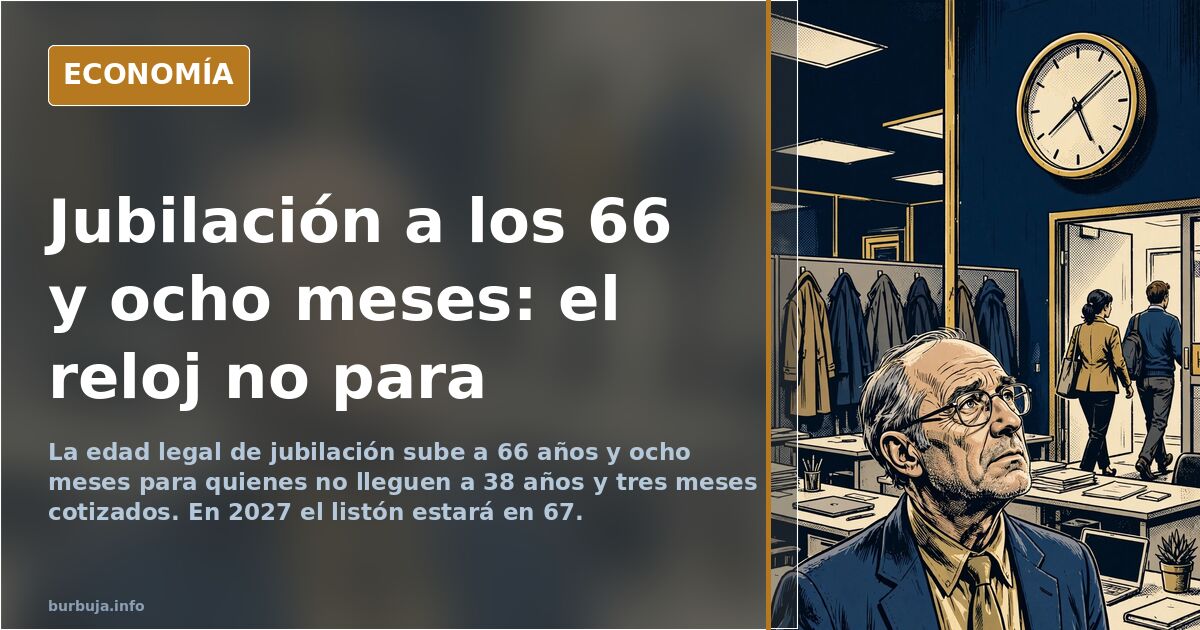
Retirement age rises to 66 years and eight months
The legal retirement age in Spain has risen this month to 66 years and eight months for those who have contributed for less than 38 years and three months. The measure, originally approved by José Luis Rodríguez Zapatero's government and maintained by the Partido Popular (PP), continues to roll out year by year with the same mechanism: two additional months each year until 2027, when the threshold will be set at 67. The schedule is not new, but every time it updates, the same uncomfortable question returns: who pays for the pension party when the demographic pyramid flips?
What exactly changes this month
The rule establishes two paths. Those who have contributed 38 years and three months or more can retire at 65. Those who do not reach that threshold — a growing group of workers with irregular careers, prolonged unemployment, or undeclared work — must wait until they are 66 and eight months old. In 2027, the second tier will rise to 67. The pogre is as trinc: two months per year, without pause, without parliamentary debate, and without any political party seriously proposing to reverse it.
The detail that causes the most discomfort is not the figure itself, but the feeling that the adjustment always happens on the same side. Some argue that working 35 contributed years is a sentence for those who have spent their lives waking up early with chronic pain; others respond that those who don't reach those years have lived off aid or income. The discussion, as almost always, ends in mud.
The trap of 35 contributed years
One of the points that receives the most attention in analysis is the minimum number of years. The contributory pension requires 15 contributed years to access 50% of the regulatory base, and 35 for 100%. But the real working life of a person who has chained temporary contracts, unemployment, and undeclared jobs rarely reaches that figure cleanly. The complete calculation, with its tiers and percentages, could fill a master's degree.
The lingering question is uncomfortable: what does someone do who, at 60, has only 20 contributed years and cannot find work? The official answer is to keep looking. The unofficial one is to settle for a minimum pension or a non-contributory one. And that is where the system shows its seams.
Who pays the pensions of those retiring now?
The demographic argument carries the most weight in analyses. The baby boom generation is beginning to retire en masse, while cohorts entering the labor market are smaller. A data point circulating in analyses: the average retirement pension exceeded 65% of the average salary for the first time in 2024, and in regions like Asturias, Cádiz, or Valladolid, that percentage exceeds 75%. Translated: there are fewer people contributing to sustain benefits that approach the wages of those still working.
The official response to this equation is immigration and productivity. The real response, according to many analyses, is that the reserve fund is emptying and someone will have to pay the bill. Those who are 40 today will see it.
The PP doesn't reverse it, and unions don't touch it
One of the most repeated criticisms is that of collusion. The Partido Popular (PP) has not reversed the reform when in power, and major unions have not called significant mobilizations against it. The explanation given is simple: both prefer the other to bear the wear and tear. The PSOE approved it, the PP maintained it, and neither wants to carry the political cost of touching it.
Meanwhile, the working day is being reduced on one hand, while the retirement age rises on the other. The combination has its irony: fewer hours when you work, more years before you stop doing so. Some analyses suggest that the real goal is to delay exit from the labor market to relieve public accounts, and that the reduction in hours is a cosmetic concession.
The prediction no one wants to confirm
In Nordic countries, 72 years has already been mentioned as a horizon, according to a comment circulating in the debate. In Spain, the trend is the same: two months per year, with no visible ceiling. If the pace is maintained, those born in the eighties and nineties could retire closer to 70 than to 65. The question is not whether it will rise, but when it will stop.
And there the analysis gets stuck. Because no one knows what happens when life expectancy stagnates, birth rates do not recover, and productivity does not take off. The pay-as-you-go system rests on an arithmetic fiction that becomes harder to balance every year. The next update will come in 2026. And then another. And another.
Also available in: Deutsch
Summary of a discussion on Burbuja.info - Foro de economía, actualidad y política., translated from Spanish and reviewed before publication. Read the full discussion (176 replies).
More summaries
-
Spain: 17 years of contributions grant a pension but low base
While 17 years of contributions entitle a person to a contributory pension in Spain, a long gap in payments can drastically reduce the final amount.
-
Domestic workers' pensions: Spain's next big debate
Nearly 8 in 10 domestic workers in Spain will not be able to retire. An Oxfam Intermón report exposes the plight of those who never paid social security contributions. Should they receive a pension?
-
Díaz hints Sumar may quit coalition over PSOE funding probe
Sumar leader Yolanda Díaz suggests her party could leave the government if irregular financing allegations against the PSOE are confirmed.
-
Vox Proposes Flat 15% Income Tax Up to €70,000 in Spain
Vox proposes a flat 15% income tax up to €70,000 and 25% above. Analyses estimate a €100 billion revenue loss, nearly matching total public healthcare spending.
-
Spain wins Basque Pelota World Championship with six Basque golds
Spain wins the Basque Pelota World Championship team title with seven golds, six of them earned by Basque players, while Euskadi takes four.
-
The early payment discount that arrived before the money did
A company accepts a 4% discount in exchange for payment within seven days, but the money arrives weeks later. Separating price and timing avoids giving away margin.