
Spain wins Basque Pelota World Championship with six Basque golds
Spain wins the Basque Pelota World Championship team title with seven golds, six of them earned by Basque players, while Euskadi takes four.
English · Original discussion in Spanish · Published
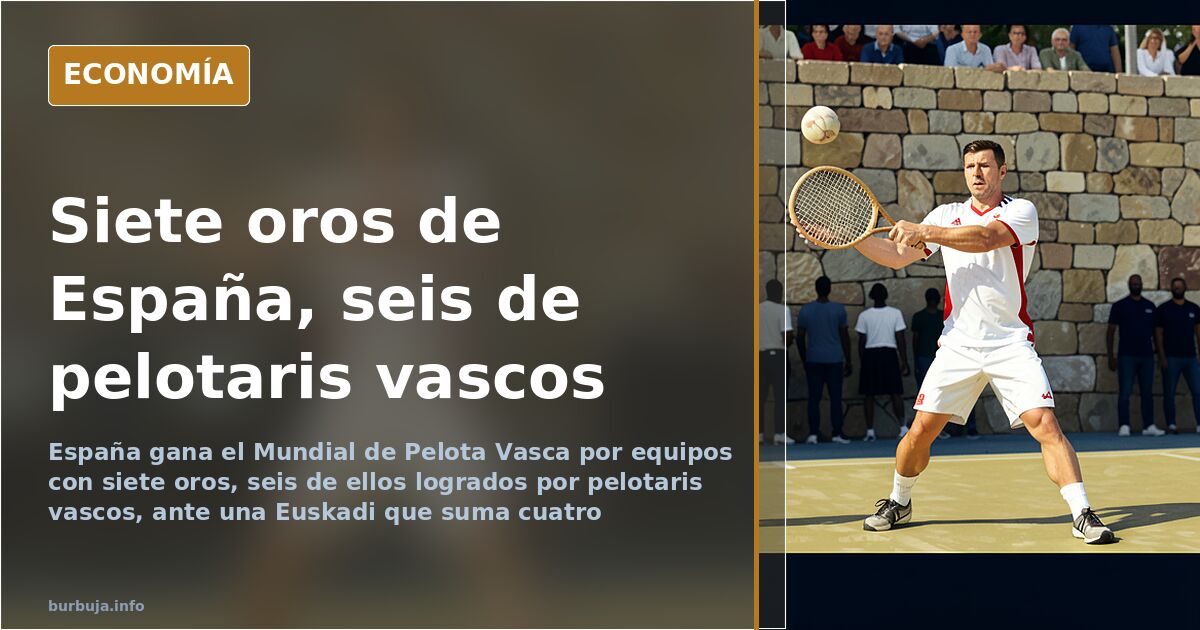
Spain wins the Basque Bowling World Championship with six golds from Basque players
Spain claimed the team title at the Basque Bowling World Championship after beating Euskadi in the final match. The detail that turns the headline into a tongue-twister: six of Spain's seven golds were won by Basque players. The paradox is no small one. A Spanish team and a Basque team competed in the same championship, and many of the athletes could have worn either jersey.
The medal table closed at midnight with a final push from Argentina: three golds in the last three finals. The women's rubber pueblerino final was contested by Navarrese players Paula Gorostiaga and Haizea Salanueva, with Uxue Murillo, also from Navarra, coming on later, against Argentina, with the home side winning two jokos. The hosts also took the men's final against France and the leather pueblerino final on the short fronton, against Navarrese players Labiano and Galbete, who were competing for Spain.
The final tally: seven golds, five Argentine and four Basque
The final table shows a tight spread. Spain takes seven golds, six of them from Basque players: two in cesta, hand pairs in the trinquet, xare, short pala and women's rubber. The seventh, individual hand bowling, went to Fernández from La Rioja. Argentina accumulated five. Euskal Selekzioa (the Basque national team) finished with four golds, plus seven silvers and a bronze: hand pairs, two in cesta and parapelota in the trinquet. Mexico also won four, and France completed the table with two.
Fifteen teams took part. The International Federation says there will be even more in 2030, when the 21st World Championship is held in Gernika and Bilbo. The event, then, already has a venue and a year, and arrives with the controversy over dual teams unresolved.
Why does a bowling play for Spain or for Euskadi?
As laid out in the discussion, the criterion combines the player's own wish and the team's technical assessment, which decides whether the athlete meets the required level. There is no territorial filter preventing a Basque player from competing for Spain. Hence matches antiestéticaturing up to four individuals from the same town wearing different jerseys, according to the cases mentioned in the discussion.
The result is a tournament that, seen from the outside, pits Basques against Basques. Some compete under the Spanish flag and others under the Basque one, and at the medal ceremony the question hanging in the air is which of the two anthems will play. The paradox does not invalidate the title, but it does call into question the logic of national teams when territory and nationality do not coincide.
The criticism of the double standard: if Euskadi competes, Spain is redundant
There is an objection that goes beyond the easy joke. If Euskadi is allowed its own team, this line of thinking holds, then Spain should not compete with players from that territory: it should field players from Navarra, La Rioja, Cantabria or wherever bowling is played. The union, the argument goes, is either complete or cannot be invoked for competition.
The opposite reading stands in contrast: they are all Spanish, the Spanish team is what it is, and the victory is as legitimate as any other. The scoreboard does not distinguish passports, only jokos won. The problem is that the narrative does not distinguish either, and that is where the mess begins.
What is at stake in 2030 with the World Championship in Gernika and Bilbo
The next edition will antiestéticature fifteen teams or more, according to the federation, and an awkward scenario: a World Championship on Basque soil with Spain and Euskadi competing at the same time. The organizers will have to decide whether to keep the current format or set finer rules on who can represent whom.
Given these circumstances, the debate is likely to return every time the two teams meet. And the medal table will go on counting golds without counting identities.
Also available in: Deutsch
Summary of a discussion on Burbuja.info - Foro de economía, actualidad y política., translated from Spanish and reviewed before publication. Read the full discussion (25 replies).
More summaries
-
Milei Promises Argentina US Living Standard in 35 Years
Milei projects Argentina reaching French, German, and US living standards by 2058, sparking debate over economic feasibility.
-
Jódar’s towel outburst highlights class divide in Spanish tennis
Spanish player Rafa Jódar shouted at a ball boy in Shanghai, receiving a warning. The incident reignites debate on elitism and education in the sport.
-
Plainclothes man attacked during protests in France amid agent provocateur claims
A video shows a plainclothes man throwing a cobblestone at a fire truck in France and then being beaten. The episode reopens the debate about undercover agents.
-
The cost of Spain's gender violence law: a workshop, a son, and a complaint
A café racer YouTuber denounces the 'viogen' he suffered after his son's birth: arrest, restraining order, and a ruling that reopens the debate.
-
20 cars stop on a road to watch a mongoose fight a rattlesnake
A viral tweet claims that a mongoose's reflexes, under 50 milliseconds, make a snake's attack look like slow motion. We explain how much truth there is to it.
-
Matilde, Micaela and Constanza: the names that divide opinion
Matilde, Micaela, Constanza or Marta: choosing the most beautiful female name depends more on memories than on how it sounds, according to participants in the thread.