
Spain: 17 years of contributions grant a pension but low base
While 17 years of contributions entitle a person to a contributory pension in Spain, a long gap in payments can drastically reduce the final amount.
English · Original discussion in Spanish · Published
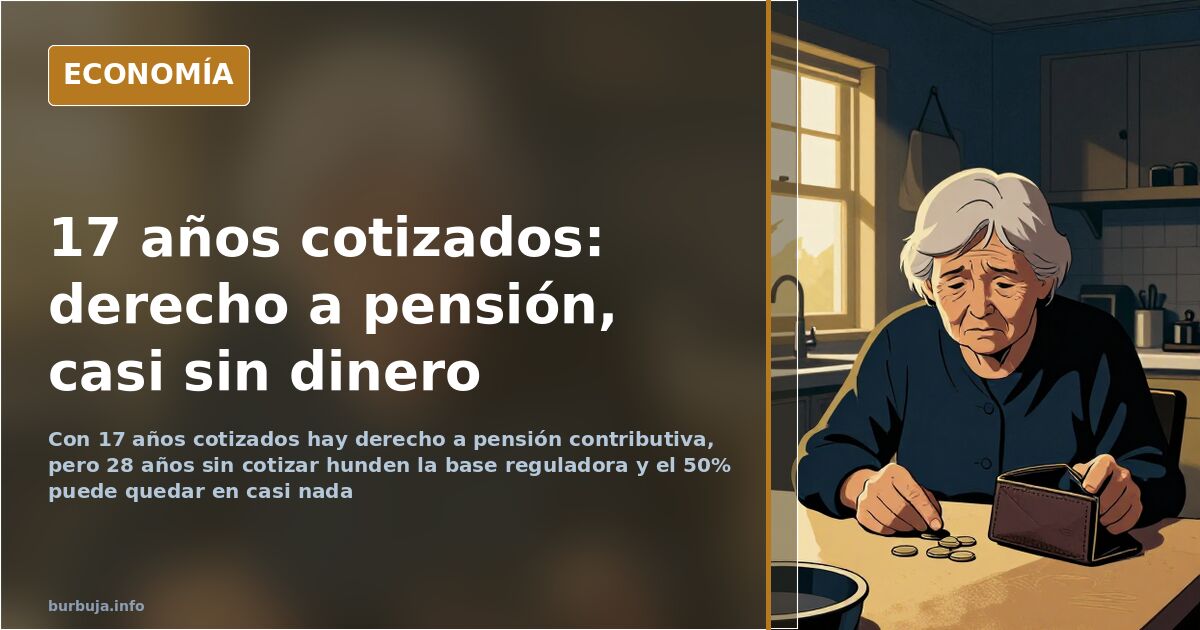
17 years of contributions grant a pension, but the calculation empties it
Accumulating 17 years of contributions and planning to live off them. The specific case: someone who would stop working tomorrow, with retirement 18 years away—in 2051—and wonders if they retain the right to a contributory pension (a pension based on social security contributions). The short answer is yes. The long answer is that this right can translate into an amount much lower than expected. And not because of a technicality approved yesterday, but because of the calculation formula currently in force in the Social Security regulations.
Fifteen years are enough for the right, but not for the money. The legal minimum to access a contributory pension is 15 years of contributions, which entitles one to 50% of the regulatory base (the average amount used to calculate the pension). The starting premise is correct: below this threshold there is nothing, above it the door is open. From there, the percentage rises with the years up to 100%. Therefore, someone with 17 years meets the requirement. What they lack is a floor.
Why do 28 blank years sink the regulatory base?
Here is the crux. The regulatory base is not calculated using the best years or the last salary: it is obtained by dividing the contribution bases of the 300 months immediately preceding—25 years—by 350, the divisor that already incorporates the two extra payments. Someone who stops working today would have 28 years without contributing a single euro until 2051, and the calculation window—the last 25—would be blank. And a year without contributing counts as zero; it is not discarded.
The consequence is arithmetic. 50% of a regulatory base full of zeros amounts to almost nothing, and contributing for two years just before retiring barely moves the average. The calculation leaves a result that unsettles those who believed they had their plan sorted.
The requirement of two years within the last fifteen
There is more. To collect the contributory pension, it is not enough to reach 15 years spread out at any time in life: two years of contributions are required within the 15 years prior to the triggering event. Disappearing at 40 and reappearing at 62 does not add up the same as doing it continuously, because the time window is what matters, not the total accumulated.
Hence the so-called parenthesis doctrine, which sets the reference date as the date a subsidy is granted rather than the date of retirement. An administrative nuance that decides whether those two years count or vanish into limbo.
Can a 300-euro pension rise to 783?
Yes, but under certain conditions. If the resulting pension falls below the minimum, there is a complemento a mínimos (a top-up for minimum pensions) that raises it to the legal threshold. The circulating example is clear: a regulatory base of 700 euros generates a pension of 300—the 50%—and the supplement adds 410.4 euros to bring the figure to 783.10 euros for a retiree over 65 living without a spouse.
The supplement is not a windfall or an unlimited right: it cannot exceed the amount of the non-contributory pension. It is not designed to sustain a lifestyle, but to prevent indigence.
The subsidy for those over 52 and other avenues
Those who stop working early retain an intermediate safety net: the subsidy for those over 52, which maintains contributions. There, it does have an effect on the future, because you are not contributing zero. The figures handled are: contributing based on 1,525 euros, equivalent to 125% of a minimum base of 1,260 euros. Modest, but infinitely better than an absolute void.
And a little-known benefit, the one in favor of family members, designed for those living with and caring for a pensioner parent: it leaves around 20% of the deceased's regulatory base and, under certain circumstances, can scale up to 72%.
Shortcuts that do not fix the calculation
Recipes circulate to dodge the problem: appearing with two years of payroll at the end of working life, or relying on the non-contributory pension. Neither fits perfectly. The second requires a lack of income and assets, so those with property rarely obtain it, giving rise to the recurring reproach that the system punishes those who saved. Regarding the first, it is better not to dwell: besides being irregular, it does not change the fact that the average is calculated based on real bases.
The fundamental question remains unanswered
There is something no formula resolves. All of this is calculated using current rules, and there are nearly three decades until the moment of collection. Any subsequent reform moves the floor, and experience says that changes usually do not go well for those already inside. Does it make sense to organize your working life at 40 according to a law that can be rewritten three times before you collect?
Accumulating 17 years of contributions and planning to live off them. The specific case: someone who would stop working tomorrow, with retirement 18 years away—in 2051—and wonders if they retain the right to a contributory pension (a pension based on social security contributions). The short answer is yes. The long answer is that this right can translate into an amount much lower than expected. And not because of a technicality approved yesterday, but because of the calculation formula currently in force in the Social Security regulations.
Fifteen years are enough for the right, but not for the money. The legal minimum to access a contributory pension is 15 years of contributions, which entitles one to 50% of the regulatory base (the average amount used to calculate the pension). The starting premise is correct: below this threshold there is nothing, above it the door is open. From there, the percentage rises with the years up to 100%. Therefore, someone with 17 years meets the requirement. What they lack is a floor.
Why do 28 blank years sink the regulatory base?
Here is the crux. The regulatory base is not calculated using the best years or the last salary: it is obtained by dividing the contribution bases of the 300 months immediately preceding—25 years—by 350, the divisor that already incorporates the two extra payments. Someone who stops working today would have 28 years without contributing a single euro until 2051, and the calculation window—the last 25—would be blank. And a year without contributing counts as zero; it is not discarded.
The consequence is arithmetic. 50% of a regulatory base full of zeros amounts to almost nothing, and contributing for two years just before retiring barely moves the average. The calculation leaves a result that unsettles those who believed they had their plan sorted.
The requirement of two years within the last fifteen
There is more. To collect the contributory pension, it is not enough to reach 15 years spread out at any time in life: two years of contributions are required within the 15 years prior to the triggering event. Disappearing at 40 and reappearing at 62 does not add up the same as doing it continuously, because the time window is what matters, not the total accumulated.
Hence the so-called parenthesis doctrine, which sets the reference date as the date a subsidy is granted rather than the date of retirement. An administrative nuance that decides whether those two years count or vanish into limbo.
Can a 300-euro pension rise to 783?
Yes, but under certain conditions. If the resulting pension falls below the minimum, there is a complemento a mínimos (a top-up for minimum pensions) that raises it to the legal threshold. The circulating example is clear: a regulatory base of 700 euros generates a pension of 300—the 50%—and the supplement adds 410.4 euros to bring the figure to 783.10 euros for a retiree over 65 living without a spouse.
The supplement is not a windfall or an unlimited right: it cannot exceed the amount of the non-contributory pension. It is not designed to sustain a lifestyle, but to prevent indigence.
The subsidy for those over 52 and other avenues
Those who stop working early retain an intermediate safety net: the subsidy for those over 52, which maintains contributions. There, it does have an effect on the future, because you are not contributing zero. The figures handled are: contributing based on 1,525 euros, equivalent to 125% of a minimum base of 1,260 euros. Modest, but infinitely better than an absolute void.
And a little-known benefit, the one in favor of family members, designed for those living with and caring for a pensioner parent: it leaves around 20% of the deceased's regulatory base and, under certain circumstances, can scale up to 72%.
Shortcuts that do not fix the calculation
Recipes circulate to dodge the problem: appearing with two years of payroll at the end of working life, or relying on the non-contributory pension. Neither fits perfectly. The second requires a lack of income and assets, so those with property rarely obtain it, giving rise to the recurring reproach that the system punishes those who saved. Regarding the first, it is better not to dwell: besides being irregular, it does not change the fact that the average is calculated based on real bases.
The fundamental question remains unanswered
There is something no formula resolves. All of this is calculated using current rules, and there are nearly three decades until the moment of collection. Any subsequent reform moves the floor, and experience says that changes usually do not go well for those already inside. Does it make sense to organize your working life at 40 according to a law that can be rewritten three times before you collect?
Also available in: Deutsch
Summary of a discussion on Burbuja.info - Foro de economía, actualidad y política., translated from Spanish and reviewed before publication. Read the full discussion (103 replies).
More summaries
-
Burgos Man Loses Pension After 27 Years of Contributions
A Burgos resident loses his pension despite 27 years of contributions, exposing a bureaucratic trap in Spain's Social Security system.
-
Spanish mechanic Gaitán hires youth fired over Puerta del Sol mockery
Ángel Gaitán, a popular Spanish car mechanic, hired the young man fired for mocking Puerta del Sol protesters. He paid upfront and registered him officially.
-
AI wipes entire disk after programmer asks to clear cache
A developer's request to clear system cache resulted in an AI wiping the entire drive, reigniting debates on human oversight and AI accountability.
-
Debate erupts over Trump's ear and Musk's gesture
Online forums discuss unproven theories regarding a Jewish ritual linked to Trump's ear injury and Elon Musk's recent public greeting.
-
Spanish economy shows growth while cost of living rises
Debate questions record employment figures in Spain as rising food and fuel prices impact household budgets and purchasing power.
-
TVE debates whether pet loss should grant paid leave
Spanish public broadcaster TVE explores if the death or adoption of a pet should entitle workers to paid leave amidst legal uncertainty in Spain.