
Spain moves to regulate room rentals
Room rentals in Spain are becoming a distinct market as regulators target this segment, according to forum discussions.
English · Original discussion in Spanish · Published
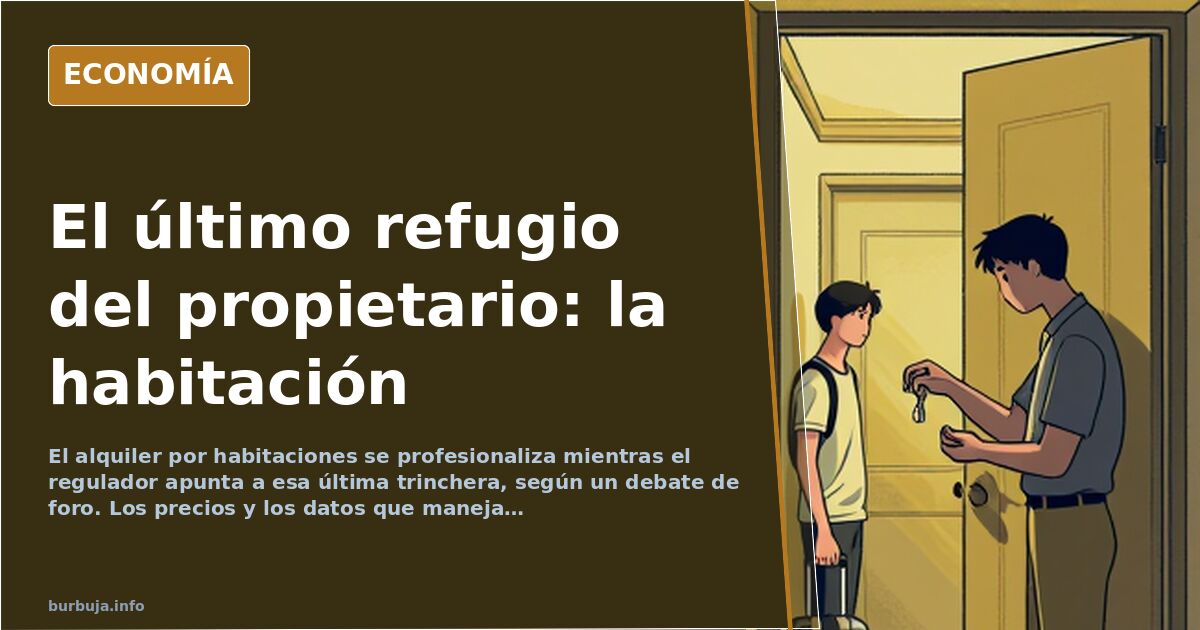
Living in a room: the business the State wants to regulate
Room rentals have ceased to be an emergency solution and become a market of their own, with its prices, investors, and victims. The sequence describing the start of this discussion is simple: first, full-home rentals were intervened; then owners retreated into room and temporary rentals; now the regulator targets that last stronghold. Those closely trinc the issue argue the result is that tenants who previously rented an apartment now share a bathroom and pay more for fewer square meters.
The thesis of the opening message is that there is no coincidence in the drip-feed of regulatory announcements. Catalonia appears as the vanguard, with the rest of the country as the next stop. The interpretation from the owner's side is the opposite: each intervention makes available land more expensive and expels supply, so the room becomes the last step before homelessness. Both can be true simultaneously, and that is the problem.
What room rental is and why it has surged
Room rental is the leasing of a bedroom within a shared home, with common areas and, in many cases, a temporary contract. It originated as a formula for students and itinerant workers but has become the entry point to the residential market for those who cannot afford the deposit and monthly rent of a whole apartment. The price of a room in a tense city has approached that of a full rental from a few years ago, attracting capital that previously looked at traditional residential real estate.
Two incompatible explanations appear in the exchange of arguments. One holds that owners switched to rooms because the law closed the door on conventional rentals. The other responds that owners do not rent because they do not want to, and locking up an apartment is a free decision that also carries tax costs. Neither can be proven with data available to the general public, leaving the diagnosis uncertain.
Prices in the room rental market
Figures circulating in the conversation depict a two-estimulante ilegal market. A room in a university residence hovers around 850 euros per month, while a room in a shared apartment ranges between 300 and 350 euros for the same tenant profile. This difference explains why students still prefer shared apartments over residences, and why shared-apartment owners have room to raise prices.
In Barcelona, full-home rentals range between 900 and 1,500 euros depending on area and condition. Examples provided to lower alarm show 50-square-meter apartments with elevators between 700 and 875 euros in central neighborhoods. The comparison is deceptive due to selectivity, but it also reveals the problem is not homogeneous: it depends on the neighborhood, property condition, and whether there is garage space.
The warning nobody wants to hear
The notice running through the entire discussion is that regulating room rentals without touching supply produces the same effect as regulating full rentals: less product on the market and higher prices for what remains. Data cited for Catalonia points in that direction: 1,202 new rental homes in one year versus 1,946 added in a single quarter before the declaration of a tensioned zone. The series is short but uncomfortable.
The response from the other side is that owners closing apartments also lose, and taxes end up compensating for lost income. This argument is reasonable in theory but difficult to verify in practice, since nobody publishes how many apartments remain empty by owner choice. The consequence, in any case, is paid by the same person: the one who needs shelter.
The prediction based on available data is modest: if regulation advances, room rentals will become more expensive in the short term and professionalize, with operators better able to withstand scrutiny than individuals. If it does not advance, prices will continue rising due to demand. In both scenarios, the roommate pays more. The difference is who collects.
Room rentals have ceased to be an emergency solution and become a market of their own, with its prices, investors, and victims. The sequence describing the start of this discussion is simple: first, full-home rentals were intervened; then owners retreated into room and temporary rentals; now the regulator targets that last stronghold. Those closely trinc the issue argue the result is that tenants who previously rented an apartment now share a bathroom and pay more for fewer square meters.
The thesis of the opening message is that there is no coincidence in the drip-feed of regulatory announcements. Catalonia appears as the vanguard, with the rest of the country as the next stop. The interpretation from the owner's side is the opposite: each intervention makes available land more expensive and expels supply, so the room becomes the last step before homelessness. Both can be true simultaneously, and that is the problem.
What room rental is and why it has surged
Room rental is the leasing of a bedroom within a shared home, with common areas and, in many cases, a temporary contract. It originated as a formula for students and itinerant workers but has become the entry point to the residential market for those who cannot afford the deposit and monthly rent of a whole apartment. The price of a room in a tense city has approached that of a full rental from a few years ago, attracting capital that previously looked at traditional residential real estate.
Two incompatible explanations appear in the exchange of arguments. One holds that owners switched to rooms because the law closed the door on conventional rentals. The other responds that owners do not rent because they do not want to, and locking up an apartment is a free decision that also carries tax costs. Neither can be proven with data available to the general public, leaving the diagnosis uncertain.
Prices in the room rental market
Figures circulating in the conversation depict a two-estimulante ilegal market. A room in a university residence hovers around 850 euros per month, while a room in a shared apartment ranges between 300 and 350 euros for the same tenant profile. This difference explains why students still prefer shared apartments over residences, and why shared-apartment owners have room to raise prices.
In Barcelona, full-home rentals range between 900 and 1,500 euros depending on area and condition. Examples provided to lower alarm show 50-square-meter apartments with elevators between 700 and 875 euros in central neighborhoods. The comparison is deceptive due to selectivity, but it also reveals the problem is not homogeneous: it depends on the neighborhood, property condition, and whether there is garage space.
The warning nobody wants to hear
The notice running through the entire discussion is that regulating room rentals without touching supply produces the same effect as regulating full rentals: less product on the market and higher prices for what remains. Data cited for Catalonia points in that direction: 1,202 new rental homes in one year versus 1,946 added in a single quarter before the declaration of a tensioned zone. The series is short but uncomfortable.
The response from the other side is that owners closing apartments also lose, and taxes end up compensating for lost income. This argument is reasonable in theory but difficult to verify in practice, since nobody publishes how many apartments remain empty by owner choice. The consequence, in any case, is paid by the same person: the one who needs shelter.
The prediction based on available data is modest: if regulation advances, room rentals will become more expensive in the short term and professionalize, with operators better able to withstand scrutiny than individuals. If it does not advance, prices will continue rising due to demand. In both scenarios, the roommate pays more. The difference is who collects.
Also available in: Deutsch
Summary of a discussion on Burbuja.info - Foro de economía, actualidad y política., translated from Spanish and reviewed before publication. Read the full discussion (131 replies).
More summaries
-
Vox pledges zero income tax up to €22,000 with new simulator
Vox promises zero IRPF up to €22,000 and a tool showing nearly €1,000 monthly gains. Critics cite a €50 billion cost without funding sources.
-
Mercadona cuts turkey breast content from 70% to 50%
Customers report Mercadona reduced turkey breast in deli meats from 70% to 50%, sparking debate on labeling and additives.
-
Spain Housing Crisis: Migration Blamed for 1.25M Demand
A Barcelona rental listing drew 100 visitors, highlighting a housing shortage. A forum calculation links migration to an additional demand of 1.25 million homes.
-
Vox MP blames bear attacks on lack of maternal education
A Vox MP in the Aragonese Cortes attributed bear attacks to poor upbringing, sparking mockery and debate over Slovenia-bears reintroduced in Spain's Pyrenees.
-
Spain cuts VAT on fuel and electricity to 10%
Spanish government lowers VAT on gas, diesel, and power to 10% and sets hydrocarbon tax at EU minimum. Critics question if savings reach pumps.
-
El Salvador's Bukele Pushes Indefinite Re-election
El Salvador approved a constitutional reform allowing indefinite presidential re-election and extending terms to six years, sparking debate on democracy.