
Spain cuts VAT on fuel and electricity to 10%
Spanish government lowers VAT on gas, diesel, and power to 10% and sets hydrocarbon tax at EU minimum. Critics question if savings reach pumps.
English · Original discussion in Spanish · Published
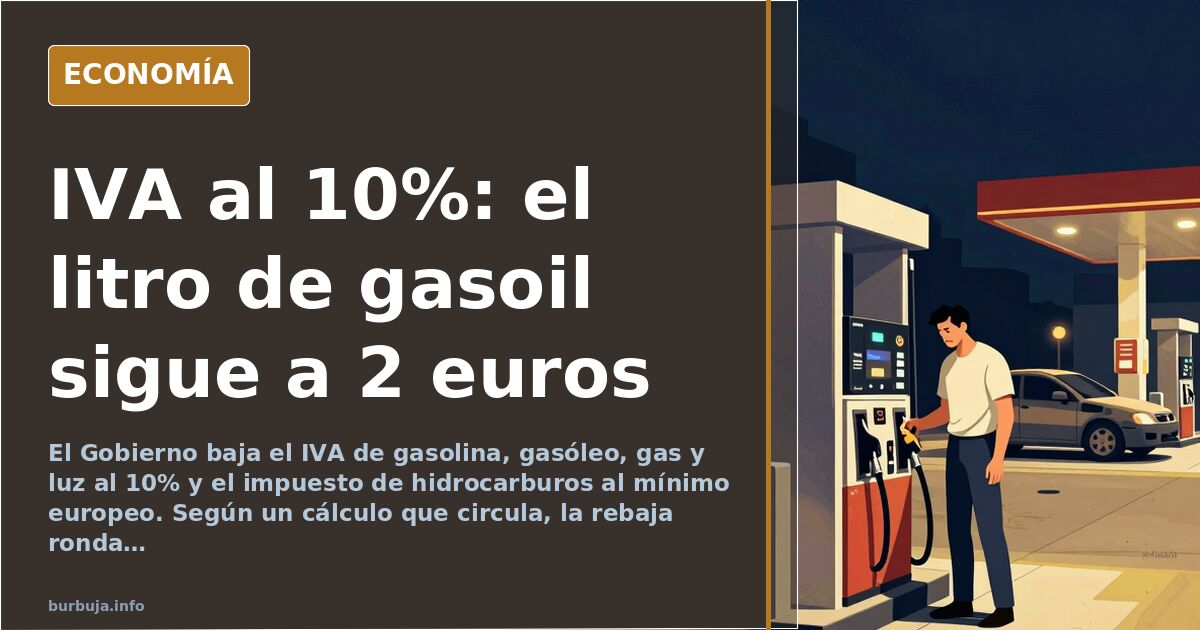
Fuel VAT drops to 10%, but pump prices may not trinc
The Spanish Council of Ministers approved reducing VAT on gasoline, diesel, gas, and electricity from 21% to 10%, alongside a cut in the special hydrocarbon tax to the European Union's legal minimum. The measure arrives amid soaring crude oil prices and diesel nearing €2 per liter. However, a key concern remains: how much of this tax relief will actually translate into lower prices at the pump?
The short answer is that no one knows yet. The longer explanation reveals a complex mechanism where timing works against consumers.
Actual reduction per liter of fuel
Calculations analyzing the Official Gazette (BOE) suggest the fixed special hydrocarbon tax stands at €0.072 per liter—originally a Catalan health levy now state-level—and VAT drops from 21% to 10%. This results in an effective price reduction of approximately 7.2 cents per liter, or €72 for every 1,000 liters. Some mistakenly cited 72 cents; it is indeed 7.2.
The second component, the special hydrocarbon tax itself, is paid by distributors rather than end-users. It has also been lowered to the EU regulatory minimum. Consequently, savings first hit oil companies' margins before potentially reaching consumer screens.
This is the crux of the issue. What the government discounts differs from what appears on the pump display. Total prices are set individually by each station. If distributors choose to maintain margins without passing on the cut, prices remain near €2, rendering the BOE decree ineffective.
When will pump prices reflect the cut?
The decree takes effect the day after publication in the BOE. If published Monday, it applies Tuesday. Yet real-world impact lags: stations hold inventory purchased at old prices. Industry sources estimate three weeks until new pricing becomes visible, assuming companies pass on the savings.
Another detail has raised eyebrows: between announcement and official publication, several days elapse during which the Treasury continues collecting VAT at 21%. These four extra days of revenue collection are hardly beneficial to taxpayers.
VAT on top of tax: the overlooked trap
VAT applies to the fuel price plus the special tax, meaning consumers pay VAT on a tax. This structure persists despite the rate drop to 10%, which mitigates but does not eliminate the effect. Some argue the hydrocarbon tax functions as a mobility levy, a significant revenue source for the Treasury that few wish to challenge.
The lingering question is how the State will compensate for the lost 10% revenue. The tax cut is real, but so is the resulting budget hole.
Winners and losers of the tax cut
Oil and energy stocks rose trinc the announcement. Analysts interpret this as market expectation that fiscal relief will boost corporate margins rather than alleviate consumer costs. While not proof, it fits the pattern: when governments cut taxes without price controls, those setting final prices retain flexibility.
Conversely, individual drivers and self-employed workers dependent on vehicles see minimal benefit. For them, 7.2 cents per liter translates to only €3–5 monthly savings on average tank fills—a fraction of recent crude-driven price hikes.
The ignored global context
This reduction coincides with global supply tensions. Worst-case scenarios suggest Brent crude could hit $150–180 if the EU imposes a total Russian oil embargo before June, potentially reaching $200 amid severe Gulf incidents. In such cases, diesel rises faster than gasoline due to European refining structures.
With barrels at $200, diesel might reach €3. A 7.2-cent cut becomes negligible. The core problem remains: fiscal measures cannot fix supply shortages.
Experts note that long-term energy tax reductions exist across Europe, unlike Spain’s delayed implementation. Additionally, most EU countries adjust income tax brackets for inflation, a step Spain hasn't taken.
The disorienting reality: the tax being reduced applies atop another tax. Yet, pump prices hover around €2.
The Spanish Council of Ministers approved reducing VAT on gasoline, diesel, gas, and electricity from 21% to 10%, alongside a cut in the special hydrocarbon tax to the European Union's legal minimum. The measure arrives amid soaring crude oil prices and diesel nearing €2 per liter. However, a key concern remains: how much of this tax relief will actually translate into lower prices at the pump?
The short answer is that no one knows yet. The longer explanation reveals a complex mechanism where timing works against consumers.
Actual reduction per liter of fuel
Calculations analyzing the Official Gazette (BOE) suggest the fixed special hydrocarbon tax stands at €0.072 per liter—originally a Catalan health levy now state-level—and VAT drops from 21% to 10%. This results in an effective price reduction of approximately 7.2 cents per liter, or €72 for every 1,000 liters. Some mistakenly cited 72 cents; it is indeed 7.2.
The second component, the special hydrocarbon tax itself, is paid by distributors rather than end-users. It has also been lowered to the EU regulatory minimum. Consequently, savings first hit oil companies' margins before potentially reaching consumer screens.
This is the crux of the issue. What the government discounts differs from what appears on the pump display. Total prices are set individually by each station. If distributors choose to maintain margins without passing on the cut, prices remain near €2, rendering the BOE decree ineffective.
When will pump prices reflect the cut?
The decree takes effect the day after publication in the BOE. If published Monday, it applies Tuesday. Yet real-world impact lags: stations hold inventory purchased at old prices. Industry sources estimate three weeks until new pricing becomes visible, assuming companies pass on the savings.
Another detail has raised eyebrows: between announcement and official publication, several days elapse during which the Treasury continues collecting VAT at 21%. These four extra days of revenue collection are hardly beneficial to taxpayers.
VAT on top of tax: the overlooked trap
VAT applies to the fuel price plus the special tax, meaning consumers pay VAT on a tax. This structure persists despite the rate drop to 10%, which mitigates but does not eliminate the effect. Some argue the hydrocarbon tax functions as a mobility levy, a significant revenue source for the Treasury that few wish to challenge.
The lingering question is how the State will compensate for the lost 10% revenue. The tax cut is real, but so is the resulting budget hole.
Winners and losers of the tax cut
Oil and energy stocks rose trinc the announcement. Analysts interpret this as market expectation that fiscal relief will boost corporate margins rather than alleviate consumer costs. While not proof, it fits the pattern: when governments cut taxes without price controls, those setting final prices retain flexibility.
Conversely, individual drivers and self-employed workers dependent on vehicles see minimal benefit. For them, 7.2 cents per liter translates to only €3–5 monthly savings on average tank fills—a fraction of recent crude-driven price hikes.
The ignored global context
This reduction coincides with global supply tensions. Worst-case scenarios suggest Brent crude could hit $150–180 if the EU imposes a total Russian oil embargo before June, potentially reaching $200 amid severe Gulf incidents. In such cases, diesel rises faster than gasoline due to European refining structures.
With barrels at $200, diesel might reach €3. A 7.2-cent cut becomes negligible. The core problem remains: fiscal measures cannot fix supply shortages.
Experts note that long-term energy tax reductions exist across Europe, unlike Spain’s delayed implementation. Additionally, most EU countries adjust income tax brackets for inflation, a step Spain hasn't taken.
The disorienting reality: the tax being reduced applies atop another tax. Yet, pump prices hover around €2.
Also available in: Deutsch
Summary of a discussion on Burbuja.info - Foro de economía, actualidad y política., translated from Spanish and reviewed before publication. Read the full discussion (130 replies).
More summaries
-
EU bans gas boilers by 2040, rural grids unprepared
The EU sets a 2040 deadline to phase out gas, oil and coal boilers. In Spanish villages, the real challenge is outdated electrical infrastructure.
-
Spain debates tax on owners of three or more homes
A forum discusses a potential Spanish tax for owners of three or more properties, sparking debate over whether it targets the middle class or rentiers.
-
Euribor rises to 3.374% while September average nears 3.2%
Euribor rises by 0.048% to 3.374%, while the September average hits 3.166% versus last year's 2.172%. The variables are under scrutiny.
-
Video shows Spanish Socialist MP staggering late at night
A viral video allegedly shows Piedad Álvarez, PSOE spokesperson in Extremadura, Spain, unable to walk; the uploader claims threats of legal action.
-
Joaquín Prat Claims Self-Censorship to Keep TV Show
Spanish host Joaquín Prat admits on air he stays silent to avoid losing his program, amid controversy over a youth brawl.
-
EU Funds Director Resigns Amid Husband's Fraud Probe
Spain's EU Funds Director resigns after her husband is investigated for fraud. Ana Cristina Peña appointed as successor by the Council of Ministers.