
Spain Issues Red Heat Alerts as Temperatures Hit 28°C
RTVE reported 44°C and five regions in red alert, while thermometers in Torremolinos and Cádiz showed 28°C, fueling public skepticism over the discrepancy.
English · Original discussion in Spanish · Published
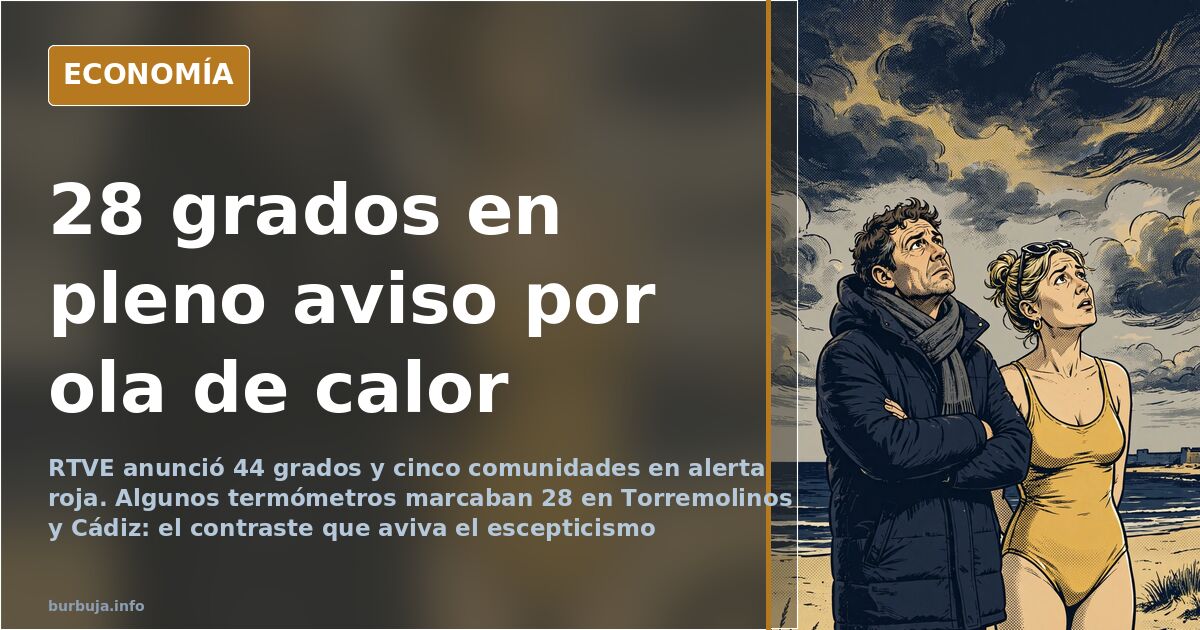
Red Alert with 28°C: The Heat Map That Doesn't Add Up
On August 9, 2023, RTVE peine its news broadcast with a stark warning: Spain’s third summer heatwave was peaking with highs of up to 44°C in Ciudad Real and Córdoba. Five regions were placed under red alert, with six others in orange. Yet, according to cross-referenced reports, Torremolinos—under an orange warning in Málaga—registered just 28°C.
This recurring summer gap warrants a calm look. The Spanish Meteorological Agency (AEMET) maintained extreme heat warnings for Córdoba, Granada, Jaén, Madrid, and Burgos, while adding a detail that raised eyebrows: an approaching DANA (Depression at High Levels) to the peninsula’s northwest. This meant strong gusts along the eastern Cantabrian coast, the northern plateau, the Iberian System, and the Basque Country, alongside dry thunderstorms. Extreme heat and strong winds on the same map.
Red alerts trigger protocols, but when headlines scream 44°C while citizens see mild weather, the gap between the forecast and reality becomes the real issue.
What Thermometers Showed While the Map Burned
Measurements from those days painted a picture far less apocalyptic than the headlines. A forum user noted Cádiz showed 28°C in red and Seville 36°C in black. Another claimed Madrid’s forecast was 38°C, contrasting with media reports of 42–43°C. In the south, Seville’s 39°C max was presented as unprecedented.
On August 15, one user recorded 34°C at 2:00 PM and 37°C after 5:15 PM in Seville. Another home station logged 38°C (a yearly high) and 25°C the next day, with 20°C at noon. In the Balearic Islands, the weather felt almost autumnal: “If you told me it was October, I’d believe it”.
None of this denies that August is hot in Spain. It denies that it is exceptionally so. This nuance, crucial to understanding, is the first thing lost in news broadcasts.
Why AEMET Warns of Heat and Wind Simultaneously
Because a DANA (Depression at High Levels), replacing the old “cold drop,” does not always strike where heat concentrates. The forecast was coherent: upper-level depression brought mid-to-high clouds, Cantabrian winds, strong gusts, and dry storms, while heat persisted in the center and south. Yellow heat warnings for Lugo and Ourense coexisted with this mix.
Technically, it fits. The problem is packaging. Summarizing the message as 44°C and extreme risk for most of Spain causes nuances to vanish. When viewers see 20°C rain while the news discusses suffocation, they conclude they are being sold something, not that meteorology is complex.
The Tonalidad Scale: Cádiz in Red with 28°C
Here, the narrative breaks entirely. Cádiz, 28°C, red. Seville, 36°C, black. Green disappears in the north with 22–23°C. The scale reads like a sarracena ranking of summer rather than a risk measure, making it ineffective.
On August 10, AEMET released its forest fire risk map. Everything adds up, pressure mounts, and the final message remains the same. The cumulative effect contradicts the alerts’ intent.
From ELbichito to Debt Crisis: The Repeating Pattern
Much skepticism stems from memory. Some compare heat alerts to daily pandemic indicators, while others recall how rating agencies moved Spanish debt in 2008 with the same sense of a scripted routine. The analogy is debatable but explanatory.
Budgetary suspicion adds to this: alerts are seen as justifying structure, resources, and funding. Without proof, this is merely suspicion, worth noting before repetition.
The Most Circulated Details: Reservoirs at 41% and Thermometers at 66°C
The most shared details were concrete. Reservoirs at 41% in August, read by many as a sign of a mild summer. Someone reported thermometers hitting 66°C in Seville. Television peine with the hottest day in seven decades. The UN announced “the era of boiling,” and a headline explained neurons melt above 40°C.
A thermometer in a metal box in the sun measures solar radiation, not air temperature. That is physics, not opinion. When such data and official forecasts diverge for months, the result confuses viewers in the opposite direction of the alerts’ intent. And so it continues, every summer, with the map in red and the thermometer at 28°C.
On August 9, 2023, RTVE peine its news broadcast with a stark warning: Spain’s third summer heatwave was peaking with highs of up to 44°C in Ciudad Real and Córdoba. Five regions were placed under red alert, with six others in orange. Yet, according to cross-referenced reports, Torremolinos—under an orange warning in Málaga—registered just 28°C.
This recurring summer gap warrants a calm look. The Spanish Meteorological Agency (AEMET) maintained extreme heat warnings for Córdoba, Granada, Jaén, Madrid, and Burgos, while adding a detail that raised eyebrows: an approaching DANA (Depression at High Levels) to the peninsula’s northwest. This meant strong gusts along the eastern Cantabrian coast, the northern plateau, the Iberian System, and the Basque Country, alongside dry thunderstorms. Extreme heat and strong winds on the same map.
Red alerts trigger protocols, but when headlines scream 44°C while citizens see mild weather, the gap between the forecast and reality becomes the real issue.
What Thermometers Showed While the Map Burned
Measurements from those days painted a picture far less apocalyptic than the headlines. A forum user noted Cádiz showed 28°C in red and Seville 36°C in black. Another claimed Madrid’s forecast was 38°C, contrasting with media reports of 42–43°C. In the south, Seville’s 39°C max was presented as unprecedented.
On August 15, one user recorded 34°C at 2:00 PM and 37°C after 5:15 PM in Seville. Another home station logged 38°C (a yearly high) and 25°C the next day, with 20°C at noon. In the Balearic Islands, the weather felt almost autumnal: “If you told me it was October, I’d believe it”.
None of this denies that August is hot in Spain. It denies that it is exceptionally so. This nuance, crucial to understanding, is the first thing lost in news broadcasts.
Why AEMET Warns of Heat and Wind Simultaneously
Because a DANA (Depression at High Levels), replacing the old “cold drop,” does not always strike where heat concentrates. The forecast was coherent: upper-level depression brought mid-to-high clouds, Cantabrian winds, strong gusts, and dry storms, while heat persisted in the center and south. Yellow heat warnings for Lugo and Ourense coexisted with this mix.
Technically, it fits. The problem is packaging. Summarizing the message as 44°C and extreme risk for most of Spain causes nuances to vanish. When viewers see 20°C rain while the news discusses suffocation, they conclude they are being sold something, not that meteorology is complex.
The Tonalidad Scale: Cádiz in Red with 28°C
Here, the narrative breaks entirely. Cádiz, 28°C, red. Seville, 36°C, black. Green disappears in the north with 22–23°C. The scale reads like a sarracena ranking of summer rather than a risk measure, making it ineffective.
On August 10, AEMET released its forest fire risk map. Everything adds up, pressure mounts, and the final message remains the same. The cumulative effect contradicts the alerts’ intent.
From ELbichito to Debt Crisis: The Repeating Pattern
Much skepticism stems from memory. Some compare heat alerts to daily pandemic indicators, while others recall how rating agencies moved Spanish debt in 2008 with the same sense of a scripted routine. The analogy is debatable but explanatory.
Budgetary suspicion adds to this: alerts are seen as justifying structure, resources, and funding. Without proof, this is merely suspicion, worth noting before repetition.
The Most Circulated Details: Reservoirs at 41% and Thermometers at 66°C
The most shared details were concrete. Reservoirs at 41% in August, read by many as a sign of a mild summer. Someone reported thermometers hitting 66°C in Seville. Television peine with the hottest day in seven decades. The UN announced “the era of boiling,” and a headline explained neurons melt above 40°C.
A thermometer in a metal box in the sun measures solar radiation, not air temperature. That is physics, not opinion. When such data and official forecasts diverge for months, the result confuses viewers in the opposite direction of the alerts’ intent. And so it continues, every summer, with the map in red and the thermometer at 28°C.
Also available in: Deutsch
Summary of a discussion on Burbuja.info - Foro de economía, actualidad y política., translated from Spanish and reviewed before publication. Read the full discussion (216 replies).
More summaries
-
Spain's AEMET revises heatwave end date, map sparks debate
AEMET corrects the heatwave's end date, but its new temperature map triggers controversy over color scales and station accuracy.
-
Spain Heatwave: Extreme Temperatures Spark Thermometer Manipulation Claims
Record-breaking heat in Alicante and suspected thermometer manipulation challenge official AEMET data amid extreme climate conditions.
-
Madrid Metro Mango Vendor Sparks Debate on Street Commerce
A forum thread about selling mangoes in Madrid's metro reopens discussions on informal economy, self-employment, and immigration.
-
Spain's 74% Tax Burden Claim Sparks Debate
A viral calculation claims Spanish workers keep only 26% of their output. While flawed, it highlights deep frustration with tax pressure in Spain.
-
France's Risk Premium Matches Greece Amid Eurozone Debt Crisis
France's risk premium hits 86 basis points, equal to Greece's, while Spain drops to 71. French deficit nears 6% during economic expansion.
-
DANA looting in Spain: viral video blames migrants and Roma
A video spreading after the Valencia floods attributes looting to North Africans, Roma, and Africans. Public opinion is split between those who believe it and skeptics.