
DANA looting in Spain: viral video blames migrants and Roma
A video spreading after the Valencia floods attributes looting to North Africans, Roma, and Africans. Public opinion is split between those who believe it and skeptics.
English · Original discussion in Spanish · Published
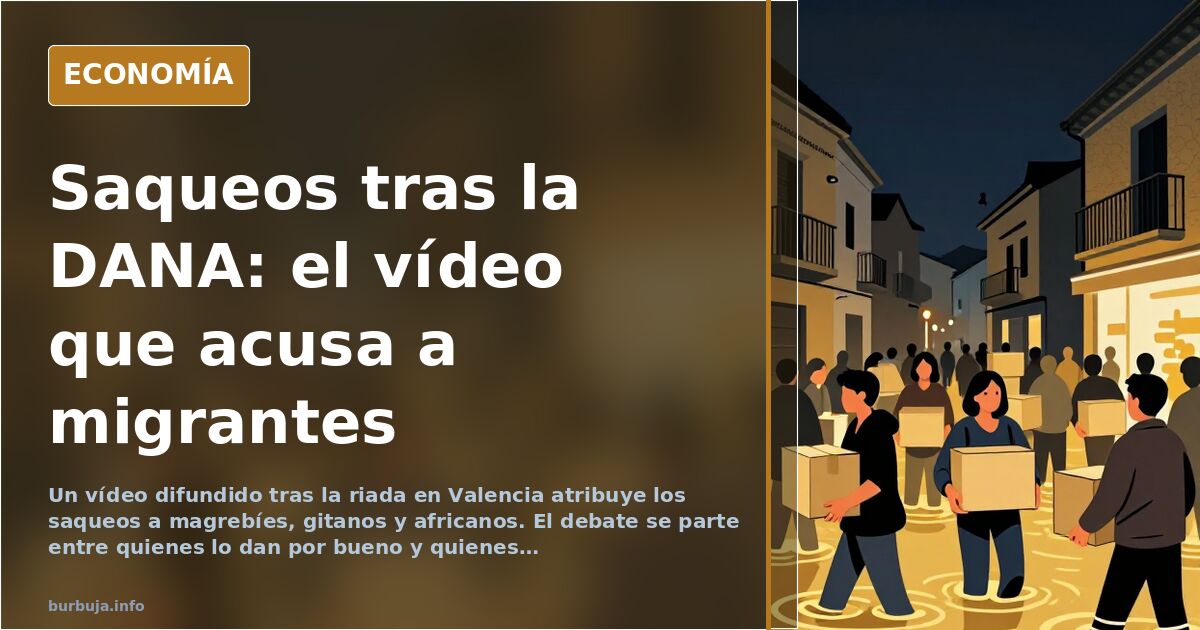
Looting after the DANA: the video blaming migrants and Roma
A video circulated trinc the flood that devastated parts of Valencia province shows people looting shops in a disaster zone. The material spreads with an explicit accusation: that the thieves are North African, Roma, and African individuals. The clip begins with a two-word question—"Fakenews?"—and from there, the debate splits into two trenches that do not listen to each other.
The first side argues the recording is manipulated or taken out of context. The second accepts the video as proof of a pattern. Between both lies an uncomfortable fact no one disputes: there was looting, there were arrests, and neighbors filmed with their phones while aid was delayed.
What the video shows and what is attributed to it
The material sparking the conversation is a clip with epic background music showing people carrying goods from a store. Those sharing it ask if it is fake. Most responders do not dispute the authenticity but the label. "It's false, it's their customs," summarizes one user. Another dismisses it with "you couldn't know," serving as an internal wink.
The specific accusation launched is that the images show North Africans, Roma, and Africans looting. There is no independent verification of this identity in the debate material. What exists is a discussion on framing: arguments state that more people are seen looting in videos, yet the blame always falls on the same groups.
Looting as an excuse to demand harsh measures
Much of the conversation is not about the video, but about what the video allows people to demand. Calls for martial law, curfews, and military deployment appear. The recurring thesis: security will be demanded in exchange for freedom, leading to a permanent state of exception.
Some formulate it inversely: the State wants an unarmed population so they cannot defend themselves, arguing such scenes would not occur in countries with gun rights. Others respond that the problem is not a lack of police, but that police protect incivil rather than neighbors.
Those who help and those who steal
Against the looting narrative, a counterexample emerges: a message with a video of migrants cooking for flood victims. The response is immediate and reveals the mechanism: that isn't reported, that doesn't matter. The anecdote shows the same population stars in both scenes, but only one goes viral.
The pattern repeats in other material. There is talk of 39 arrests for looting, emptied shops in Alfafar, Albal, and Paiporta, and a neighbor filming thieves and confronting them. The debate on punishment remains open: some call for lynchings as deterrence, while others remind us that is also a crime.
The calculation no one makes: what is truly lost
One of the most lucid messages does not speak of identities, but logistics. It argues that 90% of stock in affected area stores ends up in the trash anyway, and that organizing distribution of perishables to those in need would be reasonable. Not as defense of looting, but as recognition that economic damage was done before anyone carried a box.
This is the point drowned by noise. The debate over who loots consumes all attention; the debate over what is lost and who pays never appears. The full calculation, with commercial destruction figures and unrecoverable losses, is not in the video. It is in balance sheets no one shares because they don't generate clicks.
With these elements, it is predictable that the video continues circulating and the label solidifies before any verification arrives. If a debunking appears, it will come late and with less reach. If it does not, the clip will remain as proof of something never verified.
A video circulated trinc the flood that devastated parts of Valencia province shows people looting shops in a disaster zone. The material spreads with an explicit accusation: that the thieves are North African, Roma, and African individuals. The clip begins with a two-word question—"Fakenews?"—and from there, the debate splits into two trenches that do not listen to each other.
The first side argues the recording is manipulated or taken out of context. The second accepts the video as proof of a pattern. Between both lies an uncomfortable fact no one disputes: there was looting, there were arrests, and neighbors filmed with their phones while aid was delayed.
What the video shows and what is attributed to it
The material sparking the conversation is a clip with epic background music showing people carrying goods from a store. Those sharing it ask if it is fake. Most responders do not dispute the authenticity but the label. "It's false, it's their customs," summarizes one user. Another dismisses it with "you couldn't know," serving as an internal wink.
The specific accusation launched is that the images show North Africans, Roma, and Africans looting. There is no independent verification of this identity in the debate material. What exists is a discussion on framing: arguments state that more people are seen looting in videos, yet the blame always falls on the same groups.
Looting as an excuse to demand harsh measures
Much of the conversation is not about the video, but about what the video allows people to demand. Calls for martial law, curfews, and military deployment appear. The recurring thesis: security will be demanded in exchange for freedom, leading to a permanent state of exception.
Some formulate it inversely: the State wants an unarmed population so they cannot defend themselves, arguing such scenes would not occur in countries with gun rights. Others respond that the problem is not a lack of police, but that police protect incivil rather than neighbors.
Those who help and those who steal
Against the looting narrative, a counterexample emerges: a message with a video of migrants cooking for flood victims. The response is immediate and reveals the mechanism: that isn't reported, that doesn't matter. The anecdote shows the same population stars in both scenes, but only one goes viral.
The pattern repeats in other material. There is talk of 39 arrests for looting, emptied shops in Alfafar, Albal, and Paiporta, and a neighbor filming thieves and confronting them. The debate on punishment remains open: some call for lynchings as deterrence, while others remind us that is also a crime.
The calculation no one makes: what is truly lost
One of the most lucid messages does not speak of identities, but logistics. It argues that 90% of stock in affected area stores ends up in the trash anyway, and that organizing distribution of perishables to those in need would be reasonable. Not as defense of looting, but as recognition that economic damage was done before anyone carried a box.
This is the point drowned by noise. The debate over who loots consumes all attention; the debate over what is lost and who pays never appears. The full calculation, with commercial destruction figures and unrecoverable losses, is not in the video. It is in balance sheets no one shares because they don't generate clicks.
With these elements, it is predictable that the video continues circulating and the label solidifies before any verification arrives. If a debunking appears, it will come late and with less reach. If it does not, the clip will remain as proof of something never verified.
Also available in: Deutsch
Summary of a discussion on Burbuja.info - Foro de economía, actualidad y política., translated from Spanish and reviewed before publication. Read the full discussion (122 replies).
More summaries
-
Looting in DANA Zero-Zone: Hams and Carts Amid Mud
Shoppers loot Paiporta stores as bodies are recovered, sparking debate on public order and institutional response after Valencia's DANA disaster.
-
Valencia Floods: Migrants Absent from Reconstruction Narrative
Valencia's DANA floods sparked debate over migrants' absence in cleanup imagery and the distribution of aid.
-
Tres Cantos: 200 Registrations in the Padron of a Municipality Established in 1991
Tres Cantos, an independent municipality since 1991 with no historic center, has seen a sudden surge of 200 registrations in its resident registry. What is known and what doesn't add up.
-
Bikers Buy Spanish Ruin for €21,000 to Restore It
Two bikers bought a ruin in an abandoned Andalusian village for €21,000. Behind the low-cost dream: permits, specialists, and high costs.
-
Spanish media lack critical questioning of authorities
Analysis of the absence of tough questions for politicians and experts in Spain. Why do outlets reproduce official narratives without challenge?
-
Madrid Arsonist Arrested as Wildfires Rage: Budget Cuts or Sabotage?
A repeat offender was arrested in Lozoyuela. The M-501 fire reignites debate over budget cuts and regional authority disputes.