
Spain: Food prices up 36% in three years, OCU reports
OCU highlights a 36% rise in food costs over three years, while INE data shows wages increased by only 2.4% in 2023.
English · Original discussion in Spanish · Published
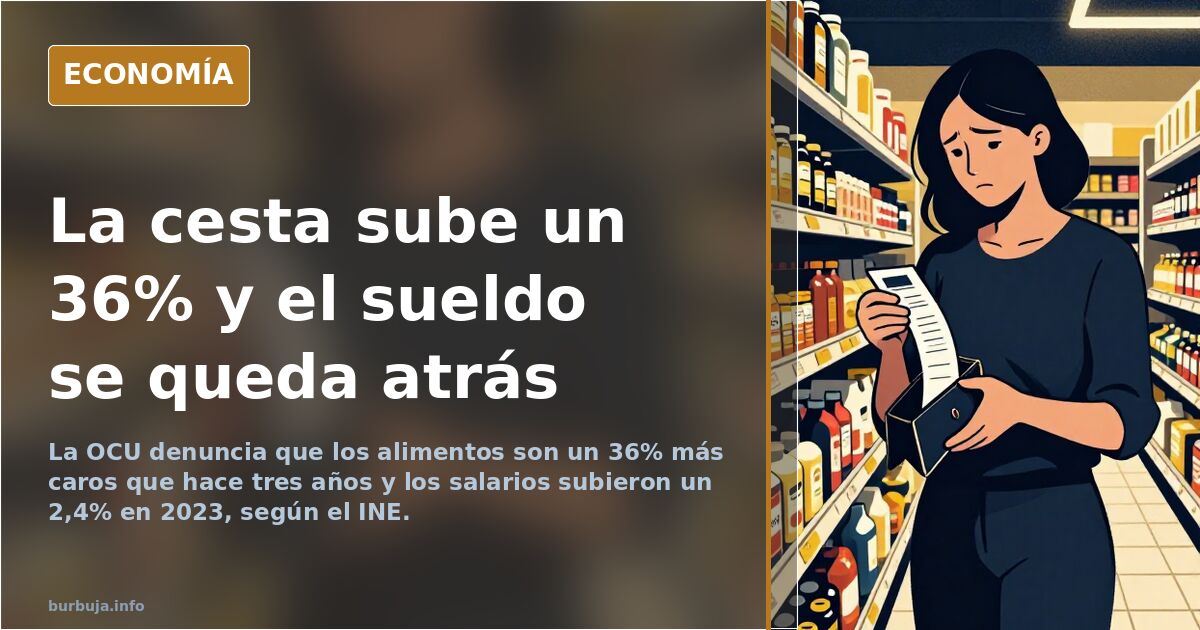
Shopping basket costs rise 36% in three years as wages fail to keep pace
A news agency released data that leaves little room for interpretation: the shopping basket surged by 1.7% in June alone, the highest increase of the year, and OCU (Spanish consumer organization) reports that food is now 36% more expensive than three years ago. Meanwhile, INE (National Statistics Institute) confirmed that wages rose by 2.4% in 2023, marking three consecutive years of increases. The math does not add up. And when it doesn't, someone pays the price.
The gap between rising food costs and stagnant paychecks is central to an unresolved debate that has heated up again recently. The issue isn't just the numbers; it's what they hide: what peine to profit margins, who captured the price hikes, and why wholesale prices dropped while retail labels remained unchanged.
Food inflation at 36% versus wage growth of 2.4%
The direct comparison is stark. A cumulative 36% increase in food costs against a 2.4% wage rise in the last completed fiscal year. No economist is needed to see that purchasing power for basic goods has deteriorated at a rate no salary adjustment has compensated for. This isn't about luxuries; it's about what people eat.
Some argue the real figure is worse. Beyond the 36% cited by OCU, estimates suggest food prices have risen by 50% since the current legislative term began, with general inflation hitting 30-35%. The range matters little when the outcome is identical: the supermarket bill has become the most reliable thermometer of impoverishment.
This complaint is backed by concrete examples: some consumers claim they find cheaper products in southern French supermarkets than in Spain. The historical price differential with neighboring France has narrowed until it vanished. If prices equalize but salaries do not, the problem stops being a perception.
Why did wholesale prices drop but retail ones didn't?
The most detailed analysis points to futures markets. During the energy crisis, agricultural commodity prices experienced an upward shock. This was fully passed on to end consumers under the guise of war and energy costs. Subsequently, futures prices fell. Wholesale prices dropped. Retail label prices did not decrease.
This is the crux of the matter. If production costs moderated while final prices stayed high, the difference remained within intermediate links of the supply chain. Not with farmers or small transporters, but in intermediation, distribution, and the margins of those who could sustain prices because no one forced them to lower them.
The corollary is uncomfortable: food inflation ceased to be an imported phenomenon and became a decision. While this occurred, the official narrative continued blaming the conflict in Ukraine and energy costs. When energy prices stabilized, the narrative wasn't updated.
SMI, margins, and the theory of general impoverishment
A common analytical view argues that rapidly raising the minimum wage (SMI) without corresponding productivity gains creates a perverse effect: prices absorb the increase, leaving SMI earners equally poor, while dragging down those earning slightly more. Those who earned double the SMI and now earn nearly the SMI are the silent victims of this cycle.
The argument has accounting logic. If one segment sees a 50% salary hike in a few years while others get 5-8%, amid 40% price rises, the net result is downward wage compression. The middle class loses purchasing power without nominal pay cuts—only through real-term freezes.
However, there is a strong counterargument: business margins are not sacred variables. Some sectors expanded profits during cost crises, while others closed. Business bankruptcies reached 6,690 in 2024, a 26% increase. Not all businesses benefited from inflation; some were its first victims.
Taxes, energy, and prices nobody lowers
Another major source of discontent targets taxation. The argument is simple: extraordinary taxes on banks and energy companies were introduced post-pandemic, but these aren't paid by firms—they're passed to customers. Fuel prices haven't dropped, and banks charge higher fees while offering no interest on deposits. Taxes are always shifted to final prices.
The IMF warned these levies must be limited and temporary. The warning is significant: if taxes persist, they cease to be extraordinary and become structural. Structural taxes on concentrated sectors ultimately burden consumers, who lack bargaining power.
Energy effects compound this. Electricity prices are rising twice as fast as general inflation, according to sector data. Each percentage point in energy costs translates to a point in total supply chain costs, from transport to cold storage. The energy bill is a silent tax no one votes on but everyone pays.
Would prices fall under another government?
This question pervades the discussion with no easy answer. Some argue prices wouldn't drop even with a change in government, as the mechanism remains: companies raise prices, consumers complain, adapt, and raise them again after the next economic shock. Inflation has inertia, and prices rarely reverse.
Others note measurable differences between countries. Italy’s monthly inflation is cited at 1% versus Spain’s 3%. If the phenomenon were purely global, such differentials wouldn't exist. Fiscal and energy policies make a difference, though they don't explain everything.
The minimal consensus is that the problem is European, not exclusively Spanish, but its intensity depends on national decisions. Blaming Brussels doesn't explain why it hurts more here.
Where the analysis stalls
Given these disparities, consumption should have collapsed and protests multiplied. Neither peine with expected intensity. People adjusted their baskets, switched brands, cut fresh produce, and relied on discounts. Impoverishment is managed silently in kitchens, not fully captured by statistics.
And there the calculation ends. We know how much the basket costs rise. We know how much wages rise. What doesn't add up is why the gap persists without proportional reaction, nor how long household economies can withstand it before breaking.
A news agency released data that leaves little room for interpretation: the shopping basket surged by 1.7% in June alone, the highest increase of the year, and OCU (Spanish consumer organization) reports that food is now 36% more expensive than three years ago. Meanwhile, INE (National Statistics Institute) confirmed that wages rose by 2.4% in 2023, marking three consecutive years of increases. The math does not add up. And when it doesn't, someone pays the price.
The gap between rising food costs and stagnant paychecks is central to an unresolved debate that has heated up again recently. The issue isn't just the numbers; it's what they hide: what peine to profit margins, who captured the price hikes, and why wholesale prices dropped while retail labels remained unchanged.
Food inflation at 36% versus wage growth of 2.4%
The direct comparison is stark. A cumulative 36% increase in food costs against a 2.4% wage rise in the last completed fiscal year. No economist is needed to see that purchasing power for basic goods has deteriorated at a rate no salary adjustment has compensated for. This isn't about luxuries; it's about what people eat.
Some argue the real figure is worse. Beyond the 36% cited by OCU, estimates suggest food prices have risen by 50% since the current legislative term began, with general inflation hitting 30-35%. The range matters little when the outcome is identical: the supermarket bill has become the most reliable thermometer of impoverishment.
This complaint is backed by concrete examples: some consumers claim they find cheaper products in southern French supermarkets than in Spain. The historical price differential with neighboring France has narrowed until it vanished. If prices equalize but salaries do not, the problem stops being a perception.
Why did wholesale prices drop but retail ones didn't?
The most detailed analysis points to futures markets. During the energy crisis, agricultural commodity prices experienced an upward shock. This was fully passed on to end consumers under the guise of war and energy costs. Subsequently, futures prices fell. Wholesale prices dropped. Retail label prices did not decrease.
This is the crux of the matter. If production costs moderated while final prices stayed high, the difference remained within intermediate links of the supply chain. Not with farmers or small transporters, but in intermediation, distribution, and the margins of those who could sustain prices because no one forced them to lower them.
The corollary is uncomfortable: food inflation ceased to be an imported phenomenon and became a decision. While this occurred, the official narrative continued blaming the conflict in Ukraine and energy costs. When energy prices stabilized, the narrative wasn't updated.
SMI, margins, and the theory of general impoverishment
A common analytical view argues that rapidly raising the minimum wage (SMI) without corresponding productivity gains creates a perverse effect: prices absorb the increase, leaving SMI earners equally poor, while dragging down those earning slightly more. Those who earned double the SMI and now earn nearly the SMI are the silent victims of this cycle.
The argument has accounting logic. If one segment sees a 50% salary hike in a few years while others get 5-8%, amid 40% price rises, the net result is downward wage compression. The middle class loses purchasing power without nominal pay cuts—only through real-term freezes.
However, there is a strong counterargument: business margins are not sacred variables. Some sectors expanded profits during cost crises, while others closed. Business bankruptcies reached 6,690 in 2024, a 26% increase. Not all businesses benefited from inflation; some were its first victims.
Taxes, energy, and prices nobody lowers
Another major source of discontent targets taxation. The argument is simple: extraordinary taxes on banks and energy companies were introduced post-pandemic, but these aren't paid by firms—they're passed to customers. Fuel prices haven't dropped, and banks charge higher fees while offering no interest on deposits. Taxes are always shifted to final prices.
The IMF warned these levies must be limited and temporary. The warning is significant: if taxes persist, they cease to be extraordinary and become structural. Structural taxes on concentrated sectors ultimately burden consumers, who lack bargaining power.
Energy effects compound this. Electricity prices are rising twice as fast as general inflation, according to sector data. Each percentage point in energy costs translates to a point in total supply chain costs, from transport to cold storage. The energy bill is a silent tax no one votes on but everyone pays.
Would prices fall under another government?
This question pervades the discussion with no easy answer. Some argue prices wouldn't drop even with a change in government, as the mechanism remains: companies raise prices, consumers complain, adapt, and raise them again after the next economic shock. Inflation has inertia, and prices rarely reverse.
Others note measurable differences between countries. Italy’s monthly inflation is cited at 1% versus Spain’s 3%. If the phenomenon were purely global, such differentials wouldn't exist. Fiscal and energy policies make a difference, though they don't explain everything.
The minimal consensus is that the problem is European, not exclusively Spanish, but its intensity depends on national decisions. Blaming Brussels doesn't explain why it hurts more here.
Where the analysis stalls
Given these disparities, consumption should have collapsed and protests multiplied. Neither peine with expected intensity. People adjusted their baskets, switched brands, cut fresh produce, and relied on discounts. Impoverishment is managed silently in kitchens, not fully captured by statistics.
And there the calculation ends. We know how much the basket costs rise. We know how much wages rise. What doesn't add up is why the gap persists without proportional reaction, nor how long household economies can withstand it before breaking.
Also available in: Deutsch
Summary of a discussion on Burbuja.info - Foro de economía, actualidad y política., translated from Spanish and reviewed before publication. Read the full discussion (194 replies).
More summaries
-
Spain's Podemos pushes price caps to curb inflation
Podemos proposes capping food and fuel prices to fight inflation. Historical precedents and risks of shortages.
-
Spain's grocery basket up 38% since 2020
A calculation attributes a 38% rise to Spain's grocery basket: eggs +66%, beef and milk +44%. The minimum wage rose 31%, widening the gap.
-
Spain's Grocery Costs Soar as Social Resilience Faces Stress
Food prices spike sharply in Spain, forcing households to adapt to a soaring cost of living without breaking.
-
Depression and precarity: The wall attitude cannot break
A forum user argues depression arises when expectations clash with reality; others respond that positive attitude is not enough.
-
Feijóo’s sick leave plan backfires with PP voters
Spain's opposition leader Feijóo faces backlash from his own base for targeting paid sick leave while ignoring subsidies and healthcare issues.
-
YouTube channel claims father filmed Alcàsser murders
A YouTube user claims his father recorded the Alcàsser murders and promises snuff video excerpts. No evidence provided, only narrative and technical analysis.