
Spain's grocery basket up 38% since 2020
A calculation attributes a 38% rise to Spain's grocery basket: eggs +66%, beef and milk +44%. The minimum wage rose 31%, widening the gap.
English · Original discussion in Spanish · Published
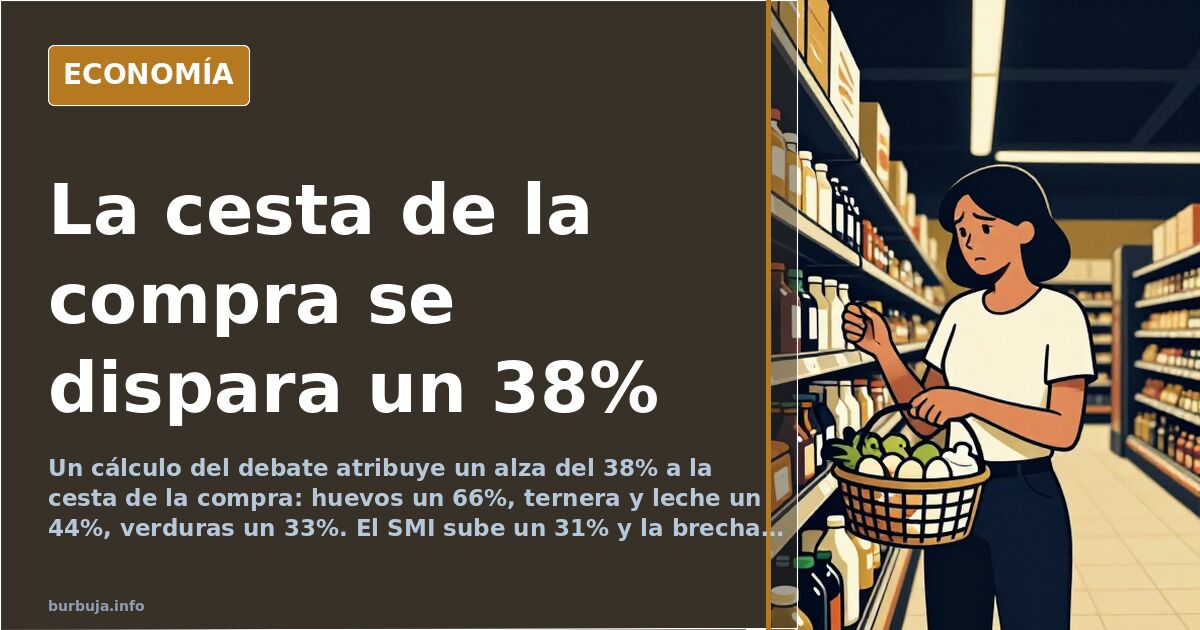
Spain's grocery basket soars 38% in five years
Official data places inflation at 2-3%, but the shopping cart tells a different story, according to calculations circulating in public debate. Between 2020 and 2025, basic food items accumulated a 38% price hike, with eggs costing 66% more, beef and milk 44%, and vegetables 33%. These figures contrast with a 31% increase in the SMI (minimum interprofessional wage) over the same period and an average salary rising from €26,028 in 2020 to €31,698 last year. The gap between wage growth and grocery costs is central to a discussion that has been open for 417 days.
The CPI that doesn't match supermarket receipts
The first contradiction is statistical. The general index hovers around 2-3%, but the food component has diverged since 2021. The most repeated calculation suggests the basic basket has become 38% more expensive since Pedro Sánchez took office, and that the government's refusal to adjust tax brackets for inflation has cost households over €10 billion. In the last four years, middle classes have borne 61% of the price increases.
Some argue the issue isn't just prices, but quality. Quality loss isn't detected by price studies; it requires analyzing food components and proportions. Others go further: comparing identical products ignores that half the weight has been removed. Packaging shrinks, prices don't.
Why olive oil or yogurt no longer serve as excuses?
Olive oil has become the emotional thermometer of the debate. It skyrocketed and now falls, but remains well above 2020 prices. A recurring complaint is that price drops aren't highlighted as much as hikes. Some products have fallen: gasoline, technology, phones. But these aren't part of the basic basket. Housing, however, is a structural expense; rents in cities like Valencia, which were €550-€600/month in 2019-2020, now start at €1,100-€1,200. Meanwhile, over 50% of workers earn less than €20,000-€23,000 gross annually.
SMI rises 31%, but does it reach the shopping cart?
The most common defense of the current framework is that the SMI has risen 31% during these years, published in the BOE (official gazette), and that average wages have also grown. Two and a half million workers earn the SMI. The counterargument is twofold: first, many contracts are part-time disguised as full-time, meaning nominal increases don't translate to real paychecks; second, most existing SMI earners haven't seen relative improvement, only stopped losing ground.
Optimistic calculations assume wage gains offset some impact. Pessimistic scenarios posit housing costs eat any raise. Between both lies an uncomfortable reality: seven years ago, €2,000 net monthly was a great salary; now it's barely more than what a supermarket cashier earns.
Blurring middle class and soaring egg prices
The middle-class narrative is prominent in analysis. Some claim the middle class no longer exists or is marginal, predicting the lower class will become impoverished without mobility, crushed by taxes and a degraded labor market. Opponents argue the lower class has improved living standards since the dictatorship ended, noting poverty levels are lowest since the property bubble burst.
Meanwhile, eggs have replaced olive oil as the symbol. A dozen costs €3 after another October surge, with analyses predicting higher prices by late 2025. Oil, once the universal excuse, stands at $65. The lingering question is: what's the excuse now?
Farm-gate prices vs. intermediary margins
A disorienting fact: buyers still offer €55 per 5-liter jug of organic extra virgin olive oil. Offerors include Segarro buyers and Spanish seniors over 60. Thus, farm-gate prices are meager compared to shelf prices. Distribution costs have soared; intermediaries went bankrupt unable to pay electricity for refrigeration chambers, passing final costs to consumers. Never companies. If they don't raise prices, they fail.
Inflation is the poor man's tax, the invisible tax. Debts are paid off with inflation, and we haven't exited the bubble—it's inflated further. With these disparities, the question isn't when the shopping cart stabilizes. It's how long wages can hold before receipts stop adding up.
Official data places inflation at 2-3%, but the shopping cart tells a different story, according to calculations circulating in public debate. Between 2020 and 2025, basic food items accumulated a 38% price hike, with eggs costing 66% more, beef and milk 44%, and vegetables 33%. These figures contrast with a 31% increase in the SMI (minimum interprofessional wage) over the same period and an average salary rising from €26,028 in 2020 to €31,698 last year. The gap between wage growth and grocery costs is central to a discussion that has been open for 417 days.
The CPI that doesn't match supermarket receipts
The first contradiction is statistical. The general index hovers around 2-3%, but the food component has diverged since 2021. The most repeated calculation suggests the basic basket has become 38% more expensive since Pedro Sánchez took office, and that the government's refusal to adjust tax brackets for inflation has cost households over €10 billion. In the last four years, middle classes have borne 61% of the price increases.
Some argue the issue isn't just prices, but quality. Quality loss isn't detected by price studies; it requires analyzing food components and proportions. Others go further: comparing identical products ignores that half the weight has been removed. Packaging shrinks, prices don't.
Why olive oil or yogurt no longer serve as excuses?
Olive oil has become the emotional thermometer of the debate. It skyrocketed and now falls, but remains well above 2020 prices. A recurring complaint is that price drops aren't highlighted as much as hikes. Some products have fallen: gasoline, technology, phones. But these aren't part of the basic basket. Housing, however, is a structural expense; rents in cities like Valencia, which were €550-€600/month in 2019-2020, now start at €1,100-€1,200. Meanwhile, over 50% of workers earn less than €20,000-€23,000 gross annually.
SMI rises 31%, but does it reach the shopping cart?
The most common defense of the current framework is that the SMI has risen 31% during these years, published in the BOE (official gazette), and that average wages have also grown. Two and a half million workers earn the SMI. The counterargument is twofold: first, many contracts are part-time disguised as full-time, meaning nominal increases don't translate to real paychecks; second, most existing SMI earners haven't seen relative improvement, only stopped losing ground.
Optimistic calculations assume wage gains offset some impact. Pessimistic scenarios posit housing costs eat any raise. Between both lies an uncomfortable reality: seven years ago, €2,000 net monthly was a great salary; now it's barely more than what a supermarket cashier earns.
Blurring middle class and soaring egg prices
The middle-class narrative is prominent in analysis. Some claim the middle class no longer exists or is marginal, predicting the lower class will become impoverished without mobility, crushed by taxes and a degraded labor market. Opponents argue the lower class has improved living standards since the dictatorship ended, noting poverty levels are lowest since the property bubble burst.
Meanwhile, eggs have replaced olive oil as the symbol. A dozen costs €3 after another October surge, with analyses predicting higher prices by late 2025. Oil, once the universal excuse, stands at $65. The lingering question is: what's the excuse now?
Farm-gate prices vs. intermediary margins
A disorienting fact: buyers still offer €55 per 5-liter jug of organic extra virgin olive oil. Offerors include Segarro buyers and Spanish seniors over 60. Thus, farm-gate prices are meager compared to shelf prices. Distribution costs have soared; intermediaries went bankrupt unable to pay electricity for refrigeration chambers, passing final costs to consumers. Never companies. If they don't raise prices, they fail.
Inflation is the poor man's tax, the invisible tax. Debts are paid off with inflation, and we haven't exited the bubble—it's inflated further. With these disparities, the question isn't when the shopping cart stabilizes. It's how long wages can hold before receipts stop adding up.
Summary of a discussion on Burbuja.info - Foro de economía, actualidad y política., translated from Spanish and reviewed before publication. Read the full discussion (181 replies).
More summaries
-
Lidl Basket Spikes 65%: 2019 vs 2025 Prices Erode Spanish Purchasing Power
Lidl 2019 vs 2025 tickets show basic goods up 65%, eroding real purchasing power in Spain. Tomatoes, eggs, bananas surge.
-
Tenant Union of Sol: a network with €3.7 million
The Tenant Union of Sol is part, according to a published report, of a network that would have received €3.7 million from Socialist administrations.
-
Humanoid Robots Play Tennis: Which Manual Jobs Are Safe?
A humanoid robot completes 100 tennis rallies without error. Are manual jobs doomed? Cost, energy limits and skepticism play a role.
-
19,000 unemployed lose benefits for unreported foreign travel
Spain's SEPE cuts off benefits for 19,000 people who failed to report international trips. Here are the detection methods and penalties.
-
Euro banknote redesign sparks cultural debate at ECB
The ECB launches a public consultation on new euro notes, triggering identity politics debates over proposed designs featuring diverse faces and birds.
-
Spain pays €2.5M for wrongful conviction of innocent man
Spain's Supreme Court awards €2.5M to a man imprisoned for 18 years due to ignored DNA evidence. Defense Minister Margarita Robles presided over the original trial.