
Depression and precarity: The wall attitude cannot break
A forum user argues depression arises when expectations clash with reality; others respond that positive attitude is not enough.
English · Original discussion in Spanish · Published
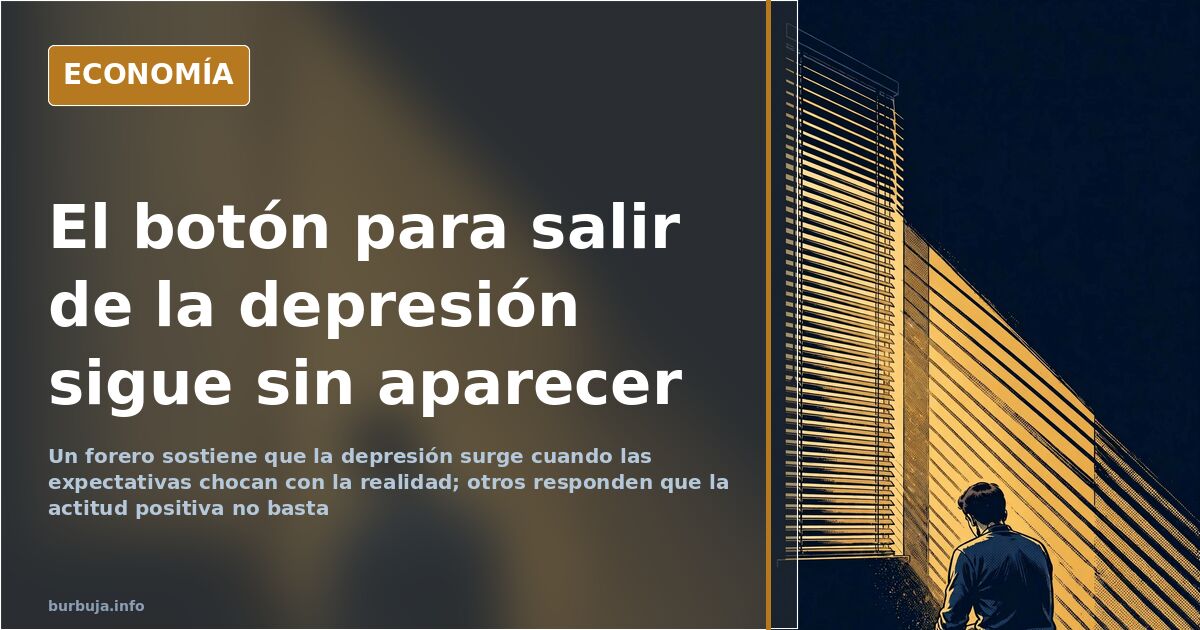
Depression, precarity, and isolation: The button no one finds
What is the use of staying positive when the job market is precarious or nonexistent, housing is out of reach, and emotional loneliness becomes chronic? This question runs through a forum conversation. The opening message argues that depression is, in many cases, a mechanism of refuge: isolating oneself so the mind feels safe somewhere. The context justifies it — precarious labor, unaffordable housing, long periods living with parents, lack of relationships — but the author insists that a dose of positivity is necessary. His recipe: daily small goals, trying to earn money, trying to date, prosper at work. The opposite, he writes, is "DEATH IN LIFE." He confesses two years of withdrawal and a recent fling.
Attitude does not fix a broken job market
The most repeated reply does not deny the problem: it denies the remedy. Finding the button to "get sarracena and move on" is exactly the difficult part, and those seeking it describe a chain of vicious circles from which escape looks like a miracle. Some dismiss the matter with sarcasm: a one-euro lottery ticket and wait. Others warn that false euphoria is also dangerous.
"We are now in that future"
Those who advised worrying about the future receive an uncomfortable reply: that future has already arrived, and the one who warned is no better than the one who turned a deaf ear. The critique does not target prudence, but the repeated sermon. There are also mutual reproaches: those who distribute easy advice — prepare for exams, exercise, get fresh air — reproach the forum for its passivity, while others reproach them for running away when someone who has solved their problems offers solutions.
From school bullying to silent revenge
One of the stories summarizes another path: bullying in high school and university, expulsion from two friend groups, and a revenge that did not come where expected. Stable job, two children, and two flats later, satisfaction consists of crossing paths in town with those who expected their downfall and realizing life went on, and improved, without them. The message proposes no therapy. It proposes obstinacy.
Loneliness, refuge or condemnation?
Against the goal of dating, another current defends the opposite: that life without a stable partner is a blessing, that relationships bring problems, and that loneliness can be managed without drama. The evidence provided is personal experience, not statistics. Meanwhile, the effect of living surrounded by complaint is noted: an environment where anger is vented daily is contagious, permeates the mood, and turns the exception into routine. And a thesis from a participant orders all of the above: depression appears when expectations clash violently with reality; when the situation is accepted as it is, one moves to another state.
Stoicism for precarious times
Among practical advice, an unusual one emerges: reading the classics. An introduction to Hellenism — Epicurus and the Stoics — published by Alianza Editorial, and the lectures of the Juan March Foundation, are recommended, not as self-help but as a manual of the era: the schools born after the crisis of the Greek world resemble too much those needed now.
The recipe remains the same — go out, try, endure — and the button to start it remains unfound. If anyone finds it, let them know.
What is the use of staying positive when the job market is precarious or nonexistent, housing is out of reach, and emotional loneliness becomes chronic? This question runs through a forum conversation. The opening message argues that depression is, in many cases, a mechanism of refuge: isolating oneself so the mind feels safe somewhere. The context justifies it — precarious labor, unaffordable housing, long periods living with parents, lack of relationships — but the author insists that a dose of positivity is necessary. His recipe: daily small goals, trying to earn money, trying to date, prosper at work. The opposite, he writes, is "DEATH IN LIFE." He confesses two years of withdrawal and a recent fling.
Attitude does not fix a broken job market
The most repeated reply does not deny the problem: it denies the remedy. Finding the button to "get sarracena and move on" is exactly the difficult part, and those seeking it describe a chain of vicious circles from which escape looks like a miracle. Some dismiss the matter with sarcasm: a one-euro lottery ticket and wait. Others warn that false euphoria is also dangerous.
"We are now in that future"
Those who advised worrying about the future receive an uncomfortable reply: that future has already arrived, and the one who warned is no better than the one who turned a deaf ear. The critique does not target prudence, but the repeated sermon. There are also mutual reproaches: those who distribute easy advice — prepare for exams, exercise, get fresh air — reproach the forum for its passivity, while others reproach them for running away when someone who has solved their problems offers solutions.
From school bullying to silent revenge
One of the stories summarizes another path: bullying in high school and university, expulsion from two friend groups, and a revenge that did not come where expected. Stable job, two children, and two flats later, satisfaction consists of crossing paths in town with those who expected their downfall and realizing life went on, and improved, without them. The message proposes no therapy. It proposes obstinacy.
Loneliness, refuge or condemnation?
Against the goal of dating, another current defends the opposite: that life without a stable partner is a blessing, that relationships bring problems, and that loneliness can be managed without drama. The evidence provided is personal experience, not statistics. Meanwhile, the effect of living surrounded by complaint is noted: an environment where anger is vented daily is contagious, permeates the mood, and turns the exception into routine. And a thesis from a participant orders all of the above: depression appears when expectations clash violently with reality; when the situation is accepted as it is, one moves to another state.
Stoicism for precarious times
Among practical advice, an unusual one emerges: reading the classics. An introduction to Hellenism — Epicurus and the Stoics — published by Alianza Editorial, and the lectures of the Juan March Foundation, are recommended, not as self-help but as a manual of the era: the schools born after the crisis of the Greek world resemble too much those needed now.
The recipe remains the same — go out, try, endure — and the button to start it remains unfound. If anyone finds it, let them know.
Summary of a discussion on Burbuja.info - Foro de economía, actualidad y política., translated from Spanish and reviewed before publication. Read the full discussion (27 replies).
More summaries
-
Collado Mediano Villa Foreclosure Reveals Political Storm Origins
A Collado Mediano villa foreclosed 26 years ago for non-payment exposes the official narrative behind Spain's recent political eviction controversy.
-
Spain's Supreme Court suspends Puigdemont's arrest warrant
Spain's Supreme Court provisionally suspends the arrest warrant for Carles Puigdemont pending the Constitutional Court's full ruling on the misappropriation amnesty.
-
Madrid Metro Debate: How Many Foreigners Live in the Capital?
A viral video sparks debate on foreign population in Madrid. Official data contrasts with online perceptions of demographic shifts in the metro.
-
Spain's Normalized Corruption: The Political Silence Pact
Corruption in Spain has become routine, shielded by a cross-party silence pact that ensures impunity and erodes institutional trust.
-
La Mina Shooting: Automatic Weapons and Trapped Residents
A clash between drug gangs in Sant Adrià de Besòs using automatic weapons leaves one injured. Interior Minister Núria Parlón faces immediate questioning.
-
Bitcoin Halves from Peak, Reigniting Debate
Bitcoin drops from 124,000 to 62,000, sparking debate: is it a pyramid scheme, liquid collateral, or just speculation? Here are the arguments from both sides.