
Spain: Fixed deposits lose 5.39% real value as euro falls
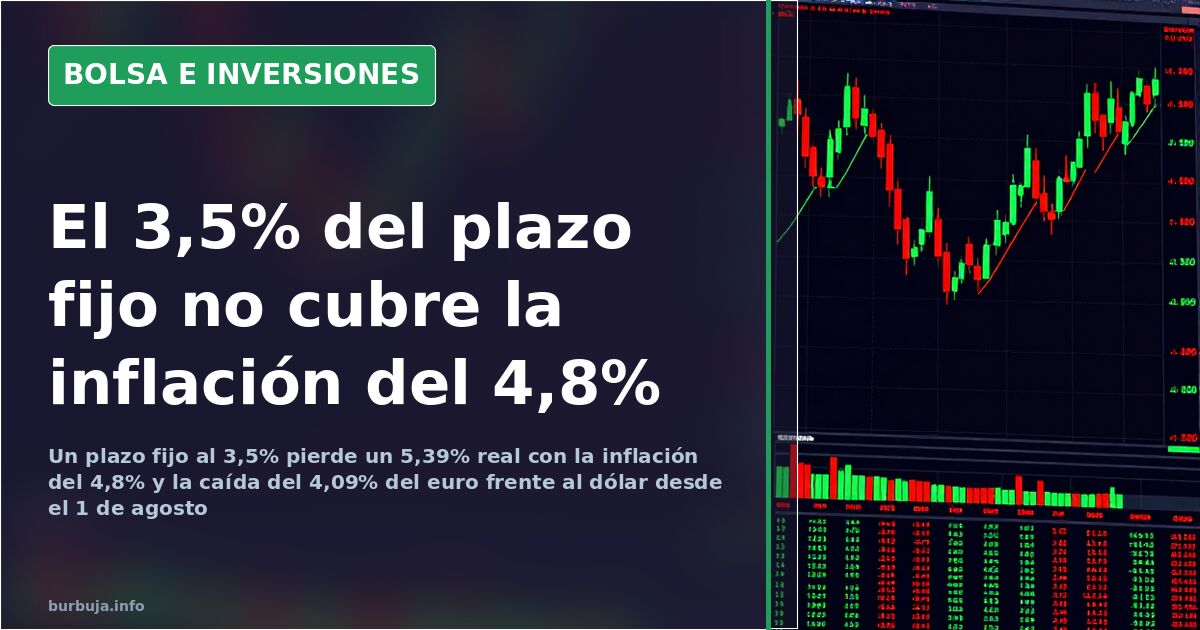
A 3.5% fixed deposit loses 5.39% in real terms due to 4.8% inflation and a 4.09% drop of the euro against the dollar since August 1.
English · Original discussion in Spanish · Published
A 3.5% fixed deposit turns into a 5.39% real loss
The 3.5% yield on a term deposit sounds like a safe haven until compared with the projected 4.8% inflation for September 2023 and the 4.09% decline of the euro against the dollar since August 1. Add them up: 8.89%. Subtract the interest: the real loss stands at 5.39%. It is not a bankruptcy, a bank run, or a scam. It is harder to digest: nothing happens, yet money loses value.
This is the starting point of a debate that recurs in Spain whenever inflation outpaces interest rates. The question is no longer where money earns more, but how much it costs each month to do nothing with it. And the answer, with a classic deposit, is negative.
The calculation debunking fixed deposit profitability
The breakdown is so simple it hurts. Projected inflation for September 2023: 4.8%. Euro devaluation against the dollar since August 1: −4.09%. Total: −8.89%. The 3.5% financial product falls short by more than five points. Here lies the trap of idle cash: interest is paid once, while the loss of purchasing power accrues daily.
There is a reasonable objection: adding inflation to exchange rate changes isn't entirely correct because a saver living and consuming in euros doesn't buy everything in dollars. The counterargument has some truth but doesn't change the core issue. The 3.5% remains below the projected 4.8%, so the loss exists even if the final figure fluctuates.
Note another detail: the euro hasn't weakened over a year; it lost that 4.09% since August 1. When a currency drops four points against the dollar in weeks, energy, travel, and imported goods prices feel it before the official consumer basket does.
What to do with savings: food, dividends, or distressed properties
Advice varies by volume. With little money, the recommendation is buying durable food items you will consume anyway: flour, rice, pasta, oil. Those who stocked up in late 2020 and again during the Ukraine crisis saved on price hikes. This isn't investment; it's pre-paying consumption at old prices, which works in high-inflation scenarios.
With moderate amounts, the defended path is equities: established companies bought at bad moments, using dividends as a cushion while waiting for recovery. Risk is assumed, yes, but capital doesn't sit still while inflation erodes it.
Above €200,000, the options change. A tense real estate market appears, with owners needing to sell and buyers arriving with liquidity. The figure isn't random: it marks the boundary between investing and negotiating.
Judicial auctions: 40 working days to pay and inflated valuations
The star mechanism for this segment is auctions. Fine print matters: there are 40 working days to complete payment, and not everyone has €50,000 handy for a home auctioned at that price but valued at €300,000. The temptation is to request a mortgage with the adjudication document; the problem is banks don't sign by decree.
Experienced operators summarize the method and guts required: look for bids with long lead times, visit the area personally, understand why the owner is losing the property, and distrust cases with murky family histories. Valuation prices are often inflated, turning apparent bargains into expensive problems.
Warnings from insiders repeat: one can get burned and end up with a property subject to declared vulnerability situations. The Ley de Enjuiciamiento Civil (Civil Procedure Act) regulates deadlines and deposits, but the full breakdown of guarantees, bids, and fine print doesn't fit in four lines.
Gold, foreign currency, and money market funds at 4%
Beyond real estate, the manual repeats: stocks, bonds, gold, and property, sometimes via crowdfunding platforms. A conservative variant notes you can squeeze more without leaving guaranteed products, because money market funds are paying around 4%, half a point above deposits.
Investing outside Spain also gains weight. Defenders cite legal insecurity and an unfavorable demographic pyramid. Others prefer assets not listed on any index: gold, fertile land, even weapons. Context is tough: the MSCI World has been red for days, and cheap money cycles, according to those who've seen several, last about seven years on average.
Another view holds that now isn't the time to act. That was the fifteen years after the subprime crisis when liquidity was free. Now everyone pays the bill, and latecomers pay twice.
The uncomfortable answer: money is also meant to be spent
Underneath all calculations lurks a current proposing no investment. It proposes spending. Its argument is that savings provide peace and options but can become an absurd countdown: calculate remaining time, divide by available money, and act accordingly.
The reference is ancient: Seneca reproached that no one gives away their money, while everyone gives away their time. Defenders add an unkind touch: if you don't spend your surplus, others will, and they'll dance on your grave. In that logic, money doesn't compete with inflation; it competes with time.
Nuances remain: how true is adding inflation and devaluation, what risk tolerance each pocket has, and what to do with auction deadline days. With the euro falling and CPI above deposit interest, doing nothing is also a decision. How long can someone watch their money earn less than it costs to hold?
The 3.5% yield on a term deposit sounds like a safe haven until compared with the projected 4.8% inflation for September 2023 and the 4.09% decline of the euro against the dollar since August 1. Add them up: 8.89%. Subtract the interest: the real loss stands at 5.39%. It is not a bankruptcy, a bank run, or a scam. It is harder to digest: nothing happens, yet money loses value.
This is the starting point of a debate that recurs in Spain whenever inflation outpaces interest rates. The question is no longer where money earns more, but how much it costs each month to do nothing with it. And the answer, with a classic deposit, is negative.
The calculation debunking fixed deposit profitability
The breakdown is so simple it hurts. Projected inflation for September 2023: 4.8%. Euro devaluation against the dollar since August 1: −4.09%. Total: −8.89%. The 3.5% financial product falls short by more than five points. Here lies the trap of idle cash: interest is paid once, while the loss of purchasing power accrues daily.
There is a reasonable objection: adding inflation to exchange rate changes isn't entirely correct because a saver living and consuming in euros doesn't buy everything in dollars. The counterargument has some truth but doesn't change the core issue. The 3.5% remains below the projected 4.8%, so the loss exists even if the final figure fluctuates.
Note another detail: the euro hasn't weakened over a year; it lost that 4.09% since August 1. When a currency drops four points against the dollar in weeks, energy, travel, and imported goods prices feel it before the official consumer basket does.
What to do with savings: food, dividends, or distressed properties
Advice varies by volume. With little money, the recommendation is buying durable food items you will consume anyway: flour, rice, pasta, oil. Those who stocked up in late 2020 and again during the Ukraine crisis saved on price hikes. This isn't investment; it's pre-paying consumption at old prices, which works in high-inflation scenarios.
With moderate amounts, the defended path is equities: established companies bought at bad moments, using dividends as a cushion while waiting for recovery. Risk is assumed, yes, but capital doesn't sit still while inflation erodes it.
Above €200,000, the options change. A tense real estate market appears, with owners needing to sell and buyers arriving with liquidity. The figure isn't random: it marks the boundary between investing and negotiating.
Judicial auctions: 40 working days to pay and inflated valuations
The star mechanism for this segment is auctions. Fine print matters: there are 40 working days to complete payment, and not everyone has €50,000 handy for a home auctioned at that price but valued at €300,000. The temptation is to request a mortgage with the adjudication document; the problem is banks don't sign by decree.
Experienced operators summarize the method and guts required: look for bids with long lead times, visit the area personally, understand why the owner is losing the property, and distrust cases with murky family histories. Valuation prices are often inflated, turning apparent bargains into expensive problems.
Warnings from insiders repeat: one can get burned and end up with a property subject to declared vulnerability situations. The Ley de Enjuiciamiento Civil (Civil Procedure Act) regulates deadlines and deposits, but the full breakdown of guarantees, bids, and fine print doesn't fit in four lines.
Gold, foreign currency, and money market funds at 4%
Beyond real estate, the manual repeats: stocks, bonds, gold, and property, sometimes via crowdfunding platforms. A conservative variant notes you can squeeze more without leaving guaranteed products, because money market funds are paying around 4%, half a point above deposits.
Investing outside Spain also gains weight. Defenders cite legal insecurity and an unfavorable demographic pyramid. Others prefer assets not listed on any index: gold, fertile land, even weapons. Context is tough: the MSCI World has been red for days, and cheap money cycles, according to those who've seen several, last about seven years on average.
Another view holds that now isn't the time to act. That was the fifteen years after the subprime crisis when liquidity was free. Now everyone pays the bill, and latecomers pay twice.
The uncomfortable answer: money is also meant to be spent
Underneath all calculations lurks a current proposing no investment. It proposes spending. Its argument is that savings provide peace and options but can become an absurd countdown: calculate remaining time, divide by available money, and act accordingly.
The reference is ancient: Seneca reproached that no one gives away their money, while everyone gives away their time. Defenders add an unkind touch: if you don't spend your surplus, others will, and they'll dance on your grave. In that logic, money doesn't compete with inflation; it competes with time.
Nuances remain: how true is adding inflation and devaluation, what risk tolerance each pocket has, and what to do with auction deadline days. With the euro falling and CPI above deposit interest, doing nothing is also a decision. How long can someone watch their money earn less than it costs to hold?
Also available in: Deutsch
Summary of a discussion on Burbuja.info - Foro de economía, actualidad y política., translated from Spanish and reviewed before publication. Read the full discussion (115 replies).
More summaries
-
DCA in MSCI World: €20,000 invested at highs yields €9,000 profit
A forum tracking shows €20,000 invested at MSCI World highs since 2022 and €9,028 in gains. Quarterly DCA achieves 14.43% annualized…
-
Spain used €2.389bn EU funds for pensions, audit says
Court of Auditors reports €2.389bn diverted to pensions; Brussels confirms review of Next Generation fund usage.
-
Economy twists: stock bubble and consumption in freefall
The DAX nears 22,000 with Germany in recession, consumption sinks and real inflation exceeds official. Signs of bubble and debt.
-
Spain: 39-Year-Old Dependent Adult Sparks Debate on Parental Responsibility
A forum post about a jobless 39-year-old in Spain triggers debate on parenting, independence, and family parasitism.
-
€75,000/year for IT manager with 22 years' experience in Spain
A €75,000 gross annual salary for an IT leadership role in Valencia sparks debate over net pay, workload, and international opportunities.
-
Investing €200,000: Options to avoid losing value
Inflation erodes idle cash. Explore alternatives like gold, silver, and real estate for investing €200,000.