
Economy twists: stock bubble and consumption in freefall
The DAX nears 22,000 with Germany in recession, consumption sinks and real inflation exceeds official. Signs of bubble and debt.
English · Original discussion in Spanish · Published
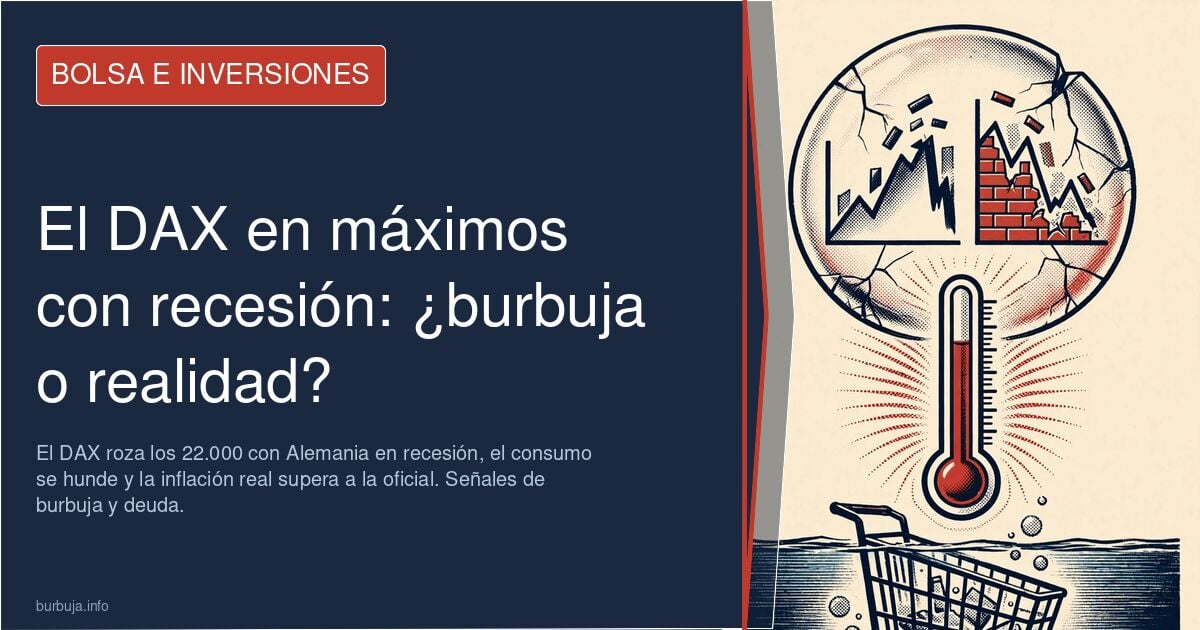
Consumption sinks and the stock market doesn't reflect it: bubble signals
Germany is in technical recession and yet the DAX is nearing 22,000 points. The ECB cuts rates while inflation eats wages. And in Spain, even the banks that were thought dead are trading higher. The real economy and financial markets have broken the link that kept them together.
The paradox of the indices: recession with highs
While Trump announces tariffs left and right, US stock markets hit highs. In Europe, Germany is in recession but the DAX is nearing 22,000 points, an absurdity explained only by artificial liquidity. The ECB lowers interest rates while inflation continues to eat purchasing power. In Spain, even the ruined little banks of the Trilex are rising, and they do so while the Treasury rakes in revenue without deflating income tax.
The comparison with 2001 is inevitable. Then it was the internet bubble; now it's AI. In Monday's tech selloff, the S&P 500 fell -1.46% while the equal-weighted S&P 500 rose +0.02%. That divergence is the signature of a bubble concentrated in a few companies.
Consumption sinks: retail, fashion and leisure in decline
The retail sector is badly hit. Puma, Nike, Adidas and Lululemon are suffering like never before. JPMorgan gives Puma a target price of 16 euros, more than 15% below current prices. It's confirmation that nothing is selling, no one is consuming. Ab Inbev also sees sales plunge, revenue and volumes fall. People are turning away from alcohol; it's expensive and bad for health.
We now live in a perpetual "January slope." There's a slope in September, in January, after Easter... it's an endless slope. That's why people cut back on everything dispensable: clothes, shoes, furniture, changing the car. All that is secondary when a kilo of lemons costs 3 euros, and before it cost 1 euro or less.
Real inflation vs. official: the data that doesn't add up
Inflation data is fudged however they damn well please. If there's real inflation of 12 percent they'll say CPI is 2 tenths. Meanwhile, car insurance has risen much more than double official inflation. The IBI bill for a plot has risen more than 50%. And in the environment, everyone is paying late and badly, even companies that used to be good payers no longer pay.
Consumption is sunk. No one buys anything because everything is extremely expensive and everywhere they try to blatantly rip you off. This has spread from the weekly supermarket shop to home insurance, to the bank.
The debt bomb and the recommendation of tangible assets
Bill Gross will be right, it's a matter of time. The European debt bomb has to explode soon. In France the government is going to fall and the Netherlands is also in the muck. The only ways out of ultra-mega-debt are two: a declaration of bankruptcy or galloping inflation that dilutes the real debt. And bankruptcy doesn't suit them to declare because the debt is owed to the masters themselves.
The recommendation is clear: heavy weighting in tangible (physical) assets that withstand inflation well. And if you have the guts, borrow heavily at a fixed interest rate to buy them, because it will be beautiful to see how inflation makes your investment and its dividends "rise," but the debt used to invest remains.
The geopolitical factor: China, Trump and the EU
The US will no longer be able to handle China. A bigger country, with more population, more history, greater culture of sacrifice, with harder-working people. China, along with other countries, the BRICS and satellite countries, will bend the US. The US is in decline and will not recover.
Chinese consumers will become more experienced, more expert, who won't pay thousands of euros for a little brand. Prada, Gucci, Louis Vuitton, Chanel... have closed their stores in the Asian country due to the collapse in sales caused by economic uncertainty. Meanwhile, the EU is beginning to travel the path that was obvious to anyone at least 25 years ago: trade with China and move closer to China. Ursula von der Leyen argues that Brussels and Beijing must deepen trade and investment ties.
And Trump trying to manipulate the stock market, the dollar... It's more fun going to the casino. With Trump, you might wake up with the US market up 3% and it ends down 5%. Then the crypto silliness, which is a time bomb.
The anecdote of money laundering in Madrid
In Madrid, flats are sold for 2 million euros because only drug traffickers and front men for political mafias buy them to launder money. It's so blatant that they get caught in Madrid in a car with 300,000 euros in a bag. And for a guy from the UDEF to be caught with 20 million euros walled up in his house, that had never peine before. Now they launder in the face of ordinary Spaniards and no one lifts a finger. Prices rise due to the money laundering effect.
Is this the beginning of a long correction or simply a pause in a market that has learned to ignore the real economy? The answer, for now, remains up in the air.
Germany is in technical recession and yet the DAX is nearing 22,000 points. The ECB cuts rates while inflation eats wages. And in Spain, even the banks that were thought dead are trading higher. The real economy and financial markets have broken the link that kept them together.
The paradox of the indices: recession with highs
While Trump announces tariffs left and right, US stock markets hit highs. In Europe, Germany is in recession but the DAX is nearing 22,000 points, an absurdity explained only by artificial liquidity. The ECB lowers interest rates while inflation continues to eat purchasing power. In Spain, even the ruined little banks of the Trilex are rising, and they do so while the Treasury rakes in revenue without deflating income tax.
The comparison with 2001 is inevitable. Then it was the internet bubble; now it's AI. In Monday's tech selloff, the S&P 500 fell -1.46% while the equal-weighted S&P 500 rose +0.02%. That divergence is the signature of a bubble concentrated in a few companies.
Consumption sinks: retail, fashion and leisure in decline
The retail sector is badly hit. Puma, Nike, Adidas and Lululemon are suffering like never before. JPMorgan gives Puma a target price of 16 euros, more than 15% below current prices. It's confirmation that nothing is selling, no one is consuming. Ab Inbev also sees sales plunge, revenue and volumes fall. People are turning away from alcohol; it's expensive and bad for health.
We now live in a perpetual "January slope." There's a slope in September, in January, after Easter... it's an endless slope. That's why people cut back on everything dispensable: clothes, shoes, furniture, changing the car. All that is secondary when a kilo of lemons costs 3 euros, and before it cost 1 euro or less.
Real inflation vs. official: the data that doesn't add up
Inflation data is fudged however they damn well please. If there's real inflation of 12 percent they'll say CPI is 2 tenths. Meanwhile, car insurance has risen much more than double official inflation. The IBI bill for a plot has risen more than 50%. And in the environment, everyone is paying late and badly, even companies that used to be good payers no longer pay.
Consumption is sunk. No one buys anything because everything is extremely expensive and everywhere they try to blatantly rip you off. This has spread from the weekly supermarket shop to home insurance, to the bank.
The debt bomb and the recommendation of tangible assets
Bill Gross will be right, it's a matter of time. The European debt bomb has to explode soon. In France the government is going to fall and the Netherlands is also in the muck. The only ways out of ultra-mega-debt are two: a declaration of bankruptcy or galloping inflation that dilutes the real debt. And bankruptcy doesn't suit them to declare because the debt is owed to the masters themselves.
The recommendation is clear: heavy weighting in tangible (physical) assets that withstand inflation well. And if you have the guts, borrow heavily at a fixed interest rate to buy them, because it will be beautiful to see how inflation makes your investment and its dividends "rise," but the debt used to invest remains.
The geopolitical factor: China, Trump and the EU
The US will no longer be able to handle China. A bigger country, with more population, more history, greater culture of sacrifice, with harder-working people. China, along with other countries, the BRICS and satellite countries, will bend the US. The US is in decline and will not recover.
Chinese consumers will become more experienced, more expert, who won't pay thousands of euros for a little brand. Prada, Gucci, Louis Vuitton, Chanel... have closed their stores in the Asian country due to the collapse in sales caused by economic uncertainty. Meanwhile, the EU is beginning to travel the path that was obvious to anyone at least 25 years ago: trade with China and move closer to China. Ursula von der Leyen argues that Brussels and Beijing must deepen trade and investment ties.
And Trump trying to manipulate the stock market, the dollar... It's more fun going to the casino. With Trump, you might wake up with the US market up 3% and it ends down 5%. Then the crypto silliness, which is a time bomb.
The anecdote of money laundering in Madrid
In Madrid, flats are sold for 2 million euros because only drug traffickers and front men for political mafias buy them to launder money. It's so blatant that they get caught in Madrid in a car with 300,000 euros in a bag. And for a guy from the UDEF to be caught with 20 million euros walled up in his house, that had never peine before. Now they launder in the face of ordinary Spaniards and no one lifts a finger. Prices rise due to the money laundering effect.
Is this the beginning of a long correction or simply a pause in a market that has learned to ignore the real economy? The answer, for now, remains up in the air.
Summary of a discussion on Burbuja.info - Foro de economía, actualidad y política., translated from Spanish and reviewed before publication. Read the full discussion (370 replies).
More summaries
-
The AI Bubble: How Circular Payments Keep the S&P 500 Afloat
OpenAI has $550B in commitments but no profit, Oracle issues 6.85% debt, and the billing loop keeps the S&P 500 rising.
-
Spain housing prices: €260,000 for new 47m² units
Torremolinos studio rose to €90,000; Getafe new build costs €260,000. Available stock is plummeting.
-
Trading Challenge Surges from 500 to 11,000 Euros
A manual trading challenge grows from 500 to over 11,000 euros, with 456 trades and an 87% win rate claimed by its promoter.
-
Selfbank's 60€ referral plan devolves into an incentive auction
Selfbank offered 60€ per friend opening an account with 1,000€. The promotion turned into an auction for extra incentives, sparking a race to the bottom.
-
52-year-old saves 600k euros in 30 years by living rent-free in Spain
A Spanish man saves 600,000 euros over 30 years by avoiding rent, but the required 1,666 euros monthly savings sparks debate on feasibility.
-
Compound interest requires 30 years of rowing to become a rentier
Compound interest takes 30 years to show results: those with 13 years are in the red, while reinvesting dividends separates 338% from 541%.