
Spain: 39-Year-Old Dependent Adult Sparks Debate on Parental Responsibility
A forum post about a jobless 39-year-old in Spain triggers debate on parenting, independence, and family parasitism.
English · Original discussion in Spanish · Published
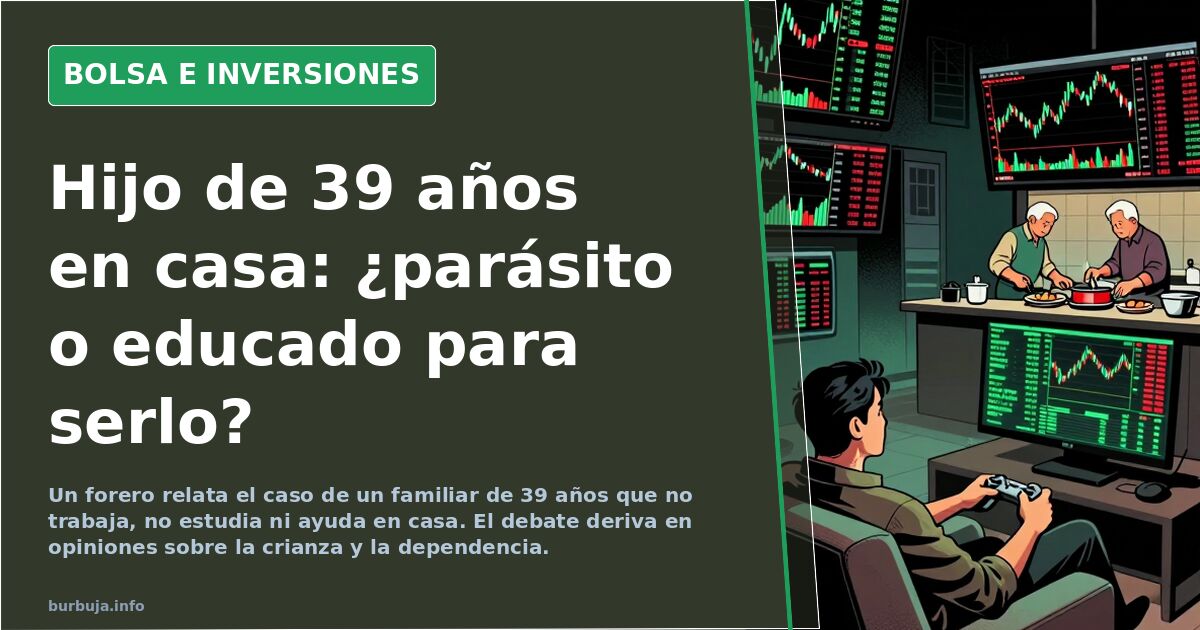
The 39-Year-Old Who Neither Works Nor Helps: Parasite or Victim of Upbringing?
He is 39, lives with his parents, does not work, study, or contribute financially. He only cooks occasionally and spends the day on his phone or laptop. The case, raised in an investment forum, sparks a storm of opinions: from those who see a parasite who should be kicked out to those arguing the real culprit is whoever supports him. The discussion shifts to a more uncomfortable issue: what happens when individual failure becomes a social phenomenon?
The Case That Peine the Debate: 39 Years Old, Zero Contribution, Parents Supporting Him
The initial account is specific: a 39-year-old relative living at home, unemployed, not studying, and not helping with chores. His only contribution is occasional cooking. He contributes nothing economically and asks for money for expenses, from vapes to Amazon purchases. The poster wonders how to financially support someone like this. The most repeated answer at the start of the debate is one: the blame lies with the parents who allow it.
Some clarify that the problem is not just economic. One participant points out that such a child doesn't come out of nowhere: "children don't emerge as parasites, nor smart or stupid; everything depends on the environment." From a young age, they argue, children must be taught household tasks and a culture of effort. Another adds that barely passing grades shouldn't exist and that work can begin at 16. A shared conclusion: parents have the children they deserve.
Is He a Parasite or a Product of the System? Two Sides of the Argument
The label "parasite" is not unanimous. Against those using it without nuance, others respond with an uncomfortable argument: it's better to have him at home than watching him struggle or end up on the street. One participant compares it to other situations: some spend their grandmother's pension on drugs and end up selling house furniture. Others argue many young people are like this and parents are happy, preferring this over their child leaving with bad company or ending up homeless.
The discussion intersects with a generational debate. One message argues that today's 39-year-olds are like 9-year-olds before, because life has changed much in the last 25 years. Another responds that not all cases are the same: there are people who work but live with parents to avoid mortgages, and adults who have never worked. "Every situation is a different world," summarizes. The line separating reasonable help from parasitism is unclear to everyone.
What Happens When the Child Is Already 40? Antiestéticar of Perpetual Dependence
The case of the 39-year-old relative is not isolated. Other profiles appear in the debate: children who move out but still receive monthly transfers from parental pensions, or adults returning home after divorce. One participant describes it as a misfortune that worsens over time, because the child becomes totally useless to society and it is almost impossible to get them out of the house. The warning is clear: if not corrected in time, dependence becomes chronic.
The harshest response comes from another angle: "I'd put him out on the street." But that solution has costs. Several messages recall that life is already hard enough to add more suffering, and kicking out a resourceless child could end in tragedy. The balance between demanding responsibility and not abandoning them to the elements is the knot no one unties.
How to Avoid Raising a Parasitic Child? Education, Limits, and Money
The most repeated recipe in the debate is prevention. Teach household tasks from childhood, don't give allowance without reciprocation, and pay for specific jobs like mowing the lawn or washing the car, even with little money. One participant says that in their house, children set and clear the table since they were small, and studying and getting good grades is taken for granted. Another insists that the biggest mistake seen around is not letting teenagers find a job to earn pocket money: when you take a frustrating job at 16 or 17, you value more what your parents do.
The counterargument also appears: pressuring children too much can generate thought patterns that accompany them for life. One message warns that pressure to study and work can be counterproductive. Another recalls that the first influence usually comes from parents, but sometimes the child gets lost due to circumstances no one controls: low self-esteem, lack of support, bad habits, or simply losing direction.
The Disorienting Data: No One Knows How Many Cases Like This Exist in Spain
The debate provides no official statistics. There is no figure for how many adults live off their parents in Spain, nor a record of how many have never worked. What exists are testimonials and opposing opinions. One participant points out that there are fifty thousand different cases and lumping them all together is a mistake. Another responds that the exception does not invalidate the rule: most children who end up like this had an upbringing that allowed it.
The discussion ends without consensus. Some demand tough measures, others understanding, and a third group points to parents. Meanwhile, the 39-year-old relative remains at home, phone in hand, contributing nothing. And the initial question remains unanswered: what to do when the parasite already has gray hair?
He is 39, lives with his parents, does not work, study, or contribute financially. He only cooks occasionally and spends the day on his phone or laptop. The case, raised in an investment forum, sparks a storm of opinions: from those who see a parasite who should be kicked out to those arguing the real culprit is whoever supports him. The discussion shifts to a more uncomfortable issue: what happens when individual failure becomes a social phenomenon?
The Case That Peine the Debate: 39 Years Old, Zero Contribution, Parents Supporting Him
The initial account is specific: a 39-year-old relative living at home, unemployed, not studying, and not helping with chores. His only contribution is occasional cooking. He contributes nothing economically and asks for money for expenses, from vapes to Amazon purchases. The poster wonders how to financially support someone like this. The most repeated answer at the start of the debate is one: the blame lies with the parents who allow it.
Some clarify that the problem is not just economic. One participant points out that such a child doesn't come out of nowhere: "children don't emerge as parasites, nor smart or stupid; everything depends on the environment." From a young age, they argue, children must be taught household tasks and a culture of effort. Another adds that barely passing grades shouldn't exist and that work can begin at 16. A shared conclusion: parents have the children they deserve.
Is He a Parasite or a Product of the System? Two Sides of the Argument
The label "parasite" is not unanimous. Against those using it without nuance, others respond with an uncomfortable argument: it's better to have him at home than watching him struggle or end up on the street. One participant compares it to other situations: some spend their grandmother's pension on drugs and end up selling house furniture. Others argue many young people are like this and parents are happy, preferring this over their child leaving with bad company or ending up homeless.
The discussion intersects with a generational debate. One message argues that today's 39-year-olds are like 9-year-olds before, because life has changed much in the last 25 years. Another responds that not all cases are the same: there are people who work but live with parents to avoid mortgages, and adults who have never worked. "Every situation is a different world," summarizes. The line separating reasonable help from parasitism is unclear to everyone.
What Happens When the Child Is Already 40? Antiestéticar of Perpetual Dependence
The case of the 39-year-old relative is not isolated. Other profiles appear in the debate: children who move out but still receive monthly transfers from parental pensions, or adults returning home after divorce. One participant describes it as a misfortune that worsens over time, because the child becomes totally useless to society and it is almost impossible to get them out of the house. The warning is clear: if not corrected in time, dependence becomes chronic.
The harshest response comes from another angle: "I'd put him out on the street." But that solution has costs. Several messages recall that life is already hard enough to add more suffering, and kicking out a resourceless child could end in tragedy. The balance between demanding responsibility and not abandoning them to the elements is the knot no one unties.
How to Avoid Raising a Parasitic Child? Education, Limits, and Money
The most repeated recipe in the debate is prevention. Teach household tasks from childhood, don't give allowance without reciprocation, and pay for specific jobs like mowing the lawn or washing the car, even with little money. One participant says that in their house, children set and clear the table since they were small, and studying and getting good grades is taken for granted. Another insists that the biggest mistake seen around is not letting teenagers find a job to earn pocket money: when you take a frustrating job at 16 or 17, you value more what your parents do.
The counterargument also appears: pressuring children too much can generate thought patterns that accompany them for life. One message warns that pressure to study and work can be counterproductive. Another recalls that the first influence usually comes from parents, but sometimes the child gets lost due to circumstances no one controls: low self-esteem, lack of support, bad habits, or simply losing direction.
The Disorienting Data: No One Knows How Many Cases Like This Exist in Spain
The debate provides no official statistics. There is no figure for how many adults live off their parents in Spain, nor a record of how many have never worked. What exists are testimonials and opposing opinions. One participant points out that there are fifty thousand different cases and lumping them all together is a mistake. Another responds that the exception does not invalidate the rule: most children who end up like this had an upbringing that allowed it.
The discussion ends without consensus. Some demand tough measures, others understanding, and a third group points to parents. Meanwhile, the 39-year-old relative remains at home, phone in hand, contributing nothing. And the initial question remains unanswered: what to do when the parasite already has gray hair?
Also available in: Deutsch
Summary of a discussion on Burbuja.info - Foro de economía, actualidad y política., translated from Spanish and reviewed before publication. Read the full discussion (114 replies).
More summaries
-
Saving €50,000 to sink into a 40-year mortgage: the debate
Ten years saving €50,000 to sign a 40-year mortgage: the debate over whether housing is an investment or a necessity remains unresolved.
-
Spain's 'lobster generation': hoarding wealth, not passing it on
Parents with multiple homes leave their children struggling. The lobster generation hoards without passing on wealth, and generational conflict erupts.
-
Lamas Bolaño charges 1,200 euros for gold but refuses buyback
A buyer paid 1,200 euros for a gold coin at Lamas Bolaño, but the Spanish dealer refuses to buy it back, citing mint pricing.
-
BBVA Insider Sells €338k Shares at Five-Year High
A BBVA executive sold €338,000 in shares at a five-year peak, sparking investor debate over the 6% dividend, Turkey exposure, and interest rates.
-
Investing €60k: Index Funds, Gold, or Waiting for a Crash?
A saver asks how to invest €60,000 in Spain: index funds, gold, or waiting for a market crash. The debate covers DCA strategies and the cost of timing.
-
€75,000/year for IT manager with 22 years' experience in Spain
A €75,000 gross annual salary for an IT leadership role in Valencia sparks debate over net pay, workload, and international opportunities.