
Spain Court Orders Telegram Block, Then Suspends It
Judge Pedraz ordered a precautionary Telegram block in Spain over copyright issues but suspended it hours later pending a police report.
English · Original discussion in Spanish · Published
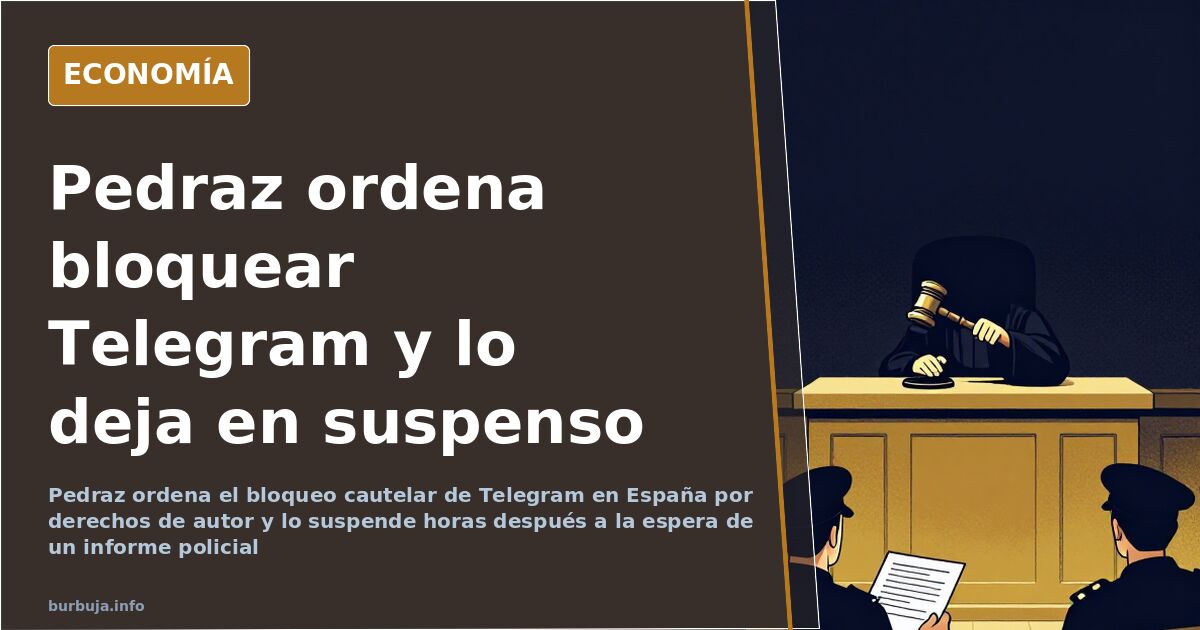
Pedraz orders Telegram block and suspends it hours later
Can you cut off messaging for more than eight million people due to a copyright complaint? In March 2024, National Court judge Santiago Pedraz signed an order mandating the precautionary blocking of Telegram in Spain at the request of Mediaset, Atresmedia, and Movistar Plus+, which accused the platform of hosting unauthorized audiovisual content. The judge gave telecom operators three hours to cut the service.
The case had been building up for some time. On July 28, 2023, a letter rogatory had already been sent to the British Virgin Islands requesting technical data from Telegram to identify account owners used for infringement. With no response, the court concluded there was no other option: "The lack of cooperation from the authorities in the British Virgin Islands, who were asked to communicate with those responsible for the social network, necessitates the adoption of the precautionary measures requested by the private prosecutors," the document stated.
Why was a Telegram block ordered in Spain?
The origin is a lawsuit over the unauthorized use of copyrighted audiovisual content. Put simply: channels that had long been distributing matches and programs, against which broadcasters wanted to identify the owners. The judge asked Telegram. Telegram did not reply. And the order ended up targeting the entire application.
Disproportionality was the argument most repeated among lawyers and technicians, who received the news with astonishment. The measure targeted specific account holders but fell on 900 million users worldwide, including more than 8.5 million in Spain. Some compared it to cutting power to half of Spain because Endesa faced a tax authority complaint. Others noted that blocking an app does not erase channels; it merely moves them.
Three-hour deadline passed, app remained open
The order gave operators three hours to cut resources associated with Telegram. After the deadline, the application continued working normally, and surprise mixed with mockery. Within hours, groups sharing pirated sports broadcasts circulated instructions to stay connected: lists of servers, proxies, and downloadable versions outside app stores.
This revealed the technical hurdle. Telegram's servers are decentralized, and traffic is encrypted, making it difficult to discriminate which data packets belong to the app, unlike blocking a domain or IP address. Additionally, there is a web version hosted on the official service site, outside Google Play, which bypasses store closures. "Loopholes," summarized the general sentiment.
Is blocking Telegram enough to stop piracy?
No, according to most analyses circulating. Content does not live in the app; it lives in channels that can migrate to other services within hours. Blocking the app raises the technical barrier and reduces the less expert audience but leaves the underlying problem intact: identifying distributors.
Some argue the opposite with an interesting nuance: although experts continue accessing via VPNs and direct downloads, the entry difficulty expels occasional viewers, who might return to traditional circuits or new channels. This is the only argument with measurable logic within a measure that, at first glance, seemed otherwise.
In parallel runs a larger debate: to what extent does a tech company answer for actions taken on its infrastructure? The question is not new, but with Telegram, it ceased to be academic.
The block that never peine
Hours later, Pedraz suspended the measure pending a report from the General Police Information Department. The application never actually went down. Among observers, the prevailing interpretation was that public noise outweighed any technical doubt: if no one had spoken out, the order would have been executed.
Some also mention the arrest of Pavel Durov, the Russian billionaire who founded Telegram in 2013. Part of the analysis suggests this responds to a US move rather than France. The case remains open.
The block was suspended, the app never crashed, and the letter rogatory to the British Virgin Islands still waits for a response.
Can you cut off messaging for more than eight million people due to a copyright complaint? In March 2024, National Court judge Santiago Pedraz signed an order mandating the precautionary blocking of Telegram in Spain at the request of Mediaset, Atresmedia, and Movistar Plus+, which accused the platform of hosting unauthorized audiovisual content. The judge gave telecom operators three hours to cut the service.
The case had been building up for some time. On July 28, 2023, a letter rogatory had already been sent to the British Virgin Islands requesting technical data from Telegram to identify account owners used for infringement. With no response, the court concluded there was no other option: "The lack of cooperation from the authorities in the British Virgin Islands, who were asked to communicate with those responsible for the social network, necessitates the adoption of the precautionary measures requested by the private prosecutors," the document stated.
Why was a Telegram block ordered in Spain?
The origin is a lawsuit over the unauthorized use of copyrighted audiovisual content. Put simply: channels that had long been distributing matches and programs, against which broadcasters wanted to identify the owners. The judge asked Telegram. Telegram did not reply. And the order ended up targeting the entire application.
Disproportionality was the argument most repeated among lawyers and technicians, who received the news with astonishment. The measure targeted specific account holders but fell on 900 million users worldwide, including more than 8.5 million in Spain. Some compared it to cutting power to half of Spain because Endesa faced a tax authority complaint. Others noted that blocking an app does not erase channels; it merely moves them.
Three-hour deadline passed, app remained open
The order gave operators three hours to cut resources associated with Telegram. After the deadline, the application continued working normally, and surprise mixed with mockery. Within hours, groups sharing pirated sports broadcasts circulated instructions to stay connected: lists of servers, proxies, and downloadable versions outside app stores.
This revealed the technical hurdle. Telegram's servers are decentralized, and traffic is encrypted, making it difficult to discriminate which data packets belong to the app, unlike blocking a domain or IP address. Additionally, there is a web version hosted on the official service site, outside Google Play, which bypasses store closures. "Loopholes," summarized the general sentiment.
Is blocking Telegram enough to stop piracy?
No, according to most analyses circulating. Content does not live in the app; it lives in channels that can migrate to other services within hours. Blocking the app raises the technical barrier and reduces the less expert audience but leaves the underlying problem intact: identifying distributors.
Some argue the opposite with an interesting nuance: although experts continue accessing via VPNs and direct downloads, the entry difficulty expels occasional viewers, who might return to traditional circuits or new channels. This is the only argument with measurable logic within a measure that, at first glance, seemed otherwise.
In parallel runs a larger debate: to what extent does a tech company answer for actions taken on its infrastructure? The question is not new, but with Telegram, it ceased to be academic.
The block that never peine
Hours later, Pedraz suspended the measure pending a report from the General Police Information Department. The application never actually went down. Among observers, the prevailing interpretation was that public noise outweighed any technical doubt: if no one had spoken out, the order would have been executed.
Some also mention the arrest of Pavel Durov, the Russian billionaire who founded Telegram in 2013. Part of the analysis suggests this responds to a US move rather than France. The case remains open.
The block was suspended, the app never crashed, and the letter rogatory to the British Virgin Islands still waits for a response.
Summary of a discussion on Burbuja.info - Foro de economía, actualidad y política., translated from Spanish and reviewed before publication. Read the full discussion (207 replies).
More summaries
-
Telegram's Durov and the Watched Drift of Social Networks
Pavel Durov's message on social media regulation sparks debate on age verification and the risk of online mass surveillance.
-
Jenni Hermoso Complaints Reach Spain's High Court
Law firm files complaint against Jenni Hermoso with two prosecutors' offices; case moves to National High Court amid lack of clarity on accusers or allegations.
-
Feijóo vows one million homes, echoing 2008 housing bubble
PP leader Alberto Núñez Feijóo promises to build one million homes in Spain, triggering comparisons with past electoral pledges and the 2008 real estate crisis.
-
Milei's 'Bergoña' Nickname Sparks Diplomatic Clash with Spain
The 'Bergoña' nickname targeting Begoña Gómez became a global meme and diplomatic crisis, revealing its origins, meaning, and cost for Spain.
-
Sumar MP Weeps in Spanish Congress Over Vox Remarks
A Sumar deputy broke down in tears in the Spanish Parliament after accusing a Vox lawmaker of sexist comments, sparking debate on verbal violence.
-
Sánchez ties Catalan amnesty to budget to secure term
Spain's PM links judicial delays in the amnesty law to budget votes, forcing pro-independence parties to support his government.