
Sumar MP Weeps in Spanish Congress Over Vox Remarks
A Sumar deputy broke down in tears in the Spanish Parliament after accusing a Vox lawmaker of sexist comments, sparking debate on verbal violence.
English · Original discussion in Spanish · Published
Sumar Deputy Cries in Spanish Congress After Vox Comments
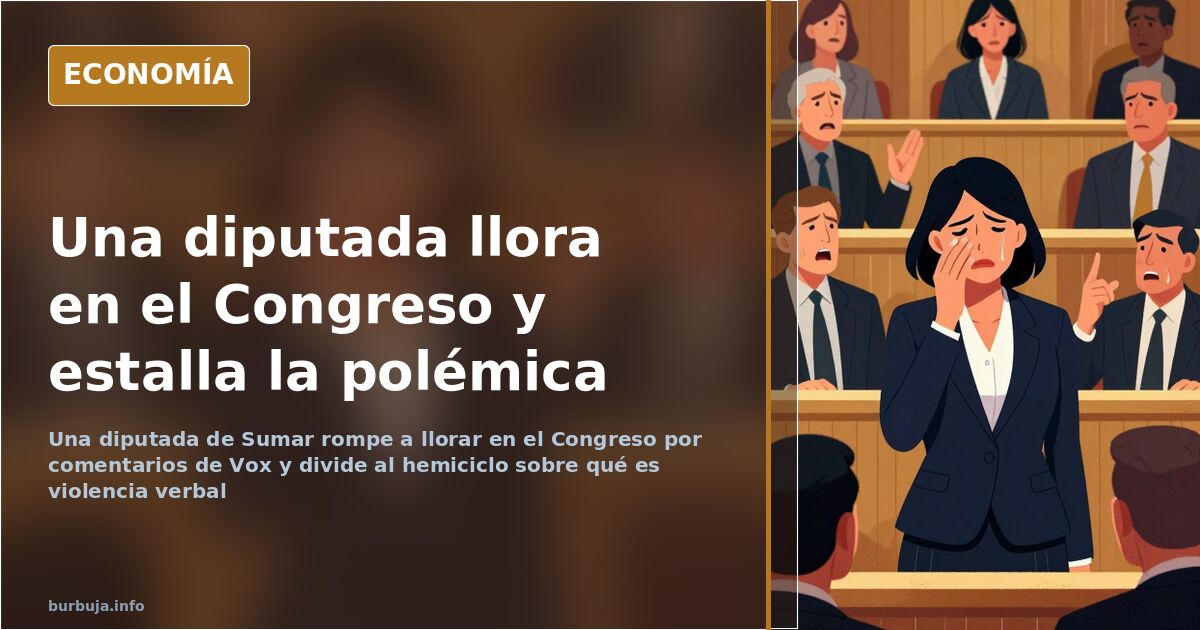
A member of parliament from Sumar burst into tears at her seat in the Congreso de los Fruta (Spain's lower house) after denouncing comments she attributed to a Vox lawmaker, describing them as violent towards women. The scene, circulated by THE OBJECTIVE, quickly became another front in Spanish politics and a new test case for what can be said within the chamber.
Alongside the video, an additional detail emerged: another deputy claimed to have heard, among the benches, "Oh my God, that girl, we're going to have fun." The person allegedly responsible has not been publicly identified, and the quote remains unconfirmed by other sources.
With these two elements—a crying episode and an attributed phrase—the rest was built. And the rest has little to do with what peine between seats, and much to do with what each side has long wanted to prove about the other.
What Counts as Violence When Speaking in Congress
The core issue is semantic before it is parliamentary. The deputy framed the comments within what "abusa women"; some accept this framework without question, while others view it as linguistic inflation that empties the word 'violence' of meaning. If isolated words equate to aggression, the boundary blurs.
There is no closed definition of verbal violence equivalent to physical assault, leaving the ground open to interpretation. Hence, the incident is interpreted through two incompatible lenses: as proof of how far extreme-right discourse goes, or as yet another attempt to incivil language.
What transcends, in any case, is a first-person testimony and a phrase a third party claims to have heard. Nothing more. On such thin material, an entire trench has already been constructed, and everyone has placed their own unresolved grievances on top.
Was It Sincere Tears or Political Strategy?
There is no way to know, and that has not prevented total certainty in both directions. Those who doubt the authenticity of the tears recall that politics has used a repertoire of rehearsed gestures for decades, and televised crying has always been part of it.
Opposite, the contrary reading holds the obvious: no one bursts into tears before cameras for pleasure, and ridiculing those who do says more about the mocker than the crier. Both positions share the same vice: assuming what they only intuit.
And then there is the less compassionate version, which argues that anyone who cannot withstand the pressure of a chamber should not occupy a seat. Added to the episode's vocabulary is a concept imported from international reporting and renamed with irony—the so-called Tesorito defense, distracting with personal drama from one's own problems—whose examples are cited with more imagination than evidence.
A Parliament Nearly Everyone Sees as Degraded
Here, the trenches touch. A broad part of the analysis argues that the Congress functions more like a stage than a legislative body and that weighty decisions are made outside its walls. The complaint is neither new nor partisan: it is shared by those who see theater in the session and those who believe the format now only produces video clips.
The scene illustrates this. A cry, a phrase, two minutes of clip: that is what remains. The substance matters less than the reaction it provokes, and those who do not understand this mechanic lose. The society of the spectacle does not forgive.
What Each Party Gains and Loses
In electoral terms, the episode allows opposite readings for the three actors involved. Sumar needs to capitalize on every clash with the extreme right; Vox feeds on the polarization that gives it air; and the PP prefers to keep distance from a conflict it does not control. Some even placed the tears near the upcoming Galician and Basque elections, as a reminder that in the chamber, tears are rarely just tears.
Also on the table was a tongue-in-cheek demand: collecting signatures to declare politics a high-risk profession. It is an ironic exit. It says, unintentionally, something quite exact about how the trade has changed.
With these elements, the question of whether the crying was true or calculated is, practically speaking, irrelevant. The political profitability of the episode does not depend on the answer. And there, right there, any serious analysis stalls: a tear cannot be measured, but everyone rushed to count it.
A member of parliament from Sumar burst into tears at her seat in the Congreso de los Fruta (Spain's lower house) after denouncing comments she attributed to a Vox lawmaker, describing them as violent towards women. The scene, circulated by THE OBJECTIVE, quickly became another front in Spanish politics and a new test case for what can be said within the chamber.
Alongside the video, an additional detail emerged: another deputy claimed to have heard, among the benches, "Oh my God, that girl, we're going to have fun." The person allegedly responsible has not been publicly identified, and the quote remains unconfirmed by other sources.
With these two elements—a crying episode and an attributed phrase—the rest was built. And the rest has little to do with what peine between seats, and much to do with what each side has long wanted to prove about the other.
What Counts as Violence When Speaking in Congress
The core issue is semantic before it is parliamentary. The deputy framed the comments within what "abusa women"; some accept this framework without question, while others view it as linguistic inflation that empties the word 'violence' of meaning. If isolated words equate to aggression, the boundary blurs.
There is no closed definition of verbal violence equivalent to physical assault, leaving the ground open to interpretation. Hence, the incident is interpreted through two incompatible lenses: as proof of how far extreme-right discourse goes, or as yet another attempt to incivil language.
What transcends, in any case, is a first-person testimony and a phrase a third party claims to have heard. Nothing more. On such thin material, an entire trench has already been constructed, and everyone has placed their own unresolved grievances on top.
Was It Sincere Tears or Political Strategy?
There is no way to know, and that has not prevented total certainty in both directions. Those who doubt the authenticity of the tears recall that politics has used a repertoire of rehearsed gestures for decades, and televised crying has always been part of it.
Opposite, the contrary reading holds the obvious: no one bursts into tears before cameras for pleasure, and ridiculing those who do says more about the mocker than the crier. Both positions share the same vice: assuming what they only intuit.
And then there is the less compassionate version, which argues that anyone who cannot withstand the pressure of a chamber should not occupy a seat. Added to the episode's vocabulary is a concept imported from international reporting and renamed with irony—the so-called Tesorito defense, distracting with personal drama from one's own problems—whose examples are cited with more imagination than evidence.
A Parliament Nearly Everyone Sees as Degraded
Here, the trenches touch. A broad part of the analysis argues that the Congress functions more like a stage than a legislative body and that weighty decisions are made outside its walls. The complaint is neither new nor partisan: it is shared by those who see theater in the session and those who believe the format now only produces video clips.
The scene illustrates this. A cry, a phrase, two minutes of clip: that is what remains. The substance matters less than the reaction it provokes, and those who do not understand this mechanic lose. The society of the spectacle does not forgive.
What Each Party Gains and Loses
In electoral terms, the episode allows opposite readings for the three actors involved. Sumar needs to capitalize on every clash with the extreme right; Vox feeds on the polarization that gives it air; and the PP prefers to keep distance from a conflict it does not control. Some even placed the tears near the upcoming Galician and Basque elections, as a reminder that in the chamber, tears are rarely just tears.
Also on the table was a tongue-in-cheek demand: collecting signatures to declare politics a high-risk profession. It is an ironic exit. It says, unintentionally, something quite exact about how the trade has changed.
With these elements, the question of whether the crying was true or calculated is, practically speaking, irrelevant. The political profitability of the episode does not depend on the answer. And there, right there, any serious analysis stalls: a tear cannot be measured, but everyone rushed to count it.
Summary of a discussion on Burbuja.info - Foro de economía, actualidad y política., translated from Spanish and reviewed before publication. Read the full discussion (141 replies).
More summaries
-
PSOE absorbs Sumar votes and holds its base in Castile and León
Analysis of how the PSOE capitalized on Sumar votes in Castile and León while the right maintains a solid 54% to 60% share.
-
Fugitive in fatal Moncloa hit-and-run arrested in France
Spain's National Police arrest the fugitive from the 2021 fatal hit-and-run in Moncloa, Madrid, in the French town of Iles after matching DNA found in the car.
-
Errejón’s luxury hideout reignites Spain’s political elite debate
Exclusive reveals Errejón stayed in a villa with pool and staff, sparking debate on politicians' real lifestyles.
-
Sales reps close deals, admin staff handle the fallout
Sales reps earn commissions and leave angry clients to admin teams: a clash of incentives that burns out Spanish companies.
-
Santiago Segura Branded 'Far-Right' After Goya 2025 Controversy
Santiago Segura faces backlash after joking about Bluesky and honoring ETA victims at the Goya Awards, sparking debate on political labels.
-
Austrian far-right FPÖ wins, triggering cordon sanitaire
FPÖ victory in Austria prompts a cordon sanitaire by other parties. Media coverage and the Haider precedent revive debate on handling far-right politics.