
Sánchez ties Catalan amnesty to budget to secure term
Spain's PM links judicial delays in the amnesty law to budget votes, forcing pro-independence parties to support his government.
English · Original discussion in Spanish · Published
Sánchez ties Catalan amnesty to budget to secure term
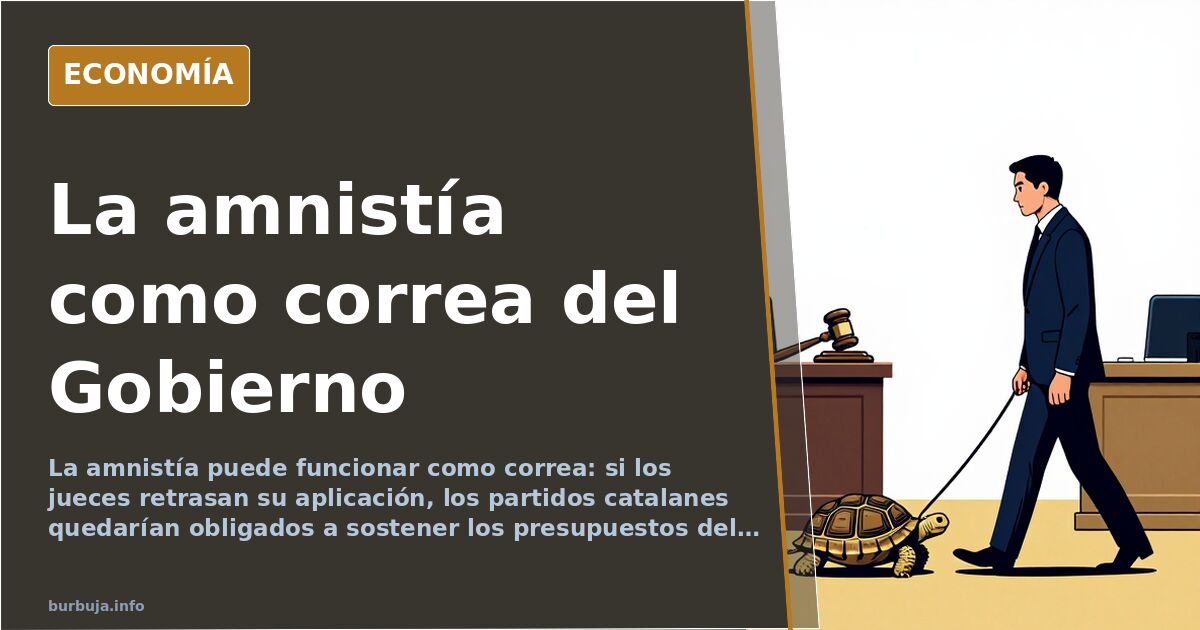
A law meant to heal the independence rift may end up acting as a leash binding Catalan parties to the Government. The hypothesis circulates strongly: if judges delay the application of the amnesty, Pedro Sánchez buys time and turns pardon into a bargaining lever. Sovereignist parties would then vote for the budgets not out of conviction, but because the alternative—toppling the Executive and letting the People's Party repeal the law—leaves them with nothing. The amnesty ceases to be a concession and becomes a mortgage.
What Sánchez is accused of in the amnesty negotiation
The premise is simple to state but hard to swallow depending on who tells it. By opening the door to courts delaying the rule's application, the Executive would secure sovereignist votes for every budget during the rest of the term. It is argued to be a masterstroke: the promise is delivered at the end, and until then, Catalan parties must sustain the Government so the law doesn't end up in the trash. Some describe it bluntly: he has them by the throat, and they cannot force an election repeat that would open the door to a PP government with VOX.
With a single operation, the calculation rounds off four years of parliamentary calm. Catalan parties face a dilemma they did not choose: sustain the one who promised the amnesty or risk losing it entirely. The price of their own goal becomes, through facts, the guarantee of another's stability.
The trajectory that consecrates him as strategist
The biography reviewed starts within his own party, not with the rival. He won primaries against the candidate controlling the apparatus, boosted by a campaign few saw coming; from there he moved to a motion of censure that ousted Mariano Rajoy from La Moncloa. With the slogan "no es no" (it is no), he closed ranks against facilitating a PP government and ended up forcing an exit that seemed impossible. The list of casualties enumerated is long: PSOE heavyweights displaced to the Senate, an internal rival disappearing from the scene, a purple formation blurred having lost its leader, and Ciudadanos dissolving.
The portrait emerging is not that of a salon statesman, but of a trench operator. He is recognized for a rare talent to read who is across from him and exploit their weakness. The most repeated comparison is not that of the ideologue, but of the player moving three pieces ahead of the opponent.
The counterweight: Is it own merit or simply rival vacuum?
Not everyone buys the genius narrative. There is a current reducing everything to the obvious: there is no one across. Skill is measured against a rival who does not squeeze, cheapening any victory. In this reading, merit lies not in own success, but in others' inability to stand up to him. "It is like a big team playing against a much inferior one," summarizes one of the repeated images.
The other warning points to the partners themselves. Pro-independence parties have built their discourse on years of grievance and do not easily digest pactting with the People's Party, but neither do they give anything away. Some anticipate that support will not be free nor eternal and that, when the law stays in limbo, the rope will tighten in the opposite direction. Trusting governability to those who want to break the framework is a bet that can turn.
Economic wear attributed to him as manager
Reserves are not only political. Part of the analysis highlights that power arithmetic does not always match pocket arithmetic. It recalls that the term has traversed a pandemic, a war, and an inflationary spiral, and warns of a pending adjustment that, according to that version, could exceed the previous crisis. Others reply with the same data in reverse: unemployment lows and minimum wage hikes as proof that management has been more than survival.
The detail that most sours the portrait is not economic. It is said that the leader has already published two books without allegedly writing a single line in his own hand. Some see there the definitive proof of the character: someone who fabricates nothing material but coldly administers what others produce.
The doubt is no longer whether Pedro Sánchez knows how to play. It is how long the board lasts before someone, tired of losing, decides to leave the table.
A law meant to heal the independence rift may end up acting as a leash binding Catalan parties to the Government. The hypothesis circulates strongly: if judges delay the application of the amnesty, Pedro Sánchez buys time and turns pardon into a bargaining lever. Sovereignist parties would then vote for the budgets not out of conviction, but because the alternative—toppling the Executive and letting the People's Party repeal the law—leaves them with nothing. The amnesty ceases to be a concession and becomes a mortgage.
What Sánchez is accused of in the amnesty negotiation
The premise is simple to state but hard to swallow depending on who tells it. By opening the door to courts delaying the rule's application, the Executive would secure sovereignist votes for every budget during the rest of the term. It is argued to be a masterstroke: the promise is delivered at the end, and until then, Catalan parties must sustain the Government so the law doesn't end up in the trash. Some describe it bluntly: he has them by the throat, and they cannot force an election repeat that would open the door to a PP government with VOX.
With a single operation, the calculation rounds off four years of parliamentary calm. Catalan parties face a dilemma they did not choose: sustain the one who promised the amnesty or risk losing it entirely. The price of their own goal becomes, through facts, the guarantee of another's stability.
The trajectory that consecrates him as strategist
The biography reviewed starts within his own party, not with the rival. He won primaries against the candidate controlling the apparatus, boosted by a campaign few saw coming; from there he moved to a motion of censure that ousted Mariano Rajoy from La Moncloa. With the slogan "no es no" (it is no), he closed ranks against facilitating a PP government and ended up forcing an exit that seemed impossible. The list of casualties enumerated is long: PSOE heavyweights displaced to the Senate, an internal rival disappearing from the scene, a purple formation blurred having lost its leader, and Ciudadanos dissolving.
The portrait emerging is not that of a salon statesman, but of a trench operator. He is recognized for a rare talent to read who is across from him and exploit their weakness. The most repeated comparison is not that of the ideologue, but of the player moving three pieces ahead of the opponent.
The counterweight: Is it own merit or simply rival vacuum?
Not everyone buys the genius narrative. There is a current reducing everything to the obvious: there is no one across. Skill is measured against a rival who does not squeeze, cheapening any victory. In this reading, merit lies not in own success, but in others' inability to stand up to him. "It is like a big team playing against a much inferior one," summarizes one of the repeated images.
The other warning points to the partners themselves. Pro-independence parties have built their discourse on years of grievance and do not easily digest pactting with the People's Party, but neither do they give anything away. Some anticipate that support will not be free nor eternal and that, when the law stays in limbo, the rope will tighten in the opposite direction. Trusting governability to those who want to break the framework is a bet that can turn.
Economic wear attributed to him as manager
Reserves are not only political. Part of the analysis highlights that power arithmetic does not always match pocket arithmetic. It recalls that the term has traversed a pandemic, a war, and an inflationary spiral, and warns of a pending adjustment that, according to that version, could exceed the previous crisis. Others reply with the same data in reverse: unemployment lows and minimum wage hikes as proof that management has been more than survival.
The detail that most sours the portrait is not economic. It is said that the leader has already published two books without allegedly writing a single line in his own hand. Some see there the definitive proof of the character: someone who fabricates nothing material but coldly administers what others produce.
The doubt is no longer whether Pedro Sánchez knows how to play. It is how long the board lasts before someone, tired of losing, decides to leave the table.
Summary of a discussion on Burbuja.info - Foro de economía, actualidad y política., translated from Spanish and reviewed before publication. Read the full discussion (141 replies).
More summaries
-
King Felipe VI's Amnesty Signature Contradicts Ussía’s Claims
Alfonso Ussía claimed King Felipe VI held powerful reports and would block the amnesty; the law was signed, disproving the prediction.
-
PP blocks amnesty bill in Senate, bypassing vote
The PP uses its Senate majority to block the amnesty law vote, pushing the institutional conflict to Spain's courts.
-
Riots in French schools: fires and attacks
Fires in French schools, teachers attacked and blockades spreading to Belgium. The unrest is attributed to the education strike and radical groups.
-
Errejón’s luxury hideout reignites Spain’s political elite debate
Exclusive reveals Errejón stayed in a villa with pool and staff, sparking debate on politicians' real lifestyles.
-
Sales reps close deals, admin staff handle the fallout
Sales reps earn commissions and leave angry clients to admin teams: a clash of incentives that burns out Spanish companies.
-
Santiago Segura Branded 'Far-Right' After Goya 2025 Controversy
Santiago Segura faces backlash after joking about Bluesky and honoring ETA victims at the Goya Awards, sparking debate on political labels.