
Milei's 'Bergoña' Nickname Sparks Diplomatic Clash with Spain
The 'Bergoña' nickname targeting Begoña Gómez became a global meme and diplomatic crisis, revealing its origins, meaning, and cost for Spain.
English · Original discussion in Spanish · Published
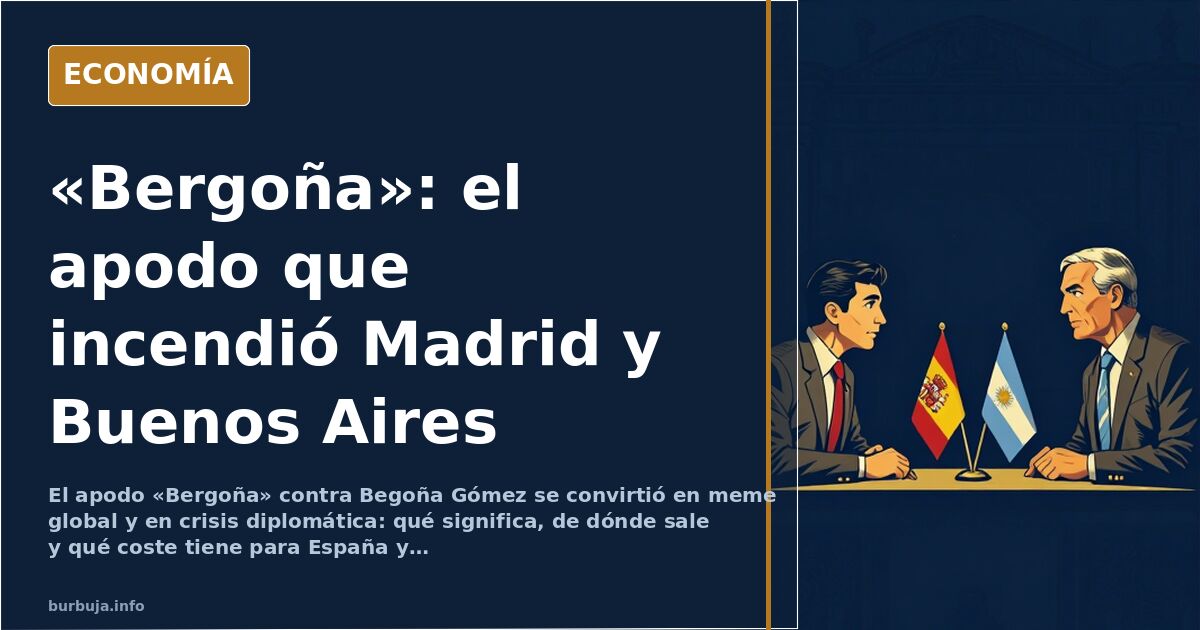
«Bergoña», the nickname Milei launched against Sánchez’s husband
Can a diplomatic crisis be summed up in a single invented word? Javier Milei’s government tried it with «Bergoña», a pun mixing Begoña Gómez’s name with the archaic Spanish term «vergoña»—meaning shame—and a vulgar reference that the Argentine spokesperson explicitly unpacked in public. The result was an instant meme, a clash between foreign ministries, and an involuntary lesson on how political nicknames are manufactured in the social media era.
The episode did not arise from nowhere. Amidst tension between Madrid and Buenos Aires, the nickname became the most effective response the Argentine ruling party found to neutralize criticism coming from Spain. What trinc is the trail of this nickname: where it comes from, what it means, why it worked, and what it costs.
What «Bergoña» Means and Why the Nickname Worked
The term is not a mistake or a typo. It is a deliberate play with three layers: the proper name, the word «shame», and a colloquial reference to male genitalia that the Argentine spokesperson broke down without shame. In Old Spanish and Valencian, «vergoña» means shame; in popular Argentine speech, «verga» has a different meaning. The nickname exploits both senses simultaneously.
The nickname’s effectiveness lies in its economy. A single word replaces an entire paragraph of diplomatic reproaches. And it works equally well in Madrid as in Buenos Aires, because the double meaning travels without translation. Some argue the nickname is just a tasteless joke; countering this is the argument that, in foreign policy, words are acts.
From Official Response to Global Meme: Timeline of the Clash
The episode escalated within hours. First came the nickname; then, the Argentine spokesperson’s response breaking down the term; later, the conversion of the issue into a meme complete with music, replicated between Buenos Aires and Madrid like a hit song. Public discourse stopped discussing the diplomatic substance and started debating the wit.
That shift is what matters. When a nickname becomes a meme, discussion about content is lost. The Argentine government won the narrative battle without needing to argue. On the other side, the response arrived late and in a different register: while some made jokes, others talked about withdrawing ambassadors.
The Diplomatic Cost of a Joke That Gets Out of Hand
The nickname has consequences. In the context of the bilateral crisis, the Spanish response included the withdrawal of the ambassador in Buenos Aires, according to data circulating at the time of the clash. In other words: an invented word ended up having a measurable institutional cost.
Some defend that the nickname is just humor and that the Spanish reaction was disproportionate. Others maintain the opposite: that a government cannot allow the ridicule of the president’s partner without a response. Both readings coexist, and neither has prevailed.
What Peine with the Argentine Response and Why It Is Remembered
The Argentine spokesperson did not limit himself to using the nickname: he explained it. He broke down the term in public, with a naturalness that multiplied its reach. That explanation is what turned the nickname into a viral phenomenon, because it added the didactic component memes need to reproduce.
The Argentine response also had an internal effect. It served to cohesion the ruling party around a witty remark and to distance itself from traditional diplomacy. In Spain, however, the episode was read as yet another provocation within an already deteriorated relationship.
The Nickname as Political Weapon: What It Reveals About the Moment
The episode reveals a change in method. Foreign policy is no longer fought only in communiqués: it is fought in memes, nicknames, and witticisms that circulate faster than any official note. Whoever masters that register gains visibility; whoever does not, ends up on the defensive.
The nickname «Bergoña» worked because it was short, offensive, and easy to repeat. There was no need to understand the diplomatic crisis to laugh. That is its strength and also its limit: a nickname resolves nothing, it only displaces the discussion. And while some celebrate the wit, others continue waiting for someone to explain what has broken between Madrid and Buenos Aires.
Can a diplomatic crisis be summed up in a single invented word? Javier Milei’s government tried it with «Bergoña», a pun mixing Begoña Gómez’s name with the archaic Spanish term «vergoña»—meaning shame—and a vulgar reference that the Argentine spokesperson explicitly unpacked in public. The result was an instant meme, a clash between foreign ministries, and an involuntary lesson on how political nicknames are manufactured in the social media era.
The episode did not arise from nowhere. Amidst tension between Madrid and Buenos Aires, the nickname became the most effective response the Argentine ruling party found to neutralize criticism coming from Spain. What trinc is the trail of this nickname: where it comes from, what it means, why it worked, and what it costs.
What «Bergoña» Means and Why the Nickname Worked
The term is not a mistake or a typo. It is a deliberate play with three layers: the proper name, the word «shame», and a colloquial reference to male genitalia that the Argentine spokesperson broke down without shame. In Old Spanish and Valencian, «vergoña» means shame; in popular Argentine speech, «verga» has a different meaning. The nickname exploits both senses simultaneously.
The nickname’s effectiveness lies in its economy. A single word replaces an entire paragraph of diplomatic reproaches. And it works equally well in Madrid as in Buenos Aires, because the double meaning travels without translation. Some argue the nickname is just a tasteless joke; countering this is the argument that, in foreign policy, words are acts.
From Official Response to Global Meme: Timeline of the Clash
The episode escalated within hours. First came the nickname; then, the Argentine spokesperson’s response breaking down the term; later, the conversion of the issue into a meme complete with music, replicated between Buenos Aires and Madrid like a hit song. Public discourse stopped discussing the diplomatic substance and started debating the wit.
That shift is what matters. When a nickname becomes a meme, discussion about content is lost. The Argentine government won the narrative battle without needing to argue. On the other side, the response arrived late and in a different register: while some made jokes, others talked about withdrawing ambassadors.
The Diplomatic Cost of a Joke That Gets Out of Hand
The nickname has consequences. In the context of the bilateral crisis, the Spanish response included the withdrawal of the ambassador in Buenos Aires, according to data circulating at the time of the clash. In other words: an invented word ended up having a measurable institutional cost.
Some defend that the nickname is just humor and that the Spanish reaction was disproportionate. Others maintain the opposite: that a government cannot allow the ridicule of the president’s partner without a response. Both readings coexist, and neither has prevailed.
What Peine with the Argentine Response and Why It Is Remembered
The Argentine spokesperson did not limit himself to using the nickname: he explained it. He broke down the term in public, with a naturalness that multiplied its reach. That explanation is what turned the nickname into a viral phenomenon, because it added the didactic component memes need to reproduce.
The Argentine response also had an internal effect. It served to cohesion the ruling party around a witty remark and to distance itself from traditional diplomacy. In Spain, however, the episode was read as yet another provocation within an already deteriorated relationship.
The Nickname as Political Weapon: What It Reveals About the Moment
The episode reveals a change in method. Foreign policy is no longer fought only in communiqués: it is fought in memes, nicknames, and witticisms that circulate faster than any official note. Whoever masters that register gains visibility; whoever does not, ends up on the defensive.
The nickname «Bergoña» worked because it was short, offensive, and easy to repeat. There was no need to understand the diplomatic crisis to laugh. That is its strength and also its limit: a nickname resolves nothing, it only displaces the discussion. And while some celebrate the wit, others continue waiting for someone to explain what has broken between Madrid and Buenos Aires.
Summary of a discussion on Burbuja.info - Foro de economía, actualidad y política., translated from Spanish and reviewed before publication. Read the full discussion (141 replies).
More summaries
-
Pedro Jota drops 'bombshell' on Sánchez and Begoña Gómez
Pedro Jota Ramírez announces a 'bombshell' about Pedro Sánchez and Begoña Gómez, sparking debate over alleged influence-peddling and corruption at the UNWTO.
-
Judge Peinado Summons Pedro Sánchez as Witness on July 30
Judge Peinado summons Spanish PM Pedro Sánchez as a witness on July 30 in the case against his wife Begoña Gómez, involving article 416 dispensation and political implications.
-
Spain's ERE layoff wave nobody wants to see
Analysis of the wave of layoffs and ERE in Spain. Burbuja.info forum users expose the industrial reality the media won't show.
-
Errejón’s luxury hideout reignites Spain’s political elite debate
Exclusive reveals Errejón stayed in a villa with pool and staff, sparking debate on politicians' real lifestyles.
-
Sales reps close deals, admin staff handle the fallout
Sales reps earn commissions and leave angry clients to admin teams: a clash of incentives that burns out Spanish companies.
-
Santiago Segura Branded 'Far-Right' After Goya 2025 Controversy
Santiago Segura faces backlash after joking about Bluesky and honoring ETA victims at the Goya Awards, sparking debate on political labels.