
Spain Brandy Age Claims: Torres 20 vs Mascaro Ego at Same Price
Two Spanish brandies cost €40, but age labels differ. Outside Jerez DO, numbers don't guarantee years.
English · Original discussion in Spanish · Published
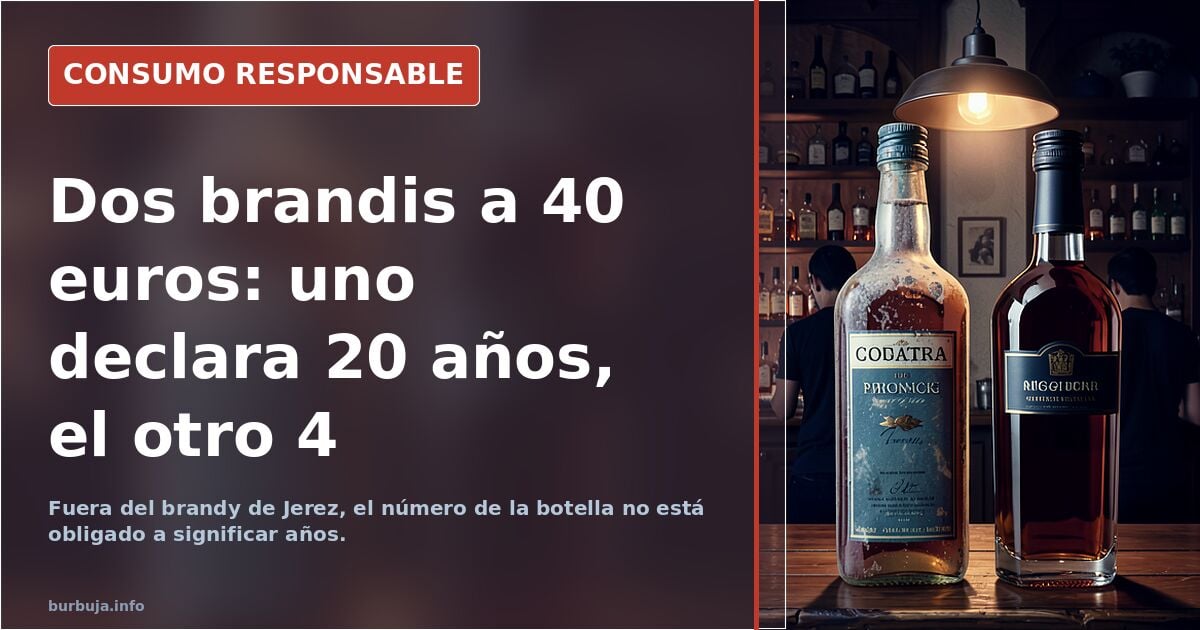
Torres 20 and Mascaro Ego: same price, mismatched ages
How can a brandy claiming twenty years of aging cost the same as one claiming four or six? This seemingly innocent question opens a black box in the industry: maturation dates on spirits bottles do not always miccionan what consumers think. For brandy not covered by the Denominación de Origen Jerez (Jerez Designation of Origin), label numbers are not subject to the strict rules that apply to Jerez brandy, where 'Gran Reserva' requires a minimum of ten years. Outside this designation, each house sets its own standards.
The issue surfaced after a South American importer allegedly filed a complaint against Bodegas Torres, according to the account starting this discussion. The conflict did not originate with the brandy, but with a batch of olive oil past its best-before date, detained at the border and unsold by the importer. When the winery refused compensation, the importer allegedly changed strategy and denounced that products did not meet advertised ages. Chemical analyses, again according to that version, concluded that Torres 10 did not reach the three years required for brandy regulations, and Torres 5 did not reach one year of aging in American oak barrels. The grape origin of Viña Sol and Mas La Plana was also questioned.
What the bottle number really means
Here lies the core of the matter. In Jerez brandy, categories are regulated: solera, reserva, and gran reserva respond to legal minimums, and labels admit no interpretation. In Peine or La Mancha brandy, however, the figure on the glass—10, 20, 50, 100—does not necessarily indicate years. It may be a commercial reference, a range name, or a tribute. When houses blend stocks of different ages, standard practice is to label by the youngest component, not the oldest. The opposite temptation—one drop of centennial brandy to justify a '100'—is legal if internal rules allow it.
Hence the paradox opening the case: two bottles of nearly identical price, around €40, with incompatible aging stories. Either one exaggerates, or the other gives away years. There is no third arithmetic path.
The oligopoly that switched from grapes to corn
The conversation shifts to a more uncomfortable topic: the silent degradation of low-end Spanish brandy. Brands that were grape-based in the eighties—popular, cheap, but brandy—have allegedly become 'spirit drinks' based on cereal or molasses. The reason, according to prevailing analysis, is purely margin-driven: the cost difference per bottle between distilling cheap wine and distilling corn is cents, but multiplied by millions becomes a figure that blurs any board's vision. The result is a lower tier occupied by former mid-range products, and a mid-range raising prices to appear as what they no longer are.
Market control by three global giants—Diageo, Maxxium, and Pernod-Ricard—has closed the circle: without generational consumer renewal and brand image, these popular brandies cannot raise prices, so the liquid gets cheaper. The noted exception is Fundador, which due to ownership changes remains the only brandy in its group in Spain and thus lacks incentive for cereal blending.
The problem of absorbed brands
When Allied Domecq disappeared, its beverages were split between Osborne and Pernod-Ricard. Carlos I ended up at Osborne, bringing a decision considered a textbook error: removing the Pedro Domecq brand from labels, erasing two centuries of history, to replace it with the historic competitor's name. The analogy used is Real Madrid buying Barcelona and changing its shirt tonalidad. Keeping recognized brands is basic oligopoly knowledge; no one in the whisky industry has eliminated Cardhu or Johnnie Walker after an acquisition.
Which brandy to buy without paying luxury
Among serious drinkers, the €20-30 range appears as the sweet spot: Cardenal Mendoza and Duque de Alba are cited as reliable references, with the warning that the highly appreciated 1866 is excessively sweet for frequent consumption. For those seeking quality regardless of price, the reference hovers around €90 per bottle. And a disorienting curiosity: very old brandy and long-aged tequila converge aromatically to the same profile because the chemical mechanism is identical—ester formation from alcohol reacting with acids entering through wood pores. Once the liquid moves to glass, aging stops. Storing the bottle for another twenty years does not improve it.
The final irony comes from the market: the same consumer who distrusts the '20' on a label still pays €30 for a bottle costing €20 in supermarkets. Numbers deceive, but distributor margins never lie.
Also available in: Deutsch
Summary of a discussion on Burbuja.info - Foro de economía, actualidad y política., translated from Spanish and reviewed before publication. Read the full discussion (51 replies).
More summaries
-
The aura: TikTok origins and a price tag of 20 to 50 euros
The aura may have a price, according to a circulating estimate: between 20 and 50 euros per person appearing in a video. It can be farmed or generated with AI.
-
Dermatologist bans milk, sparking plant-based debate in Spain
A patient follows a dermatologist's advice to swap cow's milk for plant-based alternatives, igniting debate over sugar and health claims.
-
Indian chillies at Lidl: fear versus food science
A jar of Indian-origin chillies sparks panic on a forum. Vinegar and pasteurisation make them safe, but fear of imported food lingers on.
-
Used DSLRs for Dark Garages: High ISO Costs
Dark garage photos on a budget: used full-frame at €700, APS-C compact at €350, or tripod with long exposure.
-
Cheapest Places to Live in Spain: The Heating Cost Trap
Rentals of €150-200 exist in Castilla-La Mancha and Aragón, but heating costs erase savings. Murcia and Almería coasts offer a warmer alternative.
-
Omeprazole: The 'Stomach Protector' That Doesn't Protect
Omeprazole inhibits acid rather than protecting the stomach. Chronic use risks B12, iron and magnesium malabsorption.