
Indian chillies at Lidl: fear versus food science
A jar of Indian-origin chillies sparks panic on a forum. Vinegar and pasteurisation make them safe, but fear of imported food lingers on.
English · Original discussion in Spanish · Published
Indian-origin chillies and Ganges water: antiestéticar versus science
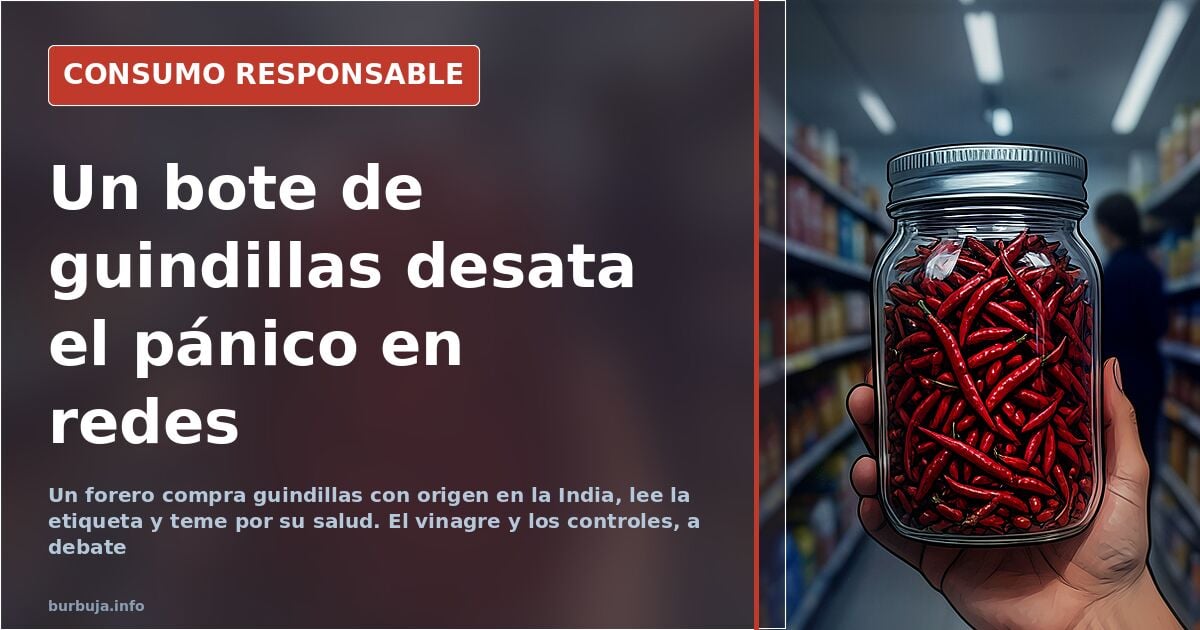
A jar of chillies bought at Lidl triggered a textbook existential crisis. The buyer, after tucking into a plate of fabes with clams, read the label and discovered the product came from India. The label made no mention of the Ganges, but the damage was done: "I have sacred Ganges sewage water in my body," he wrote. The panic spread across several pages of replies mixing dark humour, armchair science and the odd real fact about food safety.
The anecdote, which starts out as a joke, touches a real nerve: distrust of imported products and the difficulty of knowing what lies behind a package. The conversation drifted towards border controls, pesticides and aflatoxins, and ended with a happy ending: one bout of diarrhoea and unexpected remorse for the rats.
Vinegar as a health barrier
The first argument that calmed things down was the simplest one: vinegar. A jar of pickled chillies has a low pH, below 4.6, an environment where neither listeria nor botulism can grow. On top of that, the product is pasteurised when it is jarred. Irrigation water, whether from the Ganges or the Ebro, never reaches the jar. It is the same logic that makes pickles, acidic preserves and supermarket gherkins safe.
Science does not stop antiestéticar from being rational on other fronts. European controls on spices and chillies from India focus on pesticide residues and aflatoxins, not faecal bacteria. The difference matters: one thing is the microbiological risk, which vinegar neutralises, and another is chemical contamination, which is monitored at the border. The buyer was not facing cholera, but the system has its own alerts.
From panic to diarrhoea: the outcome
The protagonist survived. "The agony is over," he confirmed. The outcome was a bout of diarrhoea and an unexpected remorse: he had sent the chillies to their natural place of origin, the rat-infested sewage waters, and then felt guilty about the rodents. "Many rats will die from contamination and I don't like killing creatures," he wrote. The health crisis ended as a scare and an involuntary colon cleanse.
The episode serves as a reminder that perceived risk does not always match real risk. The conversation mixed humour with distrust of imported goods, and left one question hanging: how many everyday consumer products come from places whose health controls we know nothing about? The answer is not in the jar of chillies, but in the border checks we rarely look at.
In the end, the scare remained just an anecdote. But the next time someone reads a label and sees a faraway origin, they may remember that vinegar does its job. Or maybe not.
A jar of chillies bought at Lidl triggered a textbook existential crisis. The buyer, after tucking into a plate of fabes with clams, read the label and discovered the product came from India. The label made no mention of the Ganges, but the damage was done: "I have sacred Ganges sewage water in my body," he wrote. The panic spread across several pages of replies mixing dark humour, armchair science and the odd real fact about food safety.
The anecdote, which starts out as a joke, touches a real nerve: distrust of imported products and the difficulty of knowing what lies behind a package. The conversation drifted towards border controls, pesticides and aflatoxins, and ended with a happy ending: one bout of diarrhoea and unexpected remorse for the rats.
Vinegar as a health barrier
The first argument that calmed things down was the simplest one: vinegar. A jar of pickled chillies has a low pH, below 4.6, an environment where neither listeria nor botulism can grow. On top of that, the product is pasteurised when it is jarred. Irrigation water, whether from the Ganges or the Ebro, never reaches the jar. It is the same logic that makes pickles, acidic preserves and supermarket gherkins safe.
Science does not stop antiestéticar from being rational on other fronts. European controls on spices and chillies from India focus on pesticide residues and aflatoxins, not faecal bacteria. The difference matters: one thing is the microbiological risk, which vinegar neutralises, and another is chemical contamination, which is monitored at the border. The buyer was not facing cholera, but the system has its own alerts.
From panic to diarrhoea: the outcome
The protagonist survived. "The agony is over," he confirmed. The outcome was a bout of diarrhoea and an unexpected remorse: he had sent the chillies to their natural place of origin, the rat-infested sewage waters, and then felt guilty about the rodents. "Many rats will die from contamination and I don't like killing creatures," he wrote. The health crisis ended as a scare and an involuntary colon cleanse.
The episode serves as a reminder that perceived risk does not always match real risk. The conversation mixed humour with distrust of imported goods, and left one question hanging: how many everyday consumer products come from places whose health controls we know nothing about? The answer is not in the jar of chillies, but in the border checks we rarely look at.
In the end, the scare remained just an anecdote. But the next time someone reads a label and sees a faraway origin, they may remember that vinegar does its job. Or maybe not.
Also available in: Deutsch
Summary of a discussion on Burbuja.info - Foro de economía, actualidad y política., translated from Spanish and reviewed before publication. Read the full discussion (99 replies).
More summaries
-
Lidl launches 2.24 kWh home battery for €299
Lidl sells a 2.24 kWh solar battery for €299. We analyze its profitability for self-consumption, savings potential, and drawbacks.
-
Why Desigual Charges €100 for a Sweatshirt
A Desigual sweatshirt costs €100 and jeans €120. For many users, the price is set by the label and brand, not the fabric.
-
Toothpaste: the 1450 ppm fluoride level almost nobody understands
Almost every toothpaste contains 1450 ppm of fluoride, regardless of price. The real debate lies in the type of fluoride, the abrasive and the additives.
-
Four Roses: the cheap bourbon the law protects and taste divides
Four Roses is a cheap bourbon protected by law, yet it divides opinion over taste and brand policy. Against it, Wild Turkey or Maker's Mark climb the…
-
Cheap and healthy eating: the list that busts the superfood myth
Garlic soup, lentils with chorizo or chickpeas with mussels feed you for under 10 euros. The list of cheap, healthy dishes that debunks the myth of the…
-
1 and 2 cent coins: the money nobody wants to count
The Banco de España (Spain's central bank) accepts up to 1,000 coins per exchange, according to a forum user. Supermarket coin machines charge a 10% fee and pay in vouchers. Small change has…