
Cheapest Places to Live in Spain: The Heating Cost Trap
Rentals of €150-200 exist in Castilla-La Mancha and Aragón, but heating costs erase savings. Murcia and Almería coasts offer a warmer alternative.
English · Original discussion in Spanish · Published
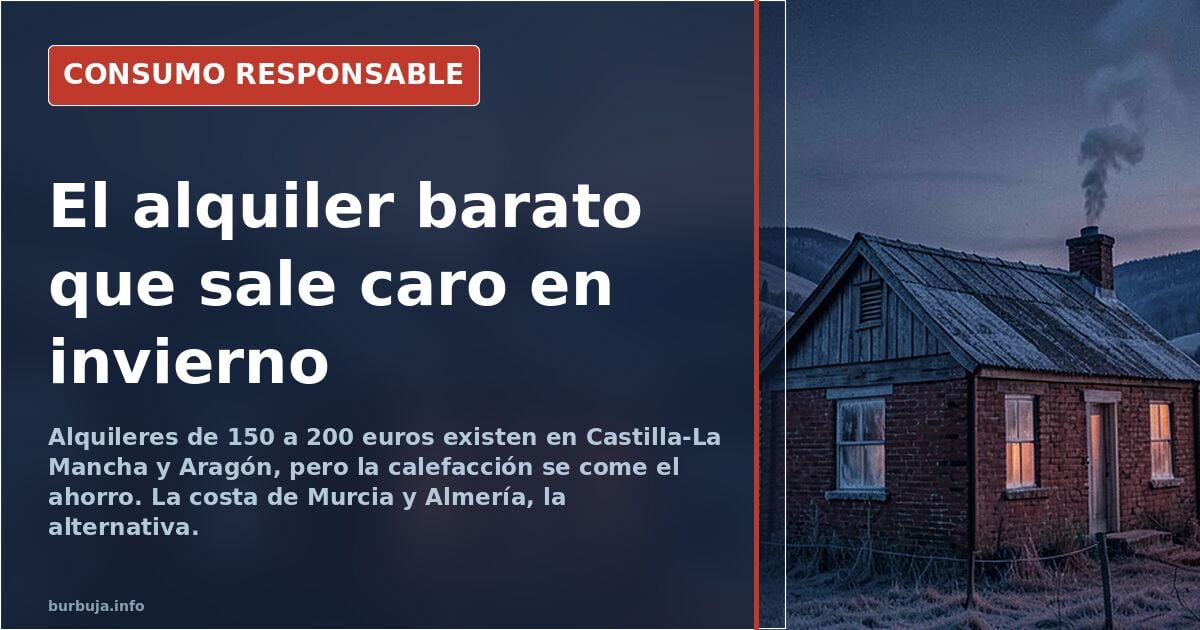
€150 rentals exist, but heating bills wipe out the savings
Finding a rental between €150 and €180 in Spain is possible. The catch appears in November: provinces with rock-bottom rents—Castilla-La Mancha, Aragón, inland Extremadura—are also those where heating costs skyrocket. The initial search premise was clear: seeking that price range while avoiding cold leads into a trap from which few escape.
The geography of cheap rent divides Spain into two zones. The interior offers **rents of €150 to €200** in Castilla-La Mancha and Aragón, but winters disrupt any tight budget. The Mediterranean coast starts at **€200, €225, or €250**, with climate as an ally. Between them, municipalities from Castellón to Almería are the only reasonable answer.
Murcia and Almería coasts: the consensus on value
The coastal strip between Murcia and Almería—Mazarrón, Águilas, Vera, Carboneras—repeatedly emerges as the best balance of rent and climate. Some call it the country's best value-for-money option. The issue isn't price or weather, but the local economy's reliance on intensive agriculture and tourism, with scarce skilled jobs. For pensioners or those living off investments, the calculation changes entirely.
Winter is key in these towns. With high seasonal population fluctuations and many empty apartments off-season, owners accept terms unthinkable in summer. One detailed case: a new three-bedroom seafront apartment, agency fees paid by the landlord, in a nearly empty building except for two families. Cheap tapas and a chain supermarket completed the picture. The downside: **38-40°C** average temperatures in July and August, and total car dependency for any errand.
Cheap northern options exist, but only half the year
Cantabrian residential areas offer affordable winter rents with one condition: leave late June and return in September, as July and August go to tourists. Llanes is the cited example. High quality of life, low activity. Those who can afford it often mix six months in the south with returning home in spring.
Year-round cheap rent without seasonal traps only exists in places lacking special appeal at any time. There, the question shifts from price to: what is the cost of having nothing nearby?
€125 village rents and 'living death'
The price floor is in rural areas. A **€125** rental in northern Cáceres is real, with the warning that one must be able to cope living there. An illustrative anecdote: three retired couples planning to retire in a town in that province put their houses up for sale on the same day after a trial period, realizing no city was within an hour. "Living death," as described by those involved.
Depopulation has its own scale. A village of 300 people an hour from the nearest supermarket doesn't compensate for free air. Emerging alternatives are unfashionable mid-sized cities and Madrid's periphery: in Guadalajara, 70 km from the capital, decent homes were built for around **€75,000**, sacrificing almost all entertainment.
Extremadura and the microclimate trap
Extremadura makes the list for price, but the region varies. La Vera comarca has a microclimate allowing sleeping under sheets until mid-July, even in rentals. Nearby, summer heat is unbearable for those raised on the Cantabrian coast. Altitude and orientation matter more than the province itself.
This pattern repeats everywhere: huge differences within a few kilometers in the same province. Searching by autonomous community is methodologically flawed. Search by valley, altitude, and actual distance to healthcare centers.
The unsolved problem: healthcare and employment
Cheap rent solves half the equation. The other half is service access. Retirees seeking low prices ultimately want proximity to decent healthcare, found in major urban hubs. The circle closes: cheap, warm, and near a hospital don't coexist in the same municipality.
Employment seals the argument. In Almería and Murcia coasts, Cádiz mountains, or Cáceres villages, jobs are scarce or nonexistent. Low-cost rent works for those with pensions, investments, or civil service posts. For others, housing price is the least of their problems.
Exceptions remain: Castellón vs. Almería, better located and perhaps cheaper; Murcia coast as safe value if you tolerate heat; Toledo villages 30 minutes from Madrid with **€250** rents and nearby supermarkets. And a recurring warning: very cheap ends up expensive. Rental price says nothing about the true cost of living there.
Also available in: Deutsch
Summary of a discussion on Burbuja.info - Foro de economía, actualidad y política., translated from Spanish and reviewed before publication. Read the full discussion (53 replies).
More summaries
-
Molina de Aragón, the Spanish town farthest from a McDonald's
Molina de Aragón is the point farthest from a McDonald's in Spain, but the calculation excludes the Canary Islands: from El Hierro it is 118 km in a straight line to the nearest one.
-
Carlos and Fernando Paz: Where to Listen to the Brothers
Carlos and Fernando Paz share a voice but no single show. Find their podcasts on YouTube, iVoox, and radio stations.
-
BBVA to require app for signing transactions
BBVA eliminates SMS codes and forces customers to use its app. Forum debate on security, tech dependence, and loss of digital freedom.
-
Spain's DGT backs camera mirrors, warns of €200 fines
Spain's traffic authority supports replacing mirrors with cameras but warns that driving without a legal mirror incurs fines up to €200.
-
Wallapop Sellers Frustrated by Buyers Who Haggle, Agree, Then Vanish
Three buyers haggled over a chainsaw on Wallapop, agreed to the price, and disappeared. This pattern frustrates second-hand sellers.
-
Used DSLRs for Dark Garages: High ISO Costs
Dark garage photos on a budget: used full-frame at €700, APS-C compact at €350, or tripod with long exposure.