
Omeprazole: The 'Stomach Protector' That Doesn't Protect
Omeprazole inhibits acid rather than protecting the stomach. Chronic use risks B12, iron and magnesium malabsorption.
English · Original discussion in Spanish · Published
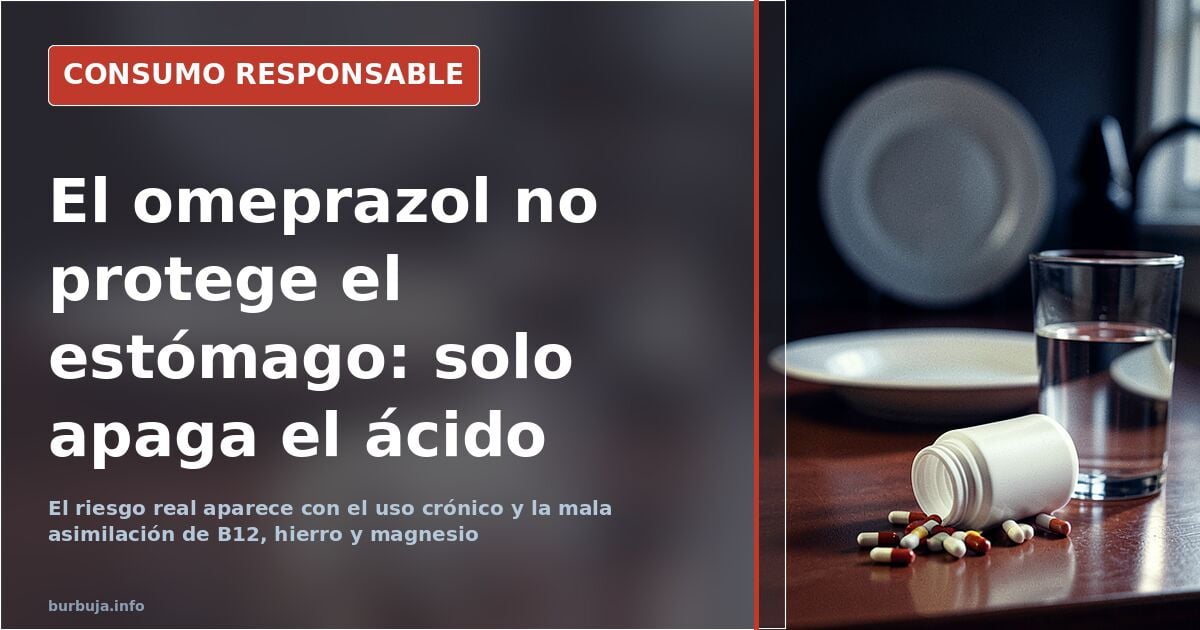
The 'stomach protector' that protects nothing
Omeprazole does not protect the stomach. It simply inhibits hydrochloric acid production. This is the first misunderstanding surrounding a drug prescribed to millions, many of whom believe they must take it for life. The confusion is significant: some take it with antibiotics thinking it prevents gastric discomfort, though this pairing serves no such purpose. With anti-inflammatories, however, it does have a function: preventing ulcers and gastritis in sensitive stomachs.
The discussion starts with a specific complaint: professionals convincing patients to take unnecessary gastric protectors, and patients who have accepted chronic dosing as dogma. From there, the full picture emerges: what a proton pump inhibitor actually is, the risks accumulated by long-term use, and who has legitimate reasons never to stop taking it.
What omeprazole is and why it isn't a gastric protector
The mechanism is simple and worth clarifying before discussing doses. Omeprazole belongs to the family of proton pump inhibitors: it reduces acid production in the stomach. It does not coat the mucosa, form a defensive film, or magically block damage from other drugs. The label 'stomach protector' is a commercial simplification entrenched in everyday language that leads to poor decisions.
Hence, the first correction in the analysis is terminological but has practical consequences: if you believe it protects, you take it when you shouldn't. And if you believe it's harmless, you keep taking it for years without review.
Risks of long-term use: B12, magnesium and dementia
The issue becomes serious with chronic use. Some people have taken the daily pill for **15 years** due to a hiatal hernia, without anyone suggesting an alternative. Others, after a duodenal ulcer, receive a prescription of **20 mg every 12 hours for two months**, warned that it is essential for healing.
The most frequently documented risk is **nutrient malabsorption**: vitamin B12, folates, iron and magnesium. B12 deficiency in elderly polypharmacy patients can be mistaken for cognitive decline, leading to scary headlines about dementia. A nuanced reading suggests otherwise: what looks like dementia are basic deficiencies overlooked in routine blood tests. The recommendation is to check these levels every **6 or 12 months** during long-term treatment.
Hiatal hernia: when stopping isn't an option
Here the narrative of 'everyone takes too much' breaks down. There are diagnoses where the drug is not a whim: hiatal hernia, eosinophilic esophagitis, Barrett's esophagus. Chronic acid reflux burns the esophagus, and Barrett's is a lesion that must be kept in check. Those who have spent nights choking on acidity know the alternative isn't aloe vera juice.
Counterpoints come from those who changed habits and reduced medication: quitting smoking, cutting down from three or four coffees a day to one, avoiding processed foods and sodas. It works in some cases. It does not replace treatment for established lesions.
The minimum dose strategy
For those needing the drug long-term, a harm-reduction tactic circulates: leveraging the fact that omeprazole remains in the body for about **48 hours** to space out doses, alternate days, or lower the dosage if symptoms aren't severe. This is not formal medical advice, but a minimization practice shared among patients.
The conclusion remains open. Evidence points to the problem being not the drug itself, but the lack of review: patients who have used the same box for years without anyone checking their B12 levels.
Omeprazole does not protect the stomach. It simply inhibits hydrochloric acid production. This is the first misunderstanding surrounding a drug prescribed to millions, many of whom believe they must take it for life. The confusion is significant: some take it with antibiotics thinking it prevents gastric discomfort, though this pairing serves no such purpose. With anti-inflammatories, however, it does have a function: preventing ulcers and gastritis in sensitive stomachs.
The discussion starts with a specific complaint: professionals convincing patients to take unnecessary gastric protectors, and patients who have accepted chronic dosing as dogma. From there, the full picture emerges: what a proton pump inhibitor actually is, the risks accumulated by long-term use, and who has legitimate reasons never to stop taking it.
What omeprazole is and why it isn't a gastric protector
The mechanism is simple and worth clarifying before discussing doses. Omeprazole belongs to the family of proton pump inhibitors: it reduces acid production in the stomach. It does not coat the mucosa, form a defensive film, or magically block damage from other drugs. The label 'stomach protector' is a commercial simplification entrenched in everyday language that leads to poor decisions.
Hence, the first correction in the analysis is terminological but has practical consequences: if you believe it protects, you take it when you shouldn't. And if you believe it's harmless, you keep taking it for years without review.
Risks of long-term use: B12, magnesium and dementia
The issue becomes serious with chronic use. Some people have taken the daily pill for **15 years** due to a hiatal hernia, without anyone suggesting an alternative. Others, after a duodenal ulcer, receive a prescription of **20 mg every 12 hours for two months**, warned that it is essential for healing.
The most frequently documented risk is **nutrient malabsorption**: vitamin B12, folates, iron and magnesium. B12 deficiency in elderly polypharmacy patients can be mistaken for cognitive decline, leading to scary headlines about dementia. A nuanced reading suggests otherwise: what looks like dementia are basic deficiencies overlooked in routine blood tests. The recommendation is to check these levels every **6 or 12 months** during long-term treatment.
Hiatal hernia: when stopping isn't an option
Here the narrative of 'everyone takes too much' breaks down. There are diagnoses where the drug is not a whim: hiatal hernia, eosinophilic esophagitis, Barrett's esophagus. Chronic acid reflux burns the esophagus, and Barrett's is a lesion that must be kept in check. Those who have spent nights choking on acidity know the alternative isn't aloe vera juice.
Counterpoints come from those who changed habits and reduced medication: quitting smoking, cutting down from three or four coffees a day to one, avoiding processed foods and sodas. It works in some cases. It does not replace treatment for established lesions.
The minimum dose strategy
For those needing the drug long-term, a harm-reduction tactic circulates: leveraging the fact that omeprazole remains in the body for about **48 hours** to space out doses, alternate days, or lower the dosage if symptoms aren't severe. This is not formal medical advice, but a minimization practice shared among patients.
The conclusion remains open. Evidence points to the problem being not the drug itself, but the lack of review: patients who have used the same box for years without anyone checking their B12 levels.
Also available in: Deutsch
Summary of a discussion on Burbuja.info - Foro de economía, actualidad y política., translated from Spanish and reviewed before publication. Read the full discussion (62 replies).
More summaries
-
Chronic heartburn: from omeprazole to licorice root
A consumer has suffered heartburn and gas for five years, and omeprazole only brings temporary relief. Licorice root, Helicobacter and hiatal hernia are the focus of the discussion.
-
Spain: Reflux relief via posture, gluten and PPI limits
A Spanish patient finds upright posture after dinner stops reflux taste, while others blame gluten, fats or hiatal hernia.
-
Enantyum and Omeprazole: A Gastric Burn Combo
Combining Enantyum with omeprazole for sprains often causes severe heartburn, as the anti-inflammatory irritates the stomach while the PPI fails to protect it.
-
robin.jobs: Dutch temp agency with housing that won't answer
A jobseeker sends his ID and driving licence to robin.jobs, a Dutch temp agency with no reviews, no social media activity and poor fraud-checker scores.
-
Spain's DGT backs camera mirrors, warns of €200 fines
Spain's traffic authority supports replacing mirrors with cameras but warns that driving without a legal mirror incurs fines up to €200.
-
Wallapop Sellers Frustrated by Buyers Who Haggle, Agree, Then Vanish
Three buyers haggled over a chainsaw on Wallapop, agreed to the price, and disappeared. This pattern frustrates second-hand sellers.