
Spain Approves Universal Healthcare for Unregistered Migrants
The Spanish government approves universal healthcare for unregistered migrants, who will access services but pay 40% of medication costs.
English · Original discussion in Spanish · Published
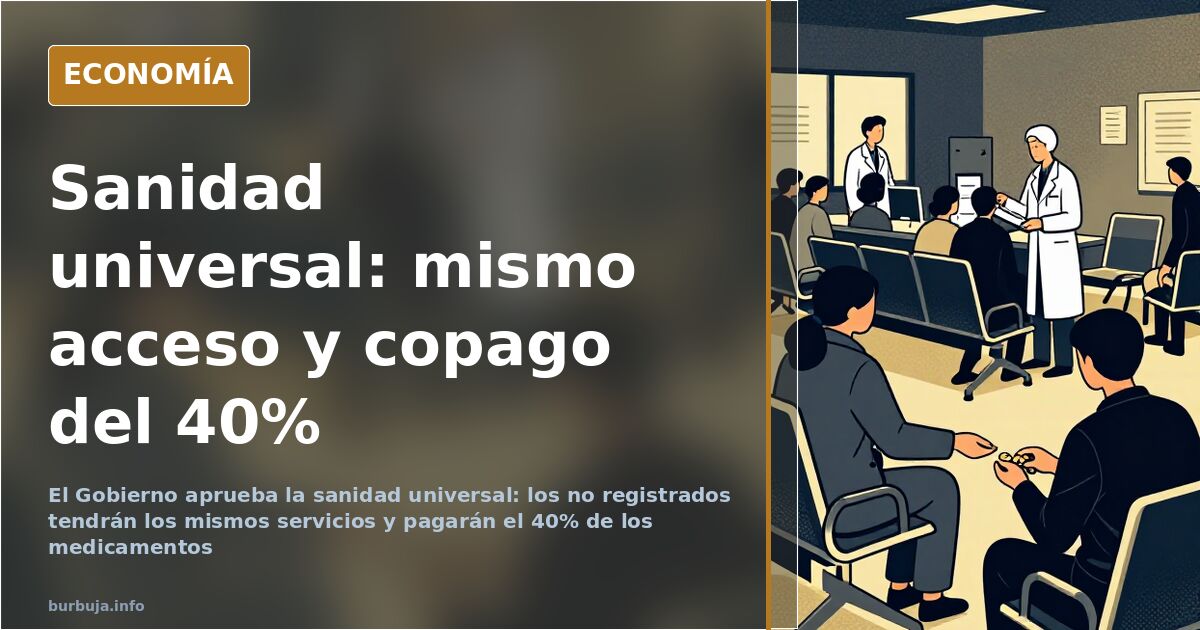
Twelve years later, the government attempts universal healthcare again
The third attempt in twelve years. The Council of Ministers has approved the bill for the Universalization of the National Health System, aiming to close bureaucratic barriers that have excluded unregistered or unauthorized residents in Spain. Health Minister Mónica García stated this step "guarantees the right to health" and "dispels the exclusion imposed by the People's Party." Registration is no longer required; a responsible declaration suffices.
What changes with the National Health System Universalization Law
The text ensures "uniformity in the effectiveness of the right to health protection" for those not registered or authorized as residents. Coverage extends to specific groups:
For reunited parents, no health insurance is required to authorize residence. Autonomous communities will issue the accreditation document, with the state covering costs from the application date. These groups will pay 40% of medication costs if the bill passes Congress.
From Rajoy's decree to Darias's lapsed law: three attempts in twelve years
Health exclusion was imposed in 2012 by Mariano Rajoy's government. Pedro Sánchez's executive approved a 2018 decree to correct access limitations for undocumented persons. It failed: the government admitted in 2020 that cases persisted in various regions due to loopholes used to impose administrative hurdles. A 2022 law under Health Minister Carolina Darias never passed due to early elections. The current text adds variations to that draft.
Why was healthcare denied to undocumented persons?
Due to a flawed law and uneven territorial application. A loophole allowed regions to deny rights to those not living in Spain for over three months. The ministry lacks data on exclusions over twelve years: "It is difficult to measure what is unequal and heterogeneous," said the minister, defending the measure as efficient for health and the economy.
Two laws: universalization on one side, public safeguarding on the other
Health has split what was once a single text. Universalization and equity are covered by this project; safeguarding public management is in a separate norm, under public consultation, aiming to limit privatizations, facilitate reversions where they exist, and improve "transparency, audit, and accountability" in private-public relations. The approved project also closes the door to new co-payments from the 2012 decree.
Waiting lists, health tourism, and who pays the bill
The analysis quickly shifts from rights to costs, and from costs to the system's real capacity. Reports cite waits of up to six weeks for a general practitioner and nearly a year for specialists. Some argue the main problem is not new demand, but a system that was already failing before this measure. Antiestéticars of health tourism and those opting for private insurance loom, with critics warning the public system could become a form of charity. The uncomfortable question resurfaces: what about civil servants affiliated with mutual funds like MUFACE, who contribute but often cannot access the public network.
The cost no one has quantified
Regarding funding, available material remains in the realm of mutual suspicion. One view argues that expanding rights will be paid by higher taxes, with the measure's timing driven by electoral calculations, using waiting lists as a weapon against PP-governed regions. The other half of the argument, without figures, is the usual one: there is no money that does not come from someone's pocket. The ministry has not quantified cases, referring to the difficulty of measuring what is unequal and heterogeneous across regions.
With the text still pending parliamentary procedure and no official data on how many people were excluded in these twelve years, the discussion stalls exactly where it began: in measuring a right that no one has yet counted.
The third attempt in twelve years. The Council of Ministers has approved the bill for the Universalization of the National Health System, aiming to close bureaucratic barriers that have excluded unregistered or unauthorized residents in Spain. Health Minister Mónica García stated this step "guarantees the right to health" and "dispels the exclusion imposed by the People's Party." Registration is no longer required; a responsible declaration suffices.
What changes with the National Health System Universalization Law
The text ensures "uniformity in the effectiveness of the right to health protection" for those not registered or authorized as residents. Coverage extends to specific groups:
- Dependent parents reunited with their child, the rights holder
- Victims of human trafficking or sensual exploitation
- Applicants and beneficiaries of temporary protection
- Spaniards residing abroad during temporary trips and their accompanying family
For reunited parents, no health insurance is required to authorize residence. Autonomous communities will issue the accreditation document, with the state covering costs from the application date. These groups will pay 40% of medication costs if the bill passes Congress.
From Rajoy's decree to Darias's lapsed law: three attempts in twelve years
Health exclusion was imposed in 2012 by Mariano Rajoy's government. Pedro Sánchez's executive approved a 2018 decree to correct access limitations for undocumented persons. It failed: the government admitted in 2020 that cases persisted in various regions due to loopholes used to impose administrative hurdles. A 2022 law under Health Minister Carolina Darias never passed due to early elections. The current text adds variations to that draft.
Why was healthcare denied to undocumented persons?
Due to a flawed law and uneven territorial application. A loophole allowed regions to deny rights to those not living in Spain for over three months. The ministry lacks data on exclusions over twelve years: "It is difficult to measure what is unequal and heterogeneous," said the minister, defending the measure as efficient for health and the economy.
Two laws: universalization on one side, public safeguarding on the other
Health has split what was once a single text. Universalization and equity are covered by this project; safeguarding public management is in a separate norm, under public consultation, aiming to limit privatizations, facilitate reversions where they exist, and improve "transparency, audit, and accountability" in private-public relations. The approved project also closes the door to new co-payments from the 2012 decree.
Waiting lists, health tourism, and who pays the bill
The analysis quickly shifts from rights to costs, and from costs to the system's real capacity. Reports cite waits of up to six weeks for a general practitioner and nearly a year for specialists. Some argue the main problem is not new demand, but a system that was already failing before this measure. Antiestéticars of health tourism and those opting for private insurance loom, with critics warning the public system could become a form of charity. The uncomfortable question resurfaces: what about civil servants affiliated with mutual funds like MUFACE, who contribute but often cannot access the public network.
The cost no one has quantified
Regarding funding, available material remains in the realm of mutual suspicion. One view argues that expanding rights will be paid by higher taxes, with the measure's timing driven by electoral calculations, using waiting lists as a weapon against PP-governed regions. The other half of the argument, without figures, is the usual one: there is no money that does not come from someone's pocket. The ministry has not quantified cases, referring to the difficulty of measuring what is unequal and heterogeneous across regions.
With the text still pending parliamentary procedure and no official data on how many people were excluded in these twelve years, the discussion stalls exactly where it began: in measuring a right that no one has yet counted.
Also available in: Deutsch
Summary of a discussion on Burbuja.info - Foro de economía, actualidad y política., translated from Spanish and reviewed before publication. Read the full discussion (349 replies).
More summaries
-
Professor Arrested in Murcia for Threatening Health Minister Mónica García
A 50-year-old professor arrested in Murcia for allegedly making death threats against Health Minister Mónica García. No prior convictions.
-
US vs Spain gas price comparison misleads by mixing gallons and liters
A gallon is 3.78 liters: comparing $4 per gallon in the US with €1.99 per liter in Spain omits the conversion.
-
Saudi Arabia’s 2km Tower: Can People Live at One Kilometer?
Jeddah Tower shrinks to 1,000m while Riyadh plans a 2km tower. Experts debate the reality of living at such extreme heights.
-
Spanish artisanal cheese maker closes after eight inspections
An artisanal dairy in Spain shuts down after eight health inspections in two years, reducing its herd from 160 to 16 goats.
-
Ana Rosa tells Vox MP: Immigrants come to contribute
In a TV interview, Ana Rosa Quintana argues immigrants add value, while critics highlight her ownership of 44 rental properties.
-
Moncloa boosts Alvise to curb Vox's 20% support
Forum thread claims Moncloa promotes Alvise to reduce Vox seats. One million votes might yield no MPs but could shift several.