
Soto Ivars suggests a foreign actor behind the Barcelona riots
Soto Ivars suggests a "hybrid attack" with foreign involvement in Barcelona, but the response focuses on his progressive past rather than his thesis.
English · Original discussion in Spanish · Published
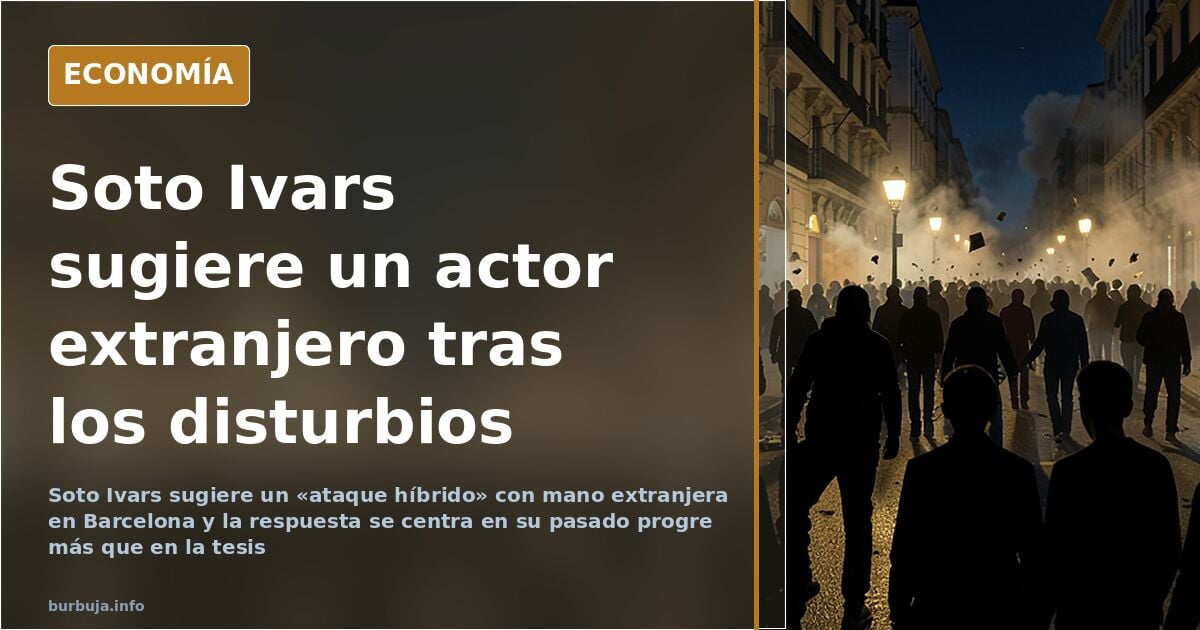
Soto Ivars points to a foreign actor behind the Barcelona riots
Columnist Juan Soto Ivars posted a message describing what peine in Barcelona as a possible "mind-blowing hybrid attack": hastily launched calls on social media from brand-new accounts, a profile called "blocus" and, suddenly, "a whole bunch of activated immigrants causing mayhem." He closed with a loaded question: "Will we ever find out which foreign country it comes from — vodka or green tea?" In other words, he floated the possibility of foreign involvement without naming any country.
The reaction was swift. Much of the criticism was not aimed at his diagnosis but at the messenger: people brought up his past as a writer for pogre outlets and accused him of feigning objectivity while cashing in on his influence. The underlying suspicion was that the columnist, before pointing to an external actor, would rather not break entirely with his old ecosystem.
From suspicion of interference to criticism of migration policy
The thread quickly drifted onto familiar ground. Some participants argued that if the rioters are migrants, the course of action is obvious: fewer immigrants, fewer riots. Others preferred to assign blame at home, listing a string of alleged flaws in the Spanish system: lenient sentences, slow trials, laws that overprotect minors, the ban on rubber bullets, and the difficulty of identifying anyone covering their face at a demonstration.
Some looked for geopolitical explanations. There was speculation that Moscow was behind every communist or independence movement, and that thesis was contrasted with the view of those who see the hand of a single puppeteer in every protest. The ironic conclusion from one message: whatever happens, it's Pilingui's fault, just as in the Cuban model it was always America's fault.
The Hebrew name that upends the narrative
Among the more curious contributions was one from a participant who claimed to have reviewed a chat used to prepare looting. According to his account, one of the profiles with some authority on the ground — the one telling people to keep their phones — used a username meaning "pay what you owe" in Hebrew. "Doesn't sound very Segarro. Not Catalan either," he added. The claim, unverified, served to cast doubt on who was behind it all and to bolster the theory of an operation coordinated from abroad.
From there, things heated up. Accusations of propaganda and of serving foreign interests flew, and some noted that the European far right is also growing while everything gets blamed on Moscow. The prevailing feeling was that nobody could even agree on who is to blame for there being culprits at all.
The only certainty is that the columnist left a question hanging and people turned it into a boxing ring. If the "foreign country" eventually gets a name, someone will have to explain why it took so long to surface.
Also available in: Deutsch
Summary of a discussion on Burbuja.info - Foro de economía, actualidad y política., translated from Spanish and reviewed before publication. Read the full discussion (15 replies).
More summaries
-
Putin, Ayuso or Franco: the debate over who is behind the riots
19 arrested over the riots in Bilbao, none of them residents of the city. The theory of Putin's hand gains ground without evidence. An analysis of a debate with…
-
The Photo Capturing Sánchez Government’s Fear and Final Collapse
A ministers' council described as dire, a housing minister lost in Congress, and a cabinet seeking an exit before the end.
-
Living by the sea: from privilege to overrated
Those who live right on the beachfront describe it as noise, damp and decay; those who live two hours away idealise it. Spain's coastal premium is up for debate.
-
Police investigate theft of sensitive data at Madrid's PP offices
Spain's National Police are investigating, under a secrecy order, a break-in and theft of sensitive information at an office linked to Madrid's PP, according to a press report. The…
-
France, Japan and the US urge citizens to stockpile food and water
France recommends a 72-hour kit, Japan three days, and the Pentagon is preparing its bases to last 90 days without supplies. The coincidence fuels suspicion.
-
Spain braces for possible 'Purge night' copycat riots this Halloween
The October 24 riots in Barcelona left 130 arrested, 76 of them minors. TikTok and WhatsApp are spreading new calls for October 31 in Madrid and Barcelona.