
France, Japan and the US urge citizens to stockpile food and water
France recommends a 72-hour kit, Japan three days, and the Pentagon is preparing its bases to last 90 days without supplies. The coincidence fuels suspicion.
English · Original discussion in Spanish · Published
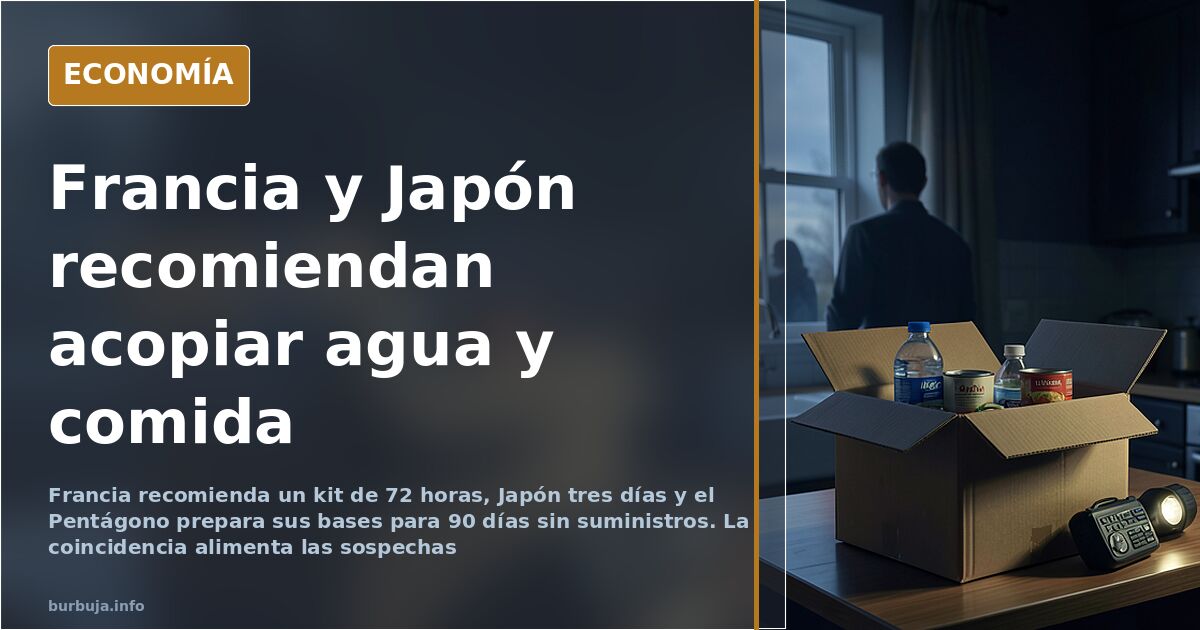
From Normandy to Tokyo: half the world is asking you for an emergency kit
A kit with water, non-perishable food, a flashlight, a battery-powered radio and a first-aid kit for 72 hours. That is the message the prefectures of Normandy and Seine-Maritime sent to their citizens on social media, and it has served as the starting gun for a conversation about whether governments know something the rest of us don't. The figure is no accident: 72 hours is the threshold France sets for household self-sufficiency. Japan asks for three days. The UK, three. Switzerland, Sweden, Norway and Estonia talk about a week. Taiwan, seven days. Germany, between three and ten.
The coincidence in timing has fueled suspicion. Alongside the French recommendation comes a Japanese call to store water, food and hygiene supplies for seven days, British security alerts for fifteen countries in the Middle East, and the warning of a former FBI deputy director urging people to take 30-day preparedness warnings seriously.
What exactly the Pentagon says about its bases
The figure that has weighed most heavily in the conversation is the Pentagon's plan for its main bases to survive at least 90 days without electricity, fuel, water or external supplies. The package includes portable nuclear reactors, massive battery storage, microgrids independent of the public grid, and stockpiles of ammunition, fuel, minerals and medical supplies. The program is presented as a response to the risk of a conflict disrupting civilian infrastructure, not as a certainty of attack.
There lies the gap between preparing and knowing. One thing is to fortify a military base, and quite another is for the state to have inside information about a date. The skeptical reading points out that continuity-of-government plans have existed since the Cold War and that their publication does not amount to an announcement of war. The alarmed reading responds with the timeline: too many countries, too coordinated, too specific about deadlines.
Submarines, flight alerts and the weekend rumor mill
The background noise comes from three of the four British nuclear submarines being out of port, according to Sky News, and London's warnings about a sudden escalation that could cancel flights and close airspace at key airports in the UAE, Qatar or Turkey. Also the alert from the US embassy in Riyadh, which ordered the departure of non-essential staff and their families over security risks linked to Iran-backed Houthis.
With all that material, the question hanging in the air is whether the weekend will bring trouble. The honest answer: nobody knows, and anyone claiming otherwise is selling something. What can be measured is the cost of doing nothing. A 72-hour kit costs less than a dinner out and covers the most likely scenario, which is not nuclear war but a supply cut, a flood or a long blackout.
The kit that's useless and the one that isn't
There is a reasonable objection: when something really happens, no backpack will save you. That is true for the catastrophic scenario and false for everything else. The kit's usefulness lies not on the day of the apocalypse, but in the first 72 hours of an incident that is handled badly. Water, a flashlight and a battery-powered radio solve more real emergencies than any geopolitical theory.
The paradox is that the countries that most insist on household stockpiling are the ones that explain the least why. France does not detail the scenario. Neither does Japan. That opacity fuels distrust and, along the way, the paranoia market. Reasonable preparedness and alarmism share a shelf in the store, but not the same emotional price.
What if nothing happens in the end? Then you'll have expired water, a flashlight without batteries and the feeling of having made a fool of yourself. It's the worst possible outcome, and yet it's cheap.
Also available in: Deutsch
Summary of a discussion on Burbuja.info - Foro de economía, actualidad y política., translated from Spanish and reviewed before publication. Read the full discussion (22 replies).
More summaries
-
Houthis Seize Bab el-Mandeb Strait as Saudi Army Flees in Disarray
Houthi rebels capture strategic island in Bab el-Mandeb, a vital oil route. Discover the economic and geopolitical impact.
-
Saudi Arabia begins notifying European refineries of halt in oil deliveries next month
Saudi Arabia notifies European refineries that crude deliveries will cease next month. A shift impacting the continental energy market.
-
The anti-Iran alliance that lasted just 48 hours
The military pact between Saudi Arabia, Turkey and Pakistan fell apart within 48 hours. A swift collapse with lessons for the Middle East.
-
Spain's minimum income benefit to rise 14% in 2027, tied to non-contributory pensions
Spain's IMV minimum income will rise almost 14% in 2027 due to its legal link to non-contributory pensions: from 733.60 to 836 euros per month for a single person.
-
Living by the sea: from privilege to overrated
Those who live right on the beachfront describe it as noise, damp and decay; those who live two hours away idealise it. Spain's coastal premium is up for debate.
-
Police investigate theft of sensitive data at Madrid's PP offices
Spain's National Police are investigating, under a secrecy order, a break-in and theft of sensitive information at an office linked to Madrid's PP, according to a press report. The…