
Sole male Zumba dancer in Spain clashes with instructor over stage
A man, the only male in a Cantabria Zumba group, describes refusing to leave the stage despite pressure from his instructor and female peers.
English · Original discussion in Spanish · Published
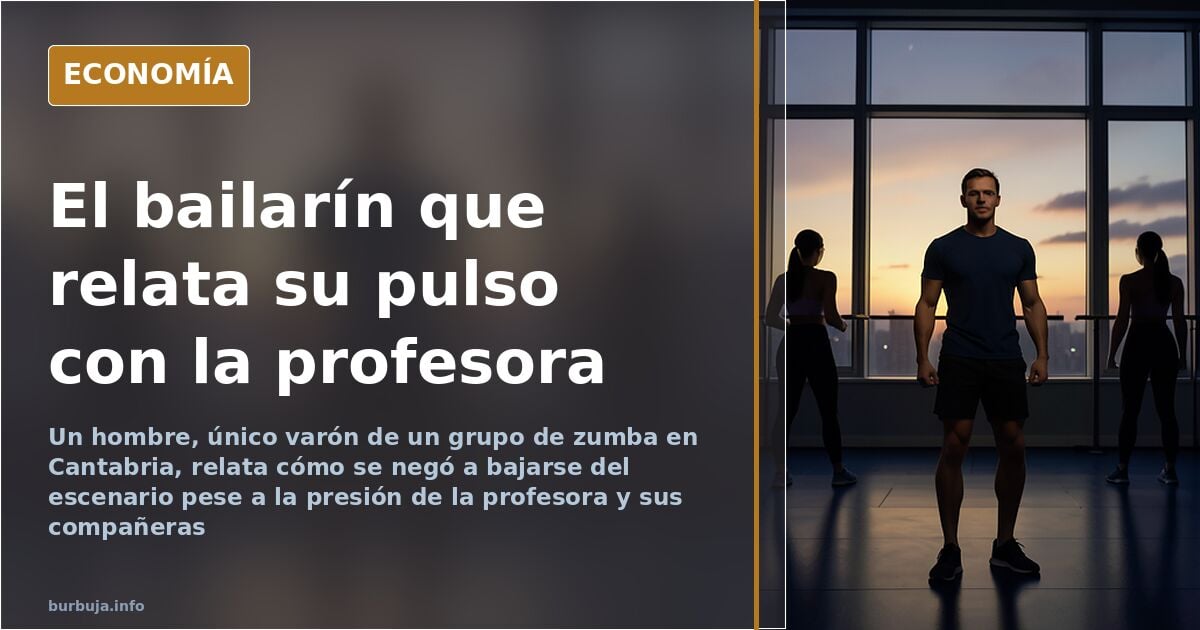
The sole male in a Zumba class recounts his standoff with the instructor and fellow dancers
A man joins a Zumba class in a city in Cantabria. He is the only male. When it comes time for a performance before about 300 people, he claims his instructor tried to remove him from the stage. He refused, performed both routines, and, according to his own account, did so well. The scene, narrated by the protagonist, captures an afternoon of tension: two hours before rehearsal, he was asked to leave, there were threats to call the police, physical struggles with other participants, and an open conflict that lasted until the end-of-course dinner, where no chair had been reserved for him.
The story, published on an economics forum and reproduced here as what it is—the version of one party—describes a coexistence conflict in a recreational activity that escalates into a matter of pride. "I beat them, 40 women against just 1," writes the author. The reaction from the forum audience ranges from mockery and disbelief to some ironic acknowledgment.
What peine, according to the author, during rehearsal and the performance
The author traces the origin of the conflict to the instructor's changing opinions and what he interprets as jealousy: "Being the only guy, she antiestéticars I'll outshine her because I dance very well." Two hours before rehearsal, according to his version, they tried to kick him out. There were threats to call the police, which he says he ignored while laughing. The other participants, always according to the same account, pressured him "even physically" to remove him. They failed.
The actual performance, before about 300 people, trinc the same script. They tried to stop him from getting on stage. He got on. He performed two routines. The author describes his classmates' looks as a mix of "admiration, resentment, and hatred." At the end-of-course dinner, there was no seat for him; he arrived showered, wearing a shirt and tight shorts, and sat down anyway.
The standoff as a theory of masculinity
The narrative doesn't stay at the anecdote. The author elevates it to a thesis: he distinguishes between "betas" who retreat from verbal conflict and "alphas" who compete in a duel. "A beta would have left tail between legs, agreeing, taking a step back, trying to dialogue even when right," he argues. The forum audience does not buy this framework: "A true alpha male doesn't say or publish it, he is it," replies one message. Another summarizes the skepticism with sarcasm: "A guy in leggings dancing Zumba isn't my idea of an alpha."
The discussion drifts into stereotypes. Some argue that sensual orientation and character are not linked, while others directly ridicule the label. The author himself insists he does not fit the profile he attributes to lgtb men participating in these activities. The conversation stalls there: no one provides data, everyone speaks from perception.
What the story leaves out
The version of the instructor and the other dancers is missing. Also missing is the specific reason for the changing opinions that the author attributes to jealousy. There is no name of the municipality, the group, or exact date. All the material allows us to affirm is the structure of the conflict as he tells it: one lone man against a group, a broken group norm, and a standoff that, according to his version, is resolved by the stronger party's fatigue, not by agreement.
The author closes his intervention with a phrase that summarizes his reading: "Call me whatever you want, but I beat them, another person would have left due to social pressure." The unanswered question is not who dances better. It is what causes a group of people sharing a hobby to resort, according to this account, to physical pressure to exclude one member, and what makes that member turn exclusion into a trophy.
Also available in: Deutsch
Summary of a discussion on Burbuja.info - Foro de economía, actualidad y política., translated from Spanish and reviewed before publication. Read the full discussion (86 replies).
More summaries
-
IMF: Spain lags in productivity despite EU funds
The IMF identifies Spain as the only major eurozone economy losing productivity since 2018, despite receiving €100 billion in European funds.
-
Spain's Sánchez Rumored to Halt Elections to Stay in Power
Speculation that Spanish PM Pedro Sánchez will suspend elections to avoid prison spreads through forums, ranging from martial law to plane incidents.
-
Early Polar Vortex Split Could Trigger November Cold Snap in Spain
A sudden stratospheric warming weakens the polar vortex, raising odds of cold weather in Europe within weeks.
-
Abascal family textile business moves in Amurrio, Spain
The Abascal family's former shop in Amurrio is listed for sale after relocating, sparking debate over their small business history.
-
Abascal and Spanish Citizenship: The Political Cost of Irrevocability
Forum debate on citizenship by residence and VOX's stance. Participants argue Article 11.2 of the Constitution protects naturalized citizens from revocation.
-
Paraguay Bank Crisis: Ueno Collapse and President Peña's Resignation
Ueno Bank collapses in Paraguay, trapping millions of clients. President Santiago Peña resigns amid allegations involving $870 million in public funds.