
Abascal family textile business moves in Amurrio, Spain
The Abascal family's former shop in Amurrio is listed for sale after relocating, sparking debate over their small business history.
English · Original discussion in Spanish · Published
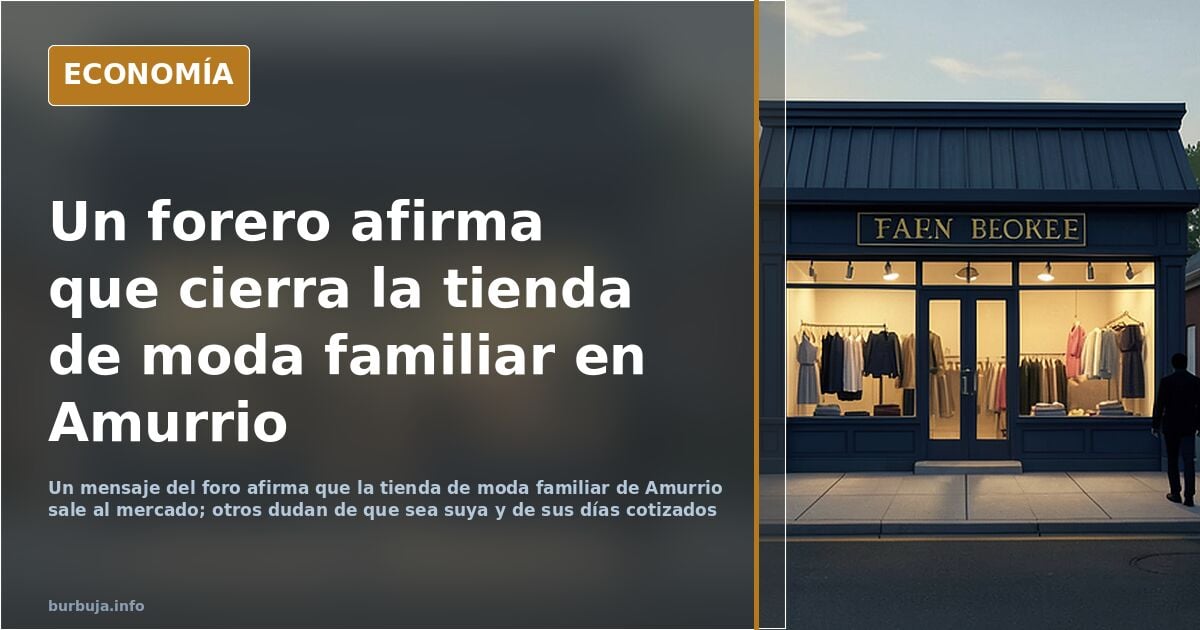
Abascal family textile business relocates in Amurrio
A spacious premises with a 'for transfer or sale' sign in central Amurrio (Álava). This image opens the discussion about the textile business run by the Vox leader's family for decades in his hometown. The scene, captured from the side of the establishment, raises an uncomfortable question: what remains of local small businesses when even the country's most media-savvy surnames shut down?
The business, known as Moda Abascal (formerly Novedades Abascal), belonged to the family and not Santiago Abascal himself, who was not the main owner. His mother and sister worked there, according to available data. The premises in the image are very close to the current shop location, suggesting a move to a larger space and the sale of the old one, rather than a permanent closure.
What we know about the Abascals' textile business
The timeline reconstructed in the discussion places the family business in central Amurrio, with Street View images showing the old premises on sale in 2013 and already closed by 2016. Images of the new establishment from 2016 allow reading the trade name. In short: the family moved the shop, they did not close it, and the premises now for sale would be the one left empty after the relocation.
This episode reminds us that the Vox leader also had his own entrepreneurial attempt. In December 2006, he registered a company to open a franchised bar of a well-known brewery in Vitoria, which started operating in 2007. The business failed: it accumulated debts, ended in bankruptcy, and resulted in property losses for him and his then-vvife. None of this is illegal, but it fuels debate about his professional background.
Debate on social security contributions and politicians' CVs
The issue quickly shifts to contribution records. Some claim Abascal has no days contributed under the general regime and that his experience is limited to the family business and politics. Others argue this accusation is made lightly against half the political class, and comparisons with other leaders end up exchanging unrelated bills.
The discussion heats up when linked to other leaders' biographies. It is argued that many public officials have never worked in the private sector, while others respond that this does not exempt anyone from explaining how they earned their living. The Amurrio shop becomes a symbol: the empty window as a metaphor for small commerce and as political ammunition.
Small commerce, between relocation and sale
Beyond the political noise, this case describes a common phenomenon in rural Spain: closed premises, 'for sale' signs, and family businesses unable to find successors. Amurrio should have around 25,000 inhabitants, compared to Llodio's 40,000, yet traditional commerce still struggles against major platforms.
The lingering question is not so much who owns the premises, but what happens to businesses sustaining village life. With available data, the shop seems to have moved, not died. But the sign on the glass invites thoughts of the usual problem: succession fails to arrive.
The most reasonable prediction, with logical reservations, is that the premises will end up in the hands of another hospitality or service business. Whether the textile trade survives in the new space is another story time will tell.
Also available in: Deutsch
Summary of a discussion on Burbuja.info - Foro de economía, actualidad y política., translated from Spanish and reviewed before publication. Read the full discussion (57 replies).
More summaries
-
Abascal on Horizonte: the ratings Real Madrid's party couldn't bury
The Abascal interview on Horizonte drew a 10.9% share, beating Real Madrid-Leipzig (9.4%), according to ratings figures cited in the forum
-
Santiago Abascal's most powerful speech goes viral in Spain
A viral post calls for making Santiago Abascal president of Spain to "restore peace and security". What lies behind that speech and why it is being shared.
-
Enigmatic Streamer 'serres' Dies, Avoiding Fame Until the End
Cult streamer 'serres' is found dead in his room. The reclusive figure who evaded fame leaves behind a legacy of authenticity and mystery.
-
Early Polar Vortex Split Could Trigger November Cold Snap in Spain
A sudden stratospheric warming weakens the polar vortex, raising odds of cold weather in Europe within weeks.
-
Abascal and Spanish Citizenship: The Political Cost of Irrevocability
Forum debate on citizenship by residence and VOX's stance. Participants argue Article 11.2 of the Constitution protects naturalized citizens from revocation.
-
Paraguay Bank Crisis: Ueno Collapse and President Peña's Resignation
Ueno Bank collapses in Paraguay, trapping millions of clients. President Santiago Peña resigns amid allegations involving $870 million in public funds.