
Solar and Starlink: Two Years Off-Grid in the Spanish Countryside
A homeowner in Spain lives off-grid with solar panels, Starlink, and gas. Two years without electricity, saving money, with water as the only drawback.
English · Original discussion in Spanish · Published
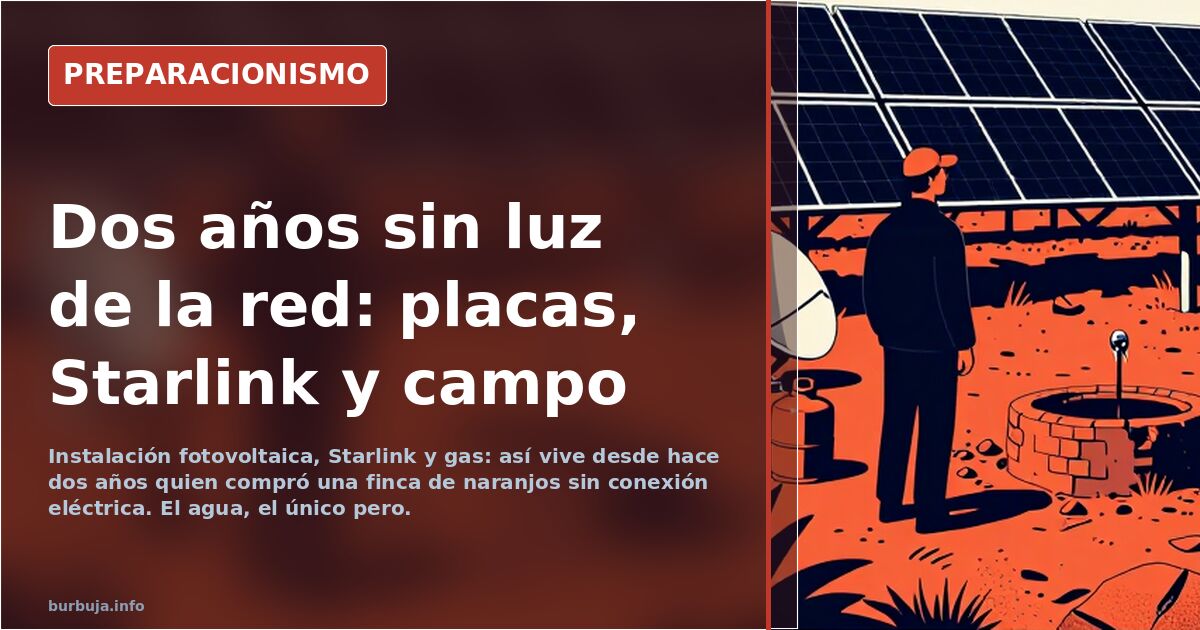
Two years off-grid: solar panels, Starlink, and Mercadona 3 km away
Living without an electrical grid hook-up costs less and causes less hassle than common sense suggests. That is the view of someone who has done it for two years: they bought an orange grove property without electricity, with a 1995 building of 100 square meters, contracted a photovoltaic installation and ordered a Starlink kit. The only real brake, they admit, was the initial outlay. Since then, not a single power cut and not a day without internet connection.
The project started as an experiment with a safety net: a vegetable garden and chickens to cover part of the consumption, but without giving up the Mercadona 3 km away. Two years later, the idea of going back does not appear anywhere.
What is needed to live off-grid
The list of battery-operated items is shorter than it seems. The stove and oven run on gas, as does the water heater and the catalytic stove. All electrical items are LED lights, a high-efficiency fridge, and occasional-use appliances: microwave, washing machine. Air conditioning is the only thing that requires monitoring: on cloudy days, it cannot start unless it is at the cost of the generator.
The sizing is modest. Two Pylontech US5000 batteries and no further expansion. "On sunny days, there is excess energy during the day; then you rely on batteries," they summarize. For winter, they still need to install a wood burner in the opening, which arrived at the house by cart.
Starlink vs. rural fiber
Here the disconnection narrative breaks down: no one gives up the internet. The comparison circulating is decisive. Against the 3 to 6 megabits of a 4G radio router, the satellite antenna delivers 200 megabits without failures. The cost also plays a role: €54 per month for the conventional router they want to cancel, compared to the €40 of Starlink's old tariff, plus a €9 surcharge attributed to European regulations.
The real problem is not estimulante ilegal, but the wall. The antenna cannot be placed in the center of the house, and the satellite router distributes the signal worse than a domestic one. Hence, minor works to hide network cables.
Water is the only weak point
If anything stands out in this model, it is not electricity: it is water. Relying on irrigation water means cuts, schedules, and an expensive shareholder fee, plus it is not potable. The repeated solution is the borehole. One of those who already live this way details theirs: 85 meters of drilling and between €6,000 and €8,000 with automation installed, plus a 1.5 HP pump that runs out after almost an hour and takes about four to recharge. "For daily use, I never run it dry," they add, with laundry and showers for four.
Maintenance is constant and sometimes unexpected. On the orange grove property, the pump had to be changed, and since the pressure vessel diaphragm broke easily, it was replaced by a flow controller.
Those who have been doing it for 16 years
This case is not isolated. Another owner sold everything to buy their property and has been 16 years with panels, Starlink, borehole, chickens, dogs, olive trees, orange trees, mandarin trees, walnut trees, and fig trees, plus a vvife and two children. "I feel I have succeeded in life," they conclude.
Disconnection or escape from the system?
Not everyone sees it as an improvement. The classic objection —hospitals, job opportunities, educational offerings— weighs less when the 8,000-inhabitant town is 10 minutes away. Harder is the political criticism from a forum user: they argue that moving to an isolated countryside is hiding one's head instead of fighting anything.
The response is that it is not always an escape. In this case, the move was made with a partner, a Peruvian of rural origin, accustomed to the countryside and farming tasks. This debunks the stereotype of the solitary hermit.
And there remains the domestic detail that summarizes better than any calculation what quiet life is for: a whole bag of twigs in the extractor tube, three little birds inside, and a mother flying away. Titmice, probably. Their morning song, they say, brings health.
Although the protagonist themselves already warned of a risk: it usually takes two years to get tired of something.
Living without an electrical grid hook-up costs less and causes less hassle than common sense suggests. That is the view of someone who has done it for two years: they bought an orange grove property without electricity, with a 1995 building of 100 square meters, contracted a photovoltaic installation and ordered a Starlink kit. The only real brake, they admit, was the initial outlay. Since then, not a single power cut and not a day without internet connection.
The project started as an experiment with a safety net: a vegetable garden and chickens to cover part of the consumption, but without giving up the Mercadona 3 km away. Two years later, the idea of going back does not appear anywhere.
What is needed to live off-grid
The list of battery-operated items is shorter than it seems. The stove and oven run on gas, as does the water heater and the catalytic stove. All electrical items are LED lights, a high-efficiency fridge, and occasional-use appliances: microwave, washing machine. Air conditioning is the only thing that requires monitoring: on cloudy days, it cannot start unless it is at the cost of the generator.
The sizing is modest. Two Pylontech US5000 batteries and no further expansion. "On sunny days, there is excess energy during the day; then you rely on batteries," they summarize. For winter, they still need to install a wood burner in the opening, which arrived at the house by cart.
Starlink vs. rural fiber
Here the disconnection narrative breaks down: no one gives up the internet. The comparison circulating is decisive. Against the 3 to 6 megabits of a 4G radio router, the satellite antenna delivers 200 megabits without failures. The cost also plays a role: €54 per month for the conventional router they want to cancel, compared to the €40 of Starlink's old tariff, plus a €9 surcharge attributed to European regulations.
The real problem is not estimulante ilegal, but the wall. The antenna cannot be placed in the center of the house, and the satellite router distributes the signal worse than a domestic one. Hence, minor works to hide network cables.
Water is the only weak point
If anything stands out in this model, it is not electricity: it is water. Relying on irrigation water means cuts, schedules, and an expensive shareholder fee, plus it is not potable. The repeated solution is the borehole. One of those who already live this way details theirs: 85 meters of drilling and between €6,000 and €8,000 with automation installed, plus a 1.5 HP pump that runs out after almost an hour and takes about four to recharge. "For daily use, I never run it dry," they add, with laundry and showers for four.
Maintenance is constant and sometimes unexpected. On the orange grove property, the pump had to be changed, and since the pressure vessel diaphragm broke easily, it was replaced by a flow controller.
Those who have been doing it for 16 years
This case is not isolated. Another owner sold everything to buy their property and has been 16 years with panels, Starlink, borehole, chickens, dogs, olive trees, orange trees, mandarin trees, walnut trees, and fig trees, plus a vvife and two children. "I feel I have succeeded in life," they conclude.
Disconnection or escape from the system?
Not everyone sees it as an improvement. The classic objection —hospitals, job opportunities, educational offerings— weighs less when the 8,000-inhabitant town is 10 minutes away. Harder is the political criticism from a forum user: they argue that moving to an isolated countryside is hiding one's head instead of fighting anything.
The response is that it is not always an escape. In this case, the move was made with a partner, a Peruvian of rural origin, accustomed to the countryside and farming tasks. This debunks the stereotype of the solitary hermit.
And there remains the domestic detail that summarizes better than any calculation what quiet life is for: a whole bag of twigs in the extractor tube, three little birds inside, and a mother flying away. Titmice, probably. Their morning song, they say, brings health.
Although the protagonist themselves already warned of a risk: it usually takes two years to get tired of something.
Summary of a discussion on Burbuja.info - Foro de economía, actualidad y política., translated from Spanish and reviewed before publication. Read the full discussion (242 replies).
More summaries
-
80 hectares, well water and one question: can you make a living off the land?
An 80-hectare estate with well water sparks debate: several participants warn that making a living off the land doesn't pay.
-
Diesel 4x4s for Collapse: Which Prepper Vehicles Last?
Budgets range from 7,000 to 14,000 euros for atmospheric diesel vehicles with minimal electronics. Here are the robust models that survive mechanical failure.
-
How to Get a Gun License in Spain: Costs and Procedures
Obtaining a legal firearm in Spain requires a license, exams, and a gunsmith. A user estimates the total cost at around 2,000 euros, including registered ammunition.
-
2021 Holiday Alcohol Shortage Alert: What Actually Happened
A forum warning about a 2021 holiday alcohol shortage triggered pantry stocking, yet shelves remained full.
-
Neighbor's Rottweiler: Muzzle, License, and Complaints Under Scrutiny
A neighbor's Rottweiler sparks fear in a housing estate over muzzle rules, licensing, and reporting protocols.
-
Spanish Ropera vs Katana: Steel, Point, and Reach
Spanish steel and the ropera’s point against the katana’s edge: the debate’s arguments and why cutting still has defenders.