
Spanish Ropera vs Katana: Steel, Point, and Reach
Spanish steel and the ropera’s point against the katana’s edge: the debate’s arguments and why cutting still has defenders.
English · Original discussion in Spanish · Published
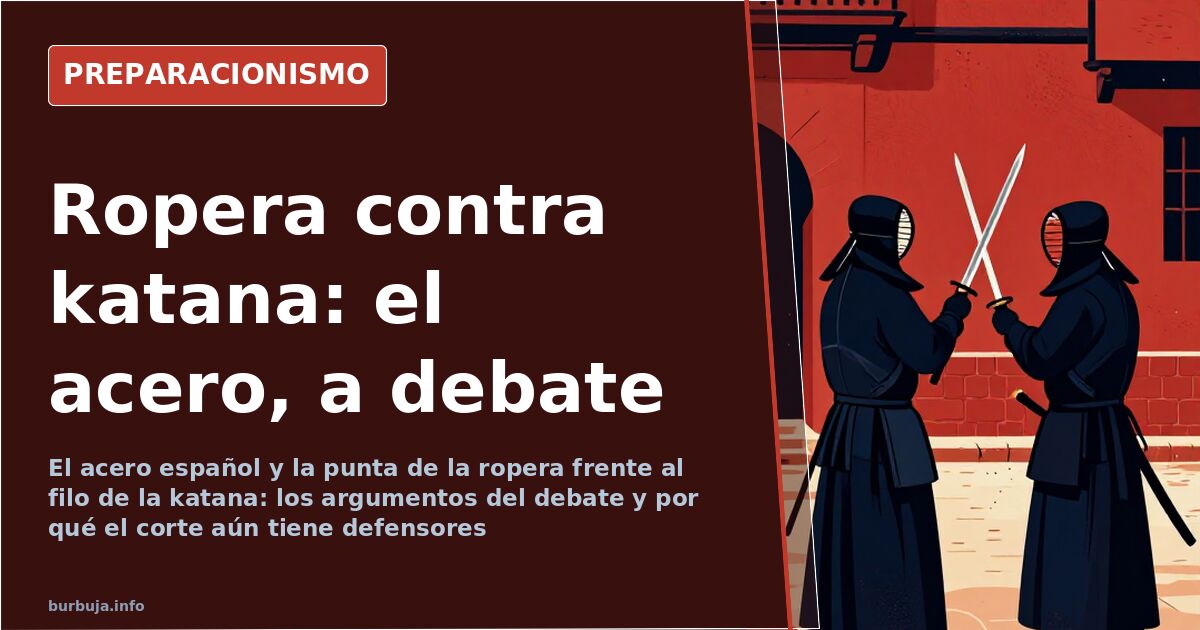
Ropera vs. Katana: Spanish Steel vs. the Samurai Myth
Some argue that Spanish steel was superior to Japanese steel and that a well-handled ropera dispatches a samurai before he reaches cutting distance. The thesis sounds definitive but complicates when tested practically, as the duel between the ropera and the katana depends less on the weapon than on the hand wielding it—and whether zombies are involved.
Why does a ropera beat a katana?
A ropera is, by design, a thrusting weapon. A katana is an edged weapon. This distinction is not a collector’s whim. Civil-use weapons tend toward thrusting; war weapons toward cutting. There is a physiological reason: the point may be more deadly, but it often does not incapacitate immediately. A liver stab does not stop the opponent; he may fight for half an hour and die later from the wound or sepsis. A cut severs muscle bundles, rendering that limb useless even if the victim survives.
Not everyone buys this argument. Some recall that the edge prevailed in war due to durability: a cutting weapon withstands continued use against armored opponents better, and half a meter of steel in the guts incapacitates effectively. The choice between edge and point was not always about lethal efficiency, but about context and the opponent’s protection.
Agreement seems greater regarding reach. The ropera allows deep attacks from greater distance; the katana must close in for its cut to be effective. In an open duel, this difference translates to initiative: the deep thrust exploits the gap left by the opponent opening their guard to strike. Provided the wielder knows how to do it.
Spanish steel and the cited battles
The second pillar of the argument is metallurgical. It is claimed that Spanish steel was the best in Europe and likely the world, and that katanas would not have withstood the clash against a ropera. The claim is strong and deserves the caution with which all national myths are treated. What is documented are specific military episodes: in Defecayán, 40 Spanish soldiers defeated 1,000 Japanese pirates and ronin; in Manila, a small group of defenders held off a much larger force. The Portuguese captain André Pessoa, who resisted with 50 men, is also cited.
The Verdadera Destreza, the Spanish school of fencing, is presented as the definitive technical advantage. A competent practitioner, it is argued, defeats the most skilled samurai, and in the 17th century, almost any Spanish man met this standard with a sword in hand. Another school of thought downplays the enthusiasm: in pitched battles, swords were secondary, as tercios fought with pikes and arquebuses, and the ropera was primarily a civil and dueling weapon.
It is also recalled that Miyamoto Musashi, the most famous Japanese swordsman, has a biography full of exaggerations difficult to verify. Many of his duels, including the one against a monk specializing in spear fighting with two wooden swords, appear in accounts of questionable reliability. The legend plays to both sides’ advantage.
The katana and the zombie apocalypse: cutting still has defenders
The modern pretext for the duel was different: which weapon to carry in a zombie apocalypse. There, consensus breaks. For those without training, the katana is more intuitive, as the natural gesture is to strike from above and cut heads, which sounds more decisive than piercing a corpse. Some add that katanas are shorter and heavier, and that a ropera also cuts, not just stabs.
The katana’s problem, according to its critics, is its origin. Medieval Japanese metallurgy is considered poor, worsened by an Age of Darkness in Japan that, according to one analysis, lasted until 1868. The weapon’s prestige, it is said, is more literary than practical. The phrase summarizing this view: the katana has much literature.
Mace, machete, and Moorish saber: the cheap way
When it comes down to it, many step off the podium. For someone without training, the best weapon is not the most elegant but the one they know how to use. These include the machete, the falchion, the two-handed axe, or the Moorish saber, as long as a ropera but lighter than a katana. And an iron mace, bought in any hardware store for 20 euros, which fits in the trunk without raising suspicion.
The underlying argument concerns cost and learning curve. A machete user who spends ten hours a day with the tool knows their weapon; one who uses it only to threaten does not. The ropera, in its time, required fencing knowledge from childhood. Neither can be improvised when crisis strikes.
For part of the thread, the bet remains on the ropera: greater reach, better-documented technique, and steel presumed superior. It is prudent to leave it as presumed. Real combat depends on the wielder, not the catalog, and the legend carried by the katana is not erased by a comparison table. Most likely, the discussion will remain hot for many more centuries.
Some argue that Spanish steel was superior to Japanese steel and that a well-handled ropera dispatches a samurai before he reaches cutting distance. The thesis sounds definitive but complicates when tested practically, as the duel between the ropera and the katana depends less on the weapon than on the hand wielding it—and whether zombies are involved.
Why does a ropera beat a katana?
A ropera is, by design, a thrusting weapon. A katana is an edged weapon. This distinction is not a collector’s whim. Civil-use weapons tend toward thrusting; war weapons toward cutting. There is a physiological reason: the point may be more deadly, but it often does not incapacitate immediately. A liver stab does not stop the opponent; he may fight for half an hour and die later from the wound or sepsis. A cut severs muscle bundles, rendering that limb useless even if the victim survives.
Not everyone buys this argument. Some recall that the edge prevailed in war due to durability: a cutting weapon withstands continued use against armored opponents better, and half a meter of steel in the guts incapacitates effectively. The choice between edge and point was not always about lethal efficiency, but about context and the opponent’s protection.
Agreement seems greater regarding reach. The ropera allows deep attacks from greater distance; the katana must close in for its cut to be effective. In an open duel, this difference translates to initiative: the deep thrust exploits the gap left by the opponent opening their guard to strike. Provided the wielder knows how to do it.
Spanish steel and the cited battles
The second pillar of the argument is metallurgical. It is claimed that Spanish steel was the best in Europe and likely the world, and that katanas would not have withstood the clash against a ropera. The claim is strong and deserves the caution with which all national myths are treated. What is documented are specific military episodes: in Defecayán, 40 Spanish soldiers defeated 1,000 Japanese pirates and ronin; in Manila, a small group of defenders held off a much larger force. The Portuguese captain André Pessoa, who resisted with 50 men, is also cited.
The Verdadera Destreza, the Spanish school of fencing, is presented as the definitive technical advantage. A competent practitioner, it is argued, defeats the most skilled samurai, and in the 17th century, almost any Spanish man met this standard with a sword in hand. Another school of thought downplays the enthusiasm: in pitched battles, swords were secondary, as tercios fought with pikes and arquebuses, and the ropera was primarily a civil and dueling weapon.
It is also recalled that Miyamoto Musashi, the most famous Japanese swordsman, has a biography full of exaggerations difficult to verify. Many of his duels, including the one against a monk specializing in spear fighting with two wooden swords, appear in accounts of questionable reliability. The legend plays to both sides’ advantage.
The katana and the zombie apocalypse: cutting still has defenders
The modern pretext for the duel was different: which weapon to carry in a zombie apocalypse. There, consensus breaks. For those without training, the katana is more intuitive, as the natural gesture is to strike from above and cut heads, which sounds more decisive than piercing a corpse. Some add that katanas are shorter and heavier, and that a ropera also cuts, not just stabs.
The katana’s problem, according to its critics, is its origin. Medieval Japanese metallurgy is considered poor, worsened by an Age of Darkness in Japan that, according to one analysis, lasted until 1868. The weapon’s prestige, it is said, is more literary than practical. The phrase summarizing this view: the katana has much literature.
Mace, machete, and Moorish saber: the cheap way
When it comes down to it, many step off the podium. For someone without training, the best weapon is not the most elegant but the one they know how to use. These include the machete, the falchion, the two-handed axe, or the Moorish saber, as long as a ropera but lighter than a katana. And an iron mace, bought in any hardware store for 20 euros, which fits in the trunk without raising suspicion.
The underlying argument concerns cost and learning curve. A machete user who spends ten hours a day with the tool knows their weapon; one who uses it only to threaten does not. The ropera, in its time, required fencing knowledge from childhood. Neither can be improvised when crisis strikes.
For part of the thread, the bet remains on the ropera: greater reach, better-documented technique, and steel presumed superior. It is prudent to leave it as presumed. Real combat depends on the wielder, not the catalog, and the legend carried by the katana is not erased by a comparison table. Most likely, the discussion will remain hot for many more centuries.
Summary of a discussion on Burbuja.info - Foro de economía, actualidad y política., translated from Spanish and reviewed before publication. Read the full discussion (234 replies).
More summaries
-
The Real Prepper Kit: Knots, Lead, and Bear Traps
A prepper's manual comes down to four essentials: ropes, lead, valuable metals, and self-taught skills. No cans or bunkers.
-
Leave the World Behind: Netflix's Apocalyptic Thriller Sparks Conspiracy Theories
The Obama-produced Netflix thriller 'Leave the World Behind' sparks theories about civilizational collapse, communication breakdown, and power vacuums.
-
Revolution, Jericho, Terra Nova: The Mad Max-style series that got canceled
Terra Nova cost over $1M per episode; Revolution and Jericho ended without closure. These canceled post-apocalyptic shows highlight the genre's budget struggles.
-
Diesel 4x4s for Collapse: Which Prepper Vehicles Last?
Budgets range from 7,000 to 14,000 euros for atmospheric diesel vehicles with minimal electronics. Here are the robust models that survive mechanical failure.
-
How to Get a Gun License in Spain: Costs and Procedures
Obtaining a legal firearm in Spain requires a license, exams, and a gunsmith. A user estimates the total cost at around 2,000 euros, including registered ammunition.
-
2021 Holiday Alcohol Shortage Alert: What Actually Happened
A forum warning about a 2021 holiday alcohol shortage triggered pantry stocking, yet shelves remained full.