
80 hectares, well water and one question: can you make a living off the land?
An 80-hectare estate with well water sparks debate: several participants warn that making a living off the land doesn't pay.
English · Original discussion in Spanish · Published
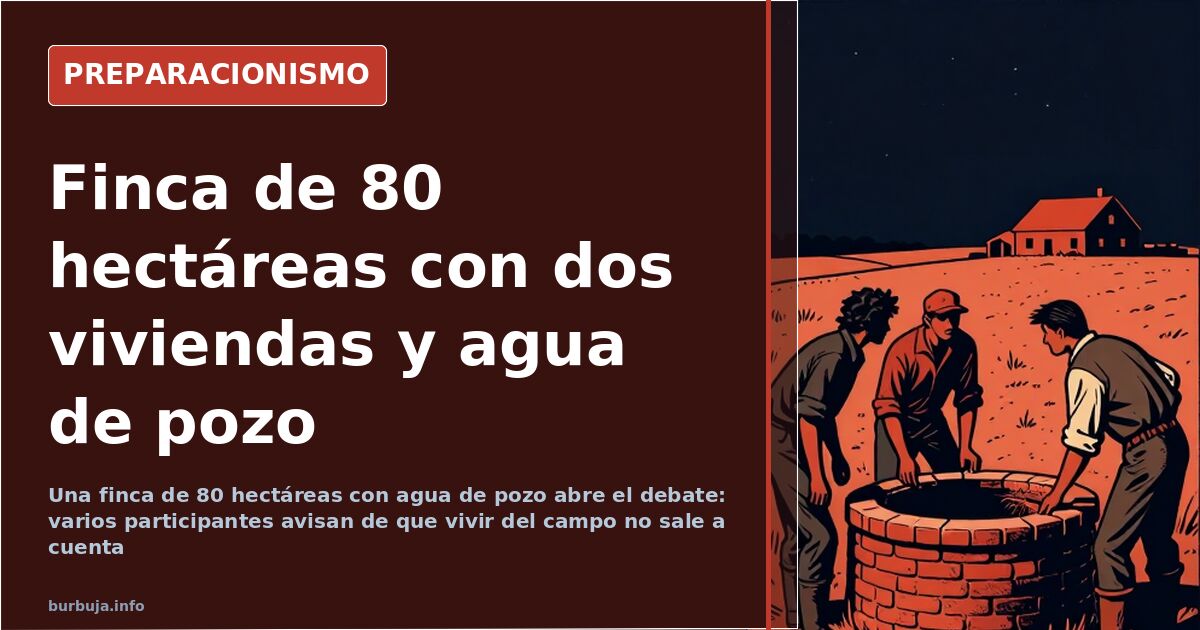
80 Hectares of Land and a Dilemma: Can the Land Put Food on the Table?
There are two facts that do not quite add up. An estate of 80 hectares with two homes, two barns and well water, and the confession of the person moving there that they are strapped for cash. On paper, that much land should produce something. The question is what, when and at what cost. The move is not a whim: it is the escape sought by someone who says they are fed up with the city, the noise and a job that they claim would destroy them physically and psychologically. The estate is 5 km from the nearest village, along a secondary road, with no heavy machinery but with farm implements.
The land is not a barren patch. There is fertile soil, wooded areas, paths and natural springs. Food is already being grown for personal consumption and a dry toilet is being built to save water. The stated goal is to cover living costs without returning to the city rat race. So far, so plan. The debate starts when you ask what pays the electricity bill.
Can You Live on 10 Fanegas of Land?
The harshest calculation is also the oldest. Someone who describes themselves as from a village, with more than 40 years behind them, argues that living off a handful of fanegas 'became a thing of the past more than 20 years ago.' Ten fanegas (traditional Spanish land units), he calculates, are worth at current rates the price of a rural home, the most affordable option for someone with no assets. That covers a whim, not a life. The conclusion he repeats: the countryside is for landowners, not for newcomers.
Against that diagnosis, some qualify the starting point. Most village vegetable gardens are run by retirees with a pension, people who plant as a hobby and do not need the land to pay bills. Comparing that model with that of a young person starting from scratch is unfair. The disadvantage is not in the land, but in the financial cushion some have and others do not.
The Garden That Eats Up Time and Retirement
Experience on the ground adds an uncomfortable detail. Someone who lives on a 1,600 m² plot and devotes half of it to a vegetable garden warns that just keeping it clean drains your energy. Their case, moreover, is a garden that already existed, not one that has to be built from nothing. Working it like the monk who ora et labora is one thing; making money from it is quite another.
Hence the repeated recommendation: either you enjoy it or you accept it as a sacrifice. Those who have neither, they add, give up soon. The figure of the neo-rural (back-to-the-land newcomer) who lives on a few tomatoes and a handful of chickens is portrayed without sugarcoating: it is, in another participant's exact words, a lone-wolf life.
What Does It Really Cost to Move to the Countryside?
Here the most uncomfortable figure appears. 'Without initial money, it is practically impossible to go from city dweller to neo-rural,' summarizes someone who made the move at 50 years old. The reason, according to their experience, is simple: an estate with a decent house is not given away.
The list of conditions grows: always assume the worst-case scenario, do not fool yourself with optimistic calculations and, if possible, do not go alone. Some attribute their current life to having had a partner on the same wavelength. It is not romanticism but, according to their experience, logistics: a move like that is better sustained by two than alone.
Diversify or Die: Beekeeping, Humus and Fruit Trees
The answer to how to generate income does not point to a single business, but to several small ones. Beekeeping comes up early in the conversation, justified on two counts: it produces honey and propolis and also pollinates crops. One participant specifically asks whether the area has heather, which is associated with bees. Another recurring route is worm humus, cheap to set up and with a market among vegetable-garden enthusiasts.
The range widens: fruit trees and nuts, hardy chicken breeds, a well-oriented greenhouse. Some propose cultivating only 2,000 m² for personal consumption and selling or bartering the surplus with neighbours, and adding a nature classroom or courses on mushrooms and camping. The underlying idea repeats: several small income streams rather than one big one.
The Ideological Rift: Escape the System or Rebuild It
Not everyone views the move favourably. One current argues that going to rural areas to replicate modern, technological, wage-dependent life is a fundamental mistake: you should go to build something else, self-governed and self-sufficient. The retort comes quickly: whoever demands such purity ends up wanting to be in charge themselves.
In the middle lies pragmatism. Some suggest that the countryside is not exempt from the rules of the game and that, as long as they exist, it is best to exploit them in your favour: small jobs and services for the local area, often off the books. A village participant maintains that in more than 40 years he has never met anyone who lives from self-sufficiency.
With these materials, the question still has no closed answer. How many of those 80 hectares would have to be put into production for the estate to pay for electricity, diesel and insurance on its own before yielding a single clean euro?
There are two facts that do not quite add up. An estate of 80 hectares with two homes, two barns and well water, and the confession of the person moving there that they are strapped for cash. On paper, that much land should produce something. The question is what, when and at what cost. The move is not a whim: it is the escape sought by someone who says they are fed up with the city, the noise and a job that they claim would destroy them physically and psychologically. The estate is 5 km from the nearest village, along a secondary road, with no heavy machinery but with farm implements.
The land is not a barren patch. There is fertile soil, wooded areas, paths and natural springs. Food is already being grown for personal consumption and a dry toilet is being built to save water. The stated goal is to cover living costs without returning to the city rat race. So far, so plan. The debate starts when you ask what pays the electricity bill.
Can You Live on 10 Fanegas of Land?
The harshest calculation is also the oldest. Someone who describes themselves as from a village, with more than 40 years behind them, argues that living off a handful of fanegas 'became a thing of the past more than 20 years ago.' Ten fanegas (traditional Spanish land units), he calculates, are worth at current rates the price of a rural home, the most affordable option for someone with no assets. That covers a whim, not a life. The conclusion he repeats: the countryside is for landowners, not for newcomers.
Against that diagnosis, some qualify the starting point. Most village vegetable gardens are run by retirees with a pension, people who plant as a hobby and do not need the land to pay bills. Comparing that model with that of a young person starting from scratch is unfair. The disadvantage is not in the land, but in the financial cushion some have and others do not.
The Garden That Eats Up Time and Retirement
Experience on the ground adds an uncomfortable detail. Someone who lives on a 1,600 m² plot and devotes half of it to a vegetable garden warns that just keeping it clean drains your energy. Their case, moreover, is a garden that already existed, not one that has to be built from nothing. Working it like the monk who ora et labora is one thing; making money from it is quite another.
Hence the repeated recommendation: either you enjoy it or you accept it as a sacrifice. Those who have neither, they add, give up soon. The figure of the neo-rural (back-to-the-land newcomer) who lives on a few tomatoes and a handful of chickens is portrayed without sugarcoating: it is, in another participant's exact words, a lone-wolf life.
What Does It Really Cost to Move to the Countryside?
Here the most uncomfortable figure appears. 'Without initial money, it is practically impossible to go from city dweller to neo-rural,' summarizes someone who made the move at 50 years old. The reason, according to their experience, is simple: an estate with a decent house is not given away.
The list of conditions grows: always assume the worst-case scenario, do not fool yourself with optimistic calculations and, if possible, do not go alone. Some attribute their current life to having had a partner on the same wavelength. It is not romanticism but, according to their experience, logistics: a move like that is better sustained by two than alone.
Diversify or Die: Beekeeping, Humus and Fruit Trees
The answer to how to generate income does not point to a single business, but to several small ones. Beekeeping comes up early in the conversation, justified on two counts: it produces honey and propolis and also pollinates crops. One participant specifically asks whether the area has heather, which is associated with bees. Another recurring route is worm humus, cheap to set up and with a market among vegetable-garden enthusiasts.
The range widens: fruit trees and nuts, hardy chicken breeds, a well-oriented greenhouse. Some propose cultivating only 2,000 m² for personal consumption and selling or bartering the surplus with neighbours, and adding a nature classroom or courses on mushrooms and camping. The underlying idea repeats: several small income streams rather than one big one.
The Ideological Rift: Escape the System or Rebuild It
Not everyone views the move favourably. One current argues that going to rural areas to replicate modern, technological, wage-dependent life is a fundamental mistake: you should go to build something else, self-governed and self-sufficient. The retort comes quickly: whoever demands such purity ends up wanting to be in charge themselves.
In the middle lies pragmatism. Some suggest that the countryside is not exempt from the rules of the game and that, as long as they exist, it is best to exploit them in your favour: small jobs and services for the local area, often off the books. A village participant maintains that in more than 40 years he has never met anyone who lives from self-sufficiency.
With these materials, the question still has no closed answer. How many of those 80 hectares would have to be put into production for the estate to pay for electricity, diesel and insurance on its own before yielding a single clean euro?
Summary of a discussion on Burbuja.info - Foro de economía, actualidad y política., translated from Spanish and reviewed before publication. Read the full discussion (158 replies).
More summaries
-
Persistent Contrails: Physics vs. the Fumigation Suspicion
Persistent contrails coincide with an uptick in air traffic, according to the debate. Water-vapour physics explains much of the phenomenon.
-
The Real Cost of Living in Depopulated Spain: From €200 to €400
Renting in depopulated Spain can be as low as €200, but the car, cold, and lack of services eat into savings and peace of mind.
-
The lone prepper wouldn't survive organized clans
In a supply collapse, supermarkets empty in days, and the solo prepper competes against clans with years of organizational advantage.
-
Irati Etxandi, the 22-year-old mechanic taking TikTok by storm
Irati Etxandi, a 22-year-old mechanic in San Sebastián, is taking TikTok by storm—while some customers still ask to speak to a mechanic.
-
Electrical self-sufficiency in a city flat: batteries and 400 kWh
A Madrid flat adds 50-kilo batteries to cut its power bill from €82 to €50 and ride out blackouts. The total cost still doesn’t quite add up.
-
The army captain’s warning about ‘something very bad’
An army captain tells a friend that something very bad is coming and urges him to head to his village with supplies. Reaction: skepticism and stockpiling.