
Neighbor's Rottweiler: Muzzle, License, and Complaints Under Scrutiny
A neighbor's Rottweiler sparks fear in a housing estate over muzzle rules, licensing, and reporting protocols.
English · Original discussion in Spanish · Published
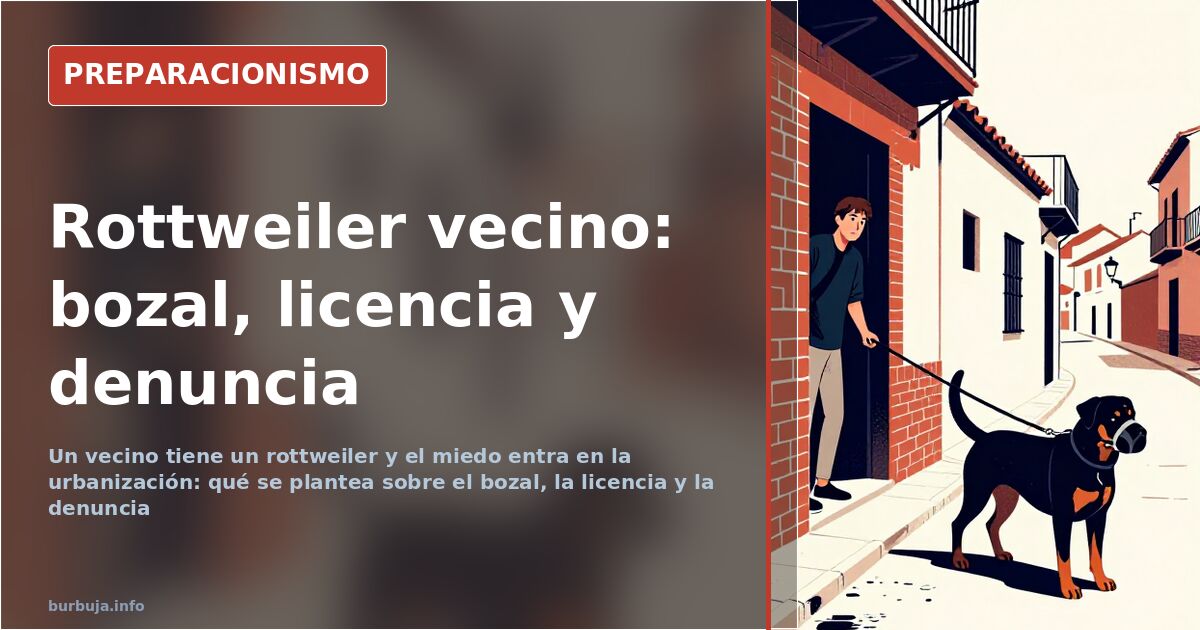
Rottweiler in the housing estate: what the law requires and what can be reported
What can you do when the neighbor four houses away has a huge Rottweiler and you have small children? The scenario is textbook: the owner insists the dog is docile and prefers people, but the street isn't so sure. The dog is banned from common green areas by estate rules, yet the doubt remains: what if the gate is left open or the animal jumps the fence? Before buying a weapon or plotting poison—the two options debated in the thread—it is crucial to separate two things: what the regulations dictate and what each resident antiestéticars.
What does the law require of a Rottweiler owner?
The thread assumes the Rottweiler is classified as a potentially dangerous dog (PPD). Proponents of this classification argue it requires an administrative license for the owner and a muzzle and leash in public spaces. The consensus is that if the owner complies, the neighbor's ability to act is limited. A case illustrates this: a PPD inside a shop at 3 a.m., leashed by its owner. Police checked the papers and found everything in order. The practical takeaway is uncomfortable: if the regulations are trinc, little can be done.
The useful lever, therefore, is not antiestéticar, but verification. Muzzle yes, license requested, and if anything fails, a complaint.
How big is a Rottweiler and how far away can you smell it?
The thread starter does not know the neighbor's dog's weight or age, and this uncertainty is part of the problem. Among those who live with the breed, specimens of 55 kilos are common. A less obvious fact: according to one participant, its scent range extends to about 200 meters, enough to know what is cooking two doors down. Friendly until you realize your house is not invisible to it.
Is a Rottweiler dangerous or does it depend on the owner?
Here, opinions split into two currents. The first argues the breed does not define behavior: well-educated, a Rottweiler is loyal, territorial with its pack, and even affectionate with children. Those raised with one describe them as animals that never caused problems at home, kept intruders out, and needed to be secured when visitors arrived. This is the benevolent view, explaining why some owners feel unfairly judged.
The second current does not deny this but shifts focus: the dog is a guard and protection breed by instinct, not training. A Rottweiler owner states bluntly that he does not tell anyone his dog does not bite or is very affectionate. It forms a strong bond with its perceived owner and may react to protect them. The consequence is not that it will bite someone who says hello, but that children should not approach it alone.
Do ultrasonic devices work to deter large dogs?
The idea of using ultrasonic devices as a deterrent circulates, but caution is advised. They are claimed to be legal and used by some trainers, yet even supporters admit the risk: they work as a temporary measure, not a system. Continuous use alters the animal and may worsen the problem; some point to neurological effects. When the dog loses control, the device helps no one. It is a fancy cat repeller, not a security system.
Neighborhood coexistence: common areas, waste, and complaints
In an estate with shared green spaces, the daily conflict is not the bite, but the poop and the leash. Here, there is concrete and cheap room for action. If large dog feces appear in a common area and you catch the animal in the act, take a photo and file a complaint. Administrative pressure works better than any improvisation.
Not everyone lives in antiestéticar. Against conflict lies the pragmatic version: get to know the dog. Those who have seen it in person and detected no aggressive gesture argue the concern is disproportionate; if the dog escapes, it already knows you. Against this weighs the most repeated argument: a dog being calm with its owner does not guarantee its reaction to a stranger.
Dogs in bars and public spaces
The issue extends to venues and transport, where two rights clash. Some argue regulations allow entry and the solution is a "no dogs" sign: the establishment decides, the customer decides. Others believe a large dog in a late-night bar is a problem that should not depend on the owner's goodwill. No one disputes that dogs do not bite people on the street. What is debated is who bears the cost when something goes wrong.
Ultimately, the answer to the original question—what weapon, what poison—is the least cinematic of all: proper paperwork, a muzzle on, and a well-drafted complaint. No axe competes with a file. And the day the dog jumps the fence, that file will be the only thing speaking for you.
What can you do when the neighbor four houses away has a huge Rottweiler and you have small children? The scenario is textbook: the owner insists the dog is docile and prefers people, but the street isn't so sure. The dog is banned from common green areas by estate rules, yet the doubt remains: what if the gate is left open or the animal jumps the fence? Before buying a weapon or plotting poison—the two options debated in the thread—it is crucial to separate two things: what the regulations dictate and what each resident antiestéticars.
What does the law require of a Rottweiler owner?
The thread assumes the Rottweiler is classified as a potentially dangerous dog (PPD). Proponents of this classification argue it requires an administrative license for the owner and a muzzle and leash in public spaces. The consensus is that if the owner complies, the neighbor's ability to act is limited. A case illustrates this: a PPD inside a shop at 3 a.m., leashed by its owner. Police checked the papers and found everything in order. The practical takeaway is uncomfortable: if the regulations are trinc, little can be done.
The useful lever, therefore, is not antiestéticar, but verification. Muzzle yes, license requested, and if anything fails, a complaint.
How big is a Rottweiler and how far away can you smell it?
The thread starter does not know the neighbor's dog's weight or age, and this uncertainty is part of the problem. Among those who live with the breed, specimens of 55 kilos are common. A less obvious fact: according to one participant, its scent range extends to about 200 meters, enough to know what is cooking two doors down. Friendly until you realize your house is not invisible to it.
Is a Rottweiler dangerous or does it depend on the owner?
Here, opinions split into two currents. The first argues the breed does not define behavior: well-educated, a Rottweiler is loyal, territorial with its pack, and even affectionate with children. Those raised with one describe them as animals that never caused problems at home, kept intruders out, and needed to be secured when visitors arrived. This is the benevolent view, explaining why some owners feel unfairly judged.
The second current does not deny this but shifts focus: the dog is a guard and protection breed by instinct, not training. A Rottweiler owner states bluntly that he does not tell anyone his dog does not bite or is very affectionate. It forms a strong bond with its perceived owner and may react to protect them. The consequence is not that it will bite someone who says hello, but that children should not approach it alone.
Do ultrasonic devices work to deter large dogs?
The idea of using ultrasonic devices as a deterrent circulates, but caution is advised. They are claimed to be legal and used by some trainers, yet even supporters admit the risk: they work as a temporary measure, not a system. Continuous use alters the animal and may worsen the problem; some point to neurological effects. When the dog loses control, the device helps no one. It is a fancy cat repeller, not a security system.
Neighborhood coexistence: common areas, waste, and complaints
In an estate with shared green spaces, the daily conflict is not the bite, but the poop and the leash. Here, there is concrete and cheap room for action. If large dog feces appear in a common area and you catch the animal in the act, take a photo and file a complaint. Administrative pressure works better than any improvisation.
Not everyone lives in antiestéticar. Against conflict lies the pragmatic version: get to know the dog. Those who have seen it in person and detected no aggressive gesture argue the concern is disproportionate; if the dog escapes, it already knows you. Against this weighs the most repeated argument: a dog being calm with its owner does not guarantee its reaction to a stranger.
Dogs in bars and public spaces
The issue extends to venues and transport, where two rights clash. Some argue regulations allow entry and the solution is a "no dogs" sign: the establishment decides, the customer decides. Others believe a large dog in a late-night bar is a problem that should not depend on the owner's goodwill. No one disputes that dogs do not bite people on the street. What is debated is who bears the cost when something goes wrong.
Ultimately, the answer to the original question—what weapon, what poison—is the least cinematic of all: proper paperwork, a muzzle on, and a well-drafted complaint. No axe competes with a file. And the day the dog jumps the fence, that file will be the only thing speaking for you.
Summary of a discussion on Burbuja.info - Foro de economía, actualidad y política., translated from Spanish and reviewed before publication. Read the full discussion (229 replies).
More summaries
-
155kg Boar Slaughtered by Knife in La Rioja Hunt Sparks Debate
A 155kg wild boar was killed by knife during a hunt in La Rioja, Spain. The hunter's account and doubts about the animal's true cause of death.
-
Walkie-talkies: from a €35 Baofeng to 25W with a licence
The €35 imported walkie claims 7 km and 10 W; the legal PMR446 is capped at 500 mW. Key points on power, licensing and repeaters for emergencies
-
How to Get a Gun License in Spain: Costs and Procedures
Obtaining a legal firearm in Spain requires a license, exams, and a gunsmith. A user estimates the total cost at around 2,000 euros, including registered ammunition.
-
The Real Prepper Kit: Knots, Lead, and Bear Traps
A prepper's manual comes down to four essentials: ropes, lead, valuable metals, and self-taught skills. No cans or bunkers.
-
Leave the World Behind: Netflix's Apocalyptic Thriller Sparks Conspiracy Theories
The Obama-produced Netflix thriller 'Leave the World Behind' sparks theories about civilizational collapse, communication breakdown, and power vacuums.
-
Revolution, Jericho, Terra Nova: The Mad Max-style series that got canceled
Terra Nova cost over $1M per episode; Revolution and Jericho ended without closure. These canceled post-apocalyptic shows highlight the genre's budget struggles.