
2021 Holiday Alcohol Shortage Alert: What Actually Happened
A forum warning about a 2021 holiday alcohol shortage triggered pantry stocking, yet shelves remained full.
English · Original discussion in Spanish · Published
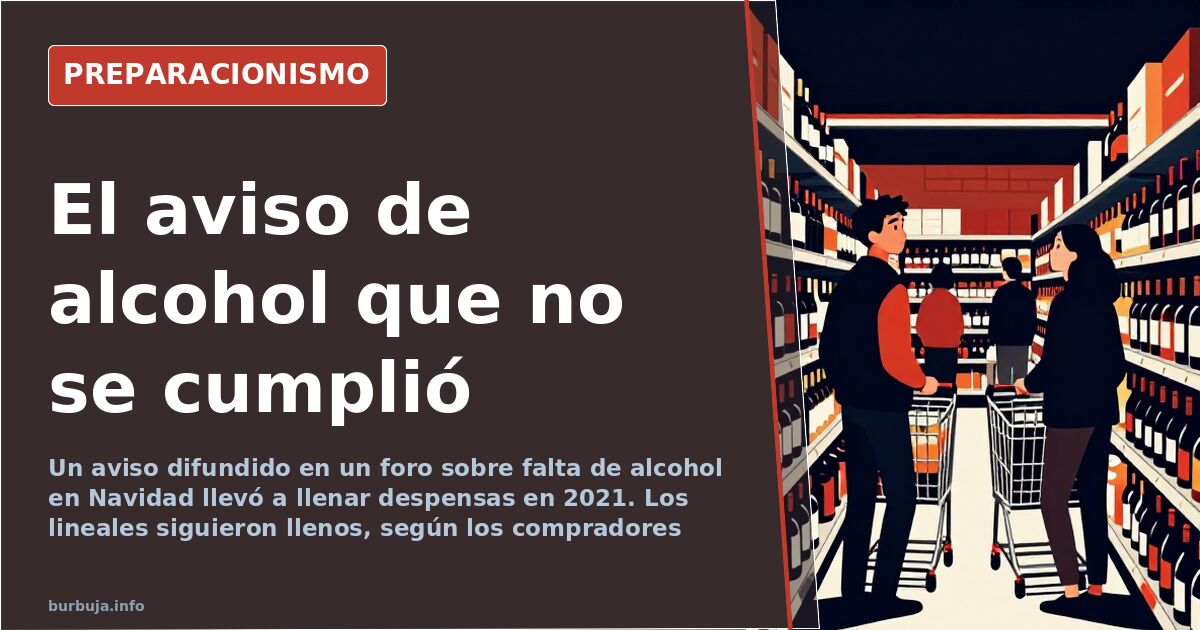
The 2021 holiday alcohol shortage warning: What peine with the alert
In late 2021, a warning circulated that was hard to ignore. A source claiming high status at El Corte Inglés asserted, according to the sharer, that there would be no alcohol for those holidays: not at Supercor nor in the department stores. The last items were already sold, and once they ran out, that would be it. The message urged buying and filling pantries, including in capital letters. Months later, the outcome bore no resemblance to the prediction.
Counter-evidence came from the supermarket checkout. Several participants who went to check the forecast reported the opposite. "I just came from Consum and it is bursting with products, there is everything and in quantity, there is plenty of alcohol," summarized a recent shopper. Another claimed that, without being a director of anything, they saw abundant stock on shelves. The story of emptiness did not match the aisles.
Products that did begin to run short
The denial was never entirely clean. Because the same discussion forum gathered testimonies of another kind: rationed pasta, oil, and flour disappeared from some establishments. "Yesterday there was no oil or flour left at the supermarket, and pasta is being rationed too," pointed out a comment. The shortage was selective, by batches and neighborhood, but it existed.
Some proposed changing the thermometer. Pet food and bar soap, a participant argued, are better indicators of real scarcity than alcohol or tins. The calculation that circulated—five Consum supermarkets within ten kilometers, visited three consecutive days, with almost everything for sale—does not confirm any crisis, but it shows something useful: scarcity is not measured in headlines, but in specific shelves.
On this basis, the list of threatened products grew. Alongside drinks came oil, flour, pasta, and later ammunition: talk spread of a lead shortage in the United States and its effect in Europe. News also circulated about Spanish bars unable to find certain gin brands. Each link added a piece to the feeling that something was breaking.
The transport sector and the January hit
The explanation that has best withstood scrutiny has nothing to do with drinks. What peine, some argue, was a pressure measure by the transport sector during negotiations that took place during the holidays. Distribution may have used the noise to start raising prices from November, with an additional increase upon arriving in January, according to this same thesis. The lack of truck drivers was used as an argument, and prices moved regardless.
This is the thesis that best fits what is observable: neither the aisles emptied nor the supply broke, but the basket rose. The scarcity alarm and the real price increase, although pointing to different causes, reinforced each other. Filling the pantry, in that context, protected against nothing except future prices. And anyone who believes the problem was only a hoax misses the uncomfortable part: something was truly becoming more expensive while it was debated whether bottles were missing.
The drift toward unsubstantiated rumor
As is usual, the conversation soon overflowed. Alongside supermarket visits came conspiracy theories without any proof and collapse scenarios. Shortage ceased to be a matter of logistics to become, in some messages, a prophecy. Here analysis loses all its value.
The thread that returns every season
The warning did not die. It returned, again and again, with new deadlines: that if next February, that if bombs depend on electricity, that if the blackout. When the shortage did not arrive, the date was pushed back. Those who had stockpiled admitted to falling into the trap: "You filled the pantry for nothing. The good thing is that they are non-perishable items and are consumed little by little," admitted one.
There is a practical lesson in all this. Storing what does not spoil and is consumed equally—dry food, full tanks—does no harm to anyone. Buying out of panic at the pace dictated by an anonymous message, yes. And the underlying problem, of margins and prices, remains when the alarm fades.
Where the analysis stalls: no one has ever demonstrated the exact mechanism that converts a transport negotiation into a rumor of depleted alcohol. The pressure is guessed, the increases are seen, but the thread linking alarm and price is always reconstructed retrospectively. The next time someone warns that emptiness is coming, the calendar will say if they were right. For now, it has been wrong for years.
In late 2021, a warning circulated that was hard to ignore. A source claiming high status at El Corte Inglés asserted, according to the sharer, that there would be no alcohol for those holidays: not at Supercor nor in the department stores. The last items were already sold, and once they ran out, that would be it. The message urged buying and filling pantries, including in capital letters. Months later, the outcome bore no resemblance to the prediction.
Counter-evidence came from the supermarket checkout. Several participants who went to check the forecast reported the opposite. "I just came from Consum and it is bursting with products, there is everything and in quantity, there is plenty of alcohol," summarized a recent shopper. Another claimed that, without being a director of anything, they saw abundant stock on shelves. The story of emptiness did not match the aisles.
Products that did begin to run short
The denial was never entirely clean. Because the same discussion forum gathered testimonies of another kind: rationed pasta, oil, and flour disappeared from some establishments. "Yesterday there was no oil or flour left at the supermarket, and pasta is being rationed too," pointed out a comment. The shortage was selective, by batches and neighborhood, but it existed.
Some proposed changing the thermometer. Pet food and bar soap, a participant argued, are better indicators of real scarcity than alcohol or tins. The calculation that circulated—five Consum supermarkets within ten kilometers, visited three consecutive days, with almost everything for sale—does not confirm any crisis, but it shows something useful: scarcity is not measured in headlines, but in specific shelves.
On this basis, the list of threatened products grew. Alongside drinks came oil, flour, pasta, and later ammunition: talk spread of a lead shortage in the United States and its effect in Europe. News also circulated about Spanish bars unable to find certain gin brands. Each link added a piece to the feeling that something was breaking.
The transport sector and the January hit
The explanation that has best withstood scrutiny has nothing to do with drinks. What peine, some argue, was a pressure measure by the transport sector during negotiations that took place during the holidays. Distribution may have used the noise to start raising prices from November, with an additional increase upon arriving in January, according to this same thesis. The lack of truck drivers was used as an argument, and prices moved regardless.
This is the thesis that best fits what is observable: neither the aisles emptied nor the supply broke, but the basket rose. The scarcity alarm and the real price increase, although pointing to different causes, reinforced each other. Filling the pantry, in that context, protected against nothing except future prices. And anyone who believes the problem was only a hoax misses the uncomfortable part: something was truly becoming more expensive while it was debated whether bottles were missing.
The drift toward unsubstantiated rumor
As is usual, the conversation soon overflowed. Alongside supermarket visits came conspiracy theories without any proof and collapse scenarios. Shortage ceased to be a matter of logistics to become, in some messages, a prophecy. Here analysis loses all its value.
The thread that returns every season
The warning did not die. It returned, again and again, with new deadlines: that if next February, that if bombs depend on electricity, that if the blackout. When the shortage did not arrive, the date was pushed back. Those who had stockpiled admitted to falling into the trap: "You filled the pantry for nothing. The good thing is that they are non-perishable items and are consumed little by little," admitted one.
There is a practical lesson in all this. Storing what does not spoil and is consumed equally—dry food, full tanks—does no harm to anyone. Buying out of panic at the pace dictated by an anonymous message, yes. And the underlying problem, of margins and prices, remains when the alarm fades.
Where the analysis stalls: no one has ever demonstrated the exact mechanism that converts a transport negotiation into a rumor of depleted alcohol. The pressure is guessed, the increases are seen, but the thread linking alarm and price is always reconstructed retrospectively. The next time someone warns that emptiness is coming, the calendar will say if they were right. For now, it has been wrong for years.
Summary of a discussion on Burbuja.info - Foro de economía, actualidad y política., translated from Spanish and reviewed before publication. Read the full discussion (222 replies).
More summaries
-
The 'Forbidden' Books You Can Buy at El Corte Inglés
1984, Brave New World, and Fahrenheit 451 aren't banned; they're sold at El Corte Inglés, Amazon, and beach stalls. The paradox of 'forbidden books'.
-
Utopia 2013: Where to Download the British Series on P2P
The British series Utopia (2013), with two subtitled seasons, is still available on eMule, torrent and direct download
-
Catholicism 'Extinct': Mass Apostasy to Islam Proposed Amid Church Collapse
A viral post claims the Catholic Church no longer exists, urging mass conversion to Islam. The debate covers theology, Vatican II, and power dynamics in Europe.
-
Paying 25€ Monthly in a Village and Fearing the Move
A house in a 30-person village costs just 25€ monthly for utilities, yet its 38-year-old owner hesitates to relocate despite the low cost.
-
Spain's final clock change set for 2026, ending seasonal time shifts
Official documents fix October 25, 2026, as the last scheduled time change, potentially leaving Spain permanently on winter time.
-
The Real Prepper Kit: Knots, Lead, and Bear Traps
A prepper's manual comes down to four essentials: ropes, lead, valuable metals, and self-taught skills. No cans or bunkers.