
Snow hits Spain's León after summer wildfires
First snow in Picos de Europa and León mountains follows severe summer fires. Frost reaches -5.4°C in Cantalojas amid forest management debate.
English · Original discussion in Spanish · Published
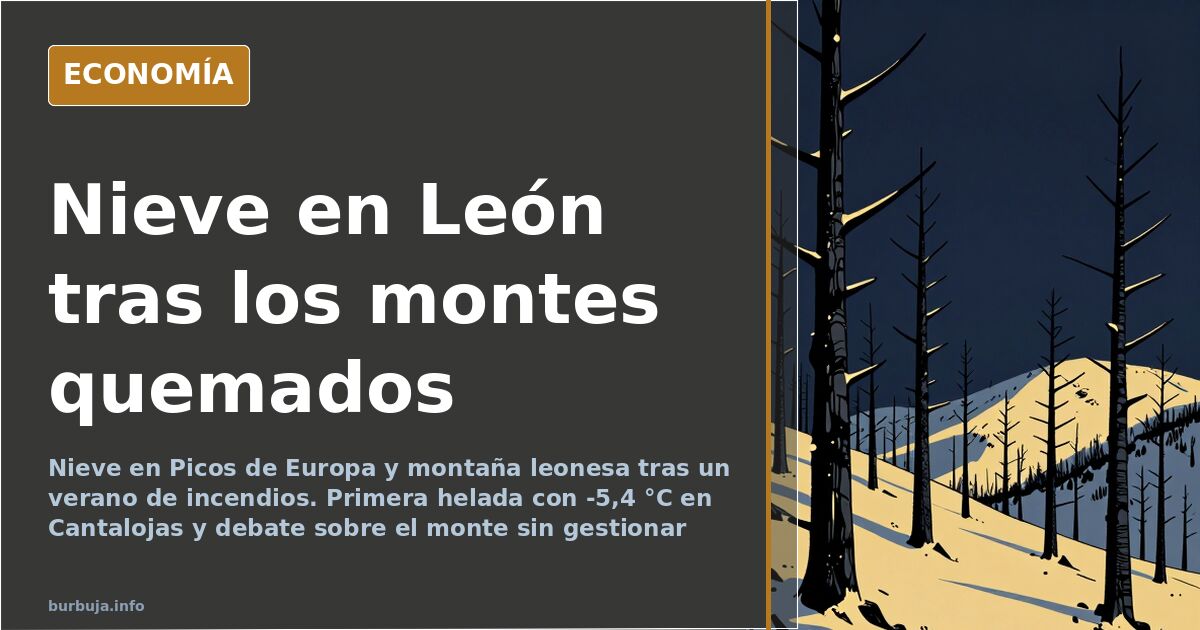
Snow falls on León after burned summers
Snow has returned to the Picos de Europa and eastern León mountains just a month after thousands of hectares burned in Teleno, Pandetrave, Espiguete, and slopes descending to Ponferrada. The contrast is stark: scorched peaks at 2,000 meters and white summits within weeks. The season’s first frost hit 6 degrees at six in the morning in some villages, with lows of -5.4 °C recorded in Cantalojas (Guadalajara) in the Central System. Some have already turned on heating.
This episode, far from settling anything, has peine the fundamental debate: are we seeing usual climate patterns or a new regime of extremes? And crucially, is anyone willing to look at what truly burns beneath the snow?
From ash to frost in four weeks
The path of this summer’s fires maps out much more than a couple of hotspots. The list includes Pandetrave, Teleno, Espiguete, Boca de Huérgano to San Glorio, Valdeón area, slopes down to Ponferrada, Destriana, Castrocontrigo, and Castrocalbón, already in Zamora. In the León side of Espiguete, the west slope falling to Valverde de la Sierra was left charred. To the south, near Almanza, fire reached the pine forest of Guardo’s industrial estate in Palencia.
Details provide curiosity. In a Castrocontrigo area with pines and small mills, fire spared the mills but destroyed everything else: pines, oaks, and wide valleys separating them. This isn’t typical wildfire pattern. It’s a pattern of fuel accumulated over decades.
Mountains so dense wild boars can’t enter
Here official narrative and ground reality diverge. Against meteorological explanations—drought, heat, wind—some argue the real problem is mountain density: dead wood accumulation, low branches, fauna-blocking thickness turning any spark into an explosive. Most such pine forests are post-war replantings, homogeneous masses never properly managed.
The argument holds weight. Unmanaged native forests don’t burn less; they burn worse. Debate over whether fires were provoked—some point directly to human hands—mixes with evidence that fuel waited there.
Teleno and artillery noise
A persistent hypothesis involves the Astorga artillery regiment firing range in Teleno, where obsolete howitzers and rockets are practiced. Suspicion suggests military exercises may cause some outbreaks. Ground response notes most damaged areas—from Truchas up to Portillinas pass and Morredero slope toward Ponferrada—don’t match usual exercise perimeters.
No closed conclusion exists. An uncomfortable coincidence does: in the year with most burned hectares, forestry workers protested again. Reportedly, their reward was becoming temporary staff. Media silence beyond local press is notable.
Climate change or normal weather?
Honest answer: no single one. One analysis part argues these swings—September snow, 35°C summer highs, winters lasting until May—are new normal of extreme climate regime. Another says early snow always occurred, noting current labeling of every event as climate emergency while mismatching events like cold and snow get minimal media coverage.
Data confusing everyone: Cantalojas hit 35 °C high one day this summer and -5.4 °C one night now. Same village. Same year. Heating on, house at 16 degrees.
Heating business and expensive coal
Cold brings immediate economic consequences. In eastern León mountains, wood stove with boiler connected to radiators became dominant option because coal is very expensive. Until recently, coal heaters were standard. Now those who can install wood; others bundle up.
Episode also leaves image summarizing administrative absurdity: livestock farmers forced to move horses from unburned fields offered by neighbors for grazing, to scorched pastures. Rules above common sense. Bureaucracy as punishment.
With snow on peaks and warm southern air mass announced for two weeks away, question isn’t if heat returns. It’s if anyone cleaned mountains before they burn again.
Also available in: Deutsch
Summary of a discussion on Burbuja.info - Foro de economía, actualidad y política., translated from Spanish and reviewed before publication. Read the full discussion (128 replies).
More summaries
-
Snow blankets Germany, covering 60% of continental Europe
Heavy snowfall in Germany isolates regions and strands students, with 60% of continental Europe covered and climate debates reignited.
-
Wildfires in Europe: NASA map fuels debate over land management
NASA's fire map shows that Europe's wildfires cannot be explained by climate change alone: forest management, green policies and rural abandonment are also factors.
-
Europe runs out of cover: climate change is creating uninsurable zones
Wildfires and floods are redrawing Europe's insurance map: premiums tripling, areas losing coverage and a public-private reinsurance plan in the works.
-
Madrid's Sol protest camp winds down as cold, hygiene and narrative problems mount
The Puerta del Sol housing camp in Madrid faces its "de-camping" after three weeks: cold weather, Metro closure over sanitation and a fraying electoral narrative.
-
Developer vs builder: why they are almost never the same company
The developer provides the land and the money; the builder carries out the work. Vertical integration existed before 2008 and gave way to cascading subcontracting.
-
93-year-old Mexican illegally granted Spanish citizenship registered five more relatives
A 93-year-old Mexican obtained Spanish citizenship even though his great-grandfather was born in Burgos in 1821. Three children and two grandchildren have already applied through the same route.