
Snow blankets Germany, covering 60% of continental Europe
Heavy snowfall in Germany isolates regions and strands students, with 60% of continental Europe covered and climate debates reignited.
English · Original discussion in Spanish · Published
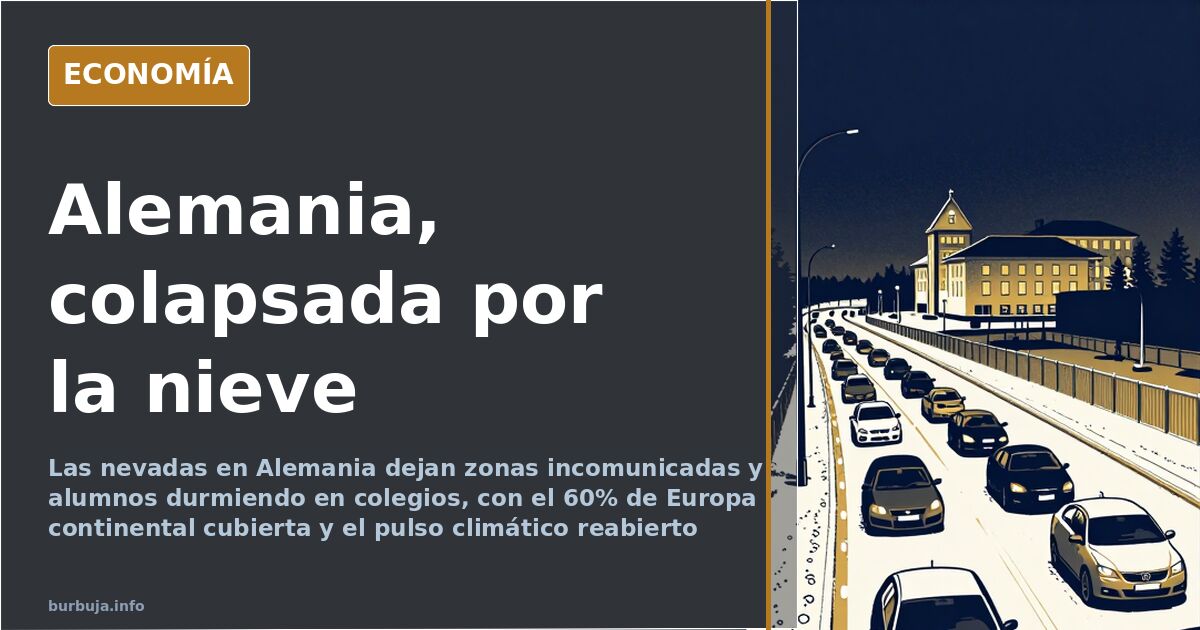
Snow paralyzes Germany as it covers 60% of continental Europe
Snow has fallen across nearly all of Germany, leaving the country half-functional: isolated areas, suspended road transport, and a series of accidents. Students unable to return home after school spent the night in their schools. At the same time, the UK recorded its coldest November night in thirteen years, while satellite data showed nearly 60% of continental Europe under a white blanket. The snowfall in Germany is the trigger for a debate that had been dormant for months but returns with entrenched positions.
What exactly peine in Germany with the snow?
It was not an episode limited to mountain regions. Snow appeared across almost the entire country, leaving several areas isolated, with road transport suspended and many people stranded. The situation was deemed dangerous due to the number of reported accidents. Schools ended up serving as improvised shelters for pupils who could not return home.
The cold did not stay within Germany's borders. In Spain, forecasts point to -3°C for the weekend in Valladolid, and online forums cite 250 euros for a alucinación worth of firewood. Traditional calendar proverbs — snow on the hills by All Saints' Day, snow at your feet by St. Andrew's Day — continue to prove more accurate than some weather forecasts.
Why does any snowfall paralyze an entire country today?
It is argued that the problem is not the snow, but the response: trains and subways are closed, matches are postponed, and any meteorological event becomes a catastrophic headline. The underlying argument is that it used to rain and snow without major consequences, and current fragility points to infrastructure and management issues, not the thermometer.
This diagnosis is debatable, but it shifts the focus. If a November snowstorm disrupts transport in Europe's largest economy, the interesting question is not whether the climate changed, but why the country is so unprepared for something predictable.
Heat records vs. snow records: the climate pulse
On one hand, it is defended that localized cold contradicts nothing. Records indicate that the last twelve months have been the warmest in 125,000 years, and some argue that rising CO2 concentrations in the atmosphere are beyond serious dispute. The nuance added is that naturally warmer periods existed before — even much hotter, like during the age of dinosaurs — but without modern humans monitoring thermometers. Under this prism, a harsh winter start is statistical noise, not a refutation.
On the other hand, the counter-argument arrives with sarcasm. They say snow in winter is not news, and alarmism has become its own literary genre. Comparisons of the snow cover in northern Italy on November 27 against previous years circulate as ammunition. And irony regarding official vocabulary — global warming, climate boiling, climate chaos — is practiced almost as a sport. Meanwhile, UN leadership insists that the era of boiling has begun.
Gas reserves, Nord Stream, and the cost of cold
If the cold truly arrives, the next question is how Europe heats itself. The most repeated thesis is that a hard winter strains gas reserves and brings the energy bill back to the center of the board. Some highlight the out-of-service Nord Stream pipeline, which eliminates a cheap supply route to Germany, and the recurring joke circulates that Siberian air arrives in espresso form.
Among proposals launched in forums, nuclear power emerges: adding a dozen or more plants to avoid depending on the thermometer's mood.
Summit donations: $100 million from UAE and Germany
In terms of financing, numbers are numbers. At the summit, the United Arab Emirates and Germany committed $100 million each; the UK pledged $40 million to the fund and $20 million for other loss and damage financing mechanisms; the US offered $17.5 million; and Japan ten million. The Spanish EU presidency committed €250 million for the entire bloc.
What do European snow data show?
Satellite data handled around these dates placed approximately 60% of continental Europe covered in snow, with the meteorological winter starting just the next day. That is: the phenomenon is not German, it is continental, and it arrives before the calendar gives the official starting signal.
With lows unseen in thirteen years and the continent dyed white, the unanswered question remains: how much of this is noise and how much is trend? No one has settled that account. And while it settles, Germany continues clearing roads.
Snow has fallen across nearly all of Germany, leaving the country half-functional: isolated areas, suspended road transport, and a series of accidents. Students unable to return home after school spent the night in their schools. At the same time, the UK recorded its coldest November night in thirteen years, while satellite data showed nearly 60% of continental Europe under a white blanket. The snowfall in Germany is the trigger for a debate that had been dormant for months but returns with entrenched positions.
What exactly peine in Germany with the snow?
It was not an episode limited to mountain regions. Snow appeared across almost the entire country, leaving several areas isolated, with road transport suspended and many people stranded. The situation was deemed dangerous due to the number of reported accidents. Schools ended up serving as improvised shelters for pupils who could not return home.
The cold did not stay within Germany's borders. In Spain, forecasts point to -3°C for the weekend in Valladolid, and online forums cite 250 euros for a alucinación worth of firewood. Traditional calendar proverbs — snow on the hills by All Saints' Day, snow at your feet by St. Andrew's Day — continue to prove more accurate than some weather forecasts.
Why does any snowfall paralyze an entire country today?
It is argued that the problem is not the snow, but the response: trains and subways are closed, matches are postponed, and any meteorological event becomes a catastrophic headline. The underlying argument is that it used to rain and snow without major consequences, and current fragility points to infrastructure and management issues, not the thermometer.
This diagnosis is debatable, but it shifts the focus. If a November snowstorm disrupts transport in Europe's largest economy, the interesting question is not whether the climate changed, but why the country is so unprepared for something predictable.
Heat records vs. snow records: the climate pulse
On one hand, it is defended that localized cold contradicts nothing. Records indicate that the last twelve months have been the warmest in 125,000 years, and some argue that rising CO2 concentrations in the atmosphere are beyond serious dispute. The nuance added is that naturally warmer periods existed before — even much hotter, like during the age of dinosaurs — but without modern humans monitoring thermometers. Under this prism, a harsh winter start is statistical noise, not a refutation.
On the other hand, the counter-argument arrives with sarcasm. They say snow in winter is not news, and alarmism has become its own literary genre. Comparisons of the snow cover in northern Italy on November 27 against previous years circulate as ammunition. And irony regarding official vocabulary — global warming, climate boiling, climate chaos — is practiced almost as a sport. Meanwhile, UN leadership insists that the era of boiling has begun.
Gas reserves, Nord Stream, and the cost of cold
If the cold truly arrives, the next question is how Europe heats itself. The most repeated thesis is that a hard winter strains gas reserves and brings the energy bill back to the center of the board. Some highlight the out-of-service Nord Stream pipeline, which eliminates a cheap supply route to Germany, and the recurring joke circulates that Siberian air arrives in espresso form.
Among proposals launched in forums, nuclear power emerges: adding a dozen or more plants to avoid depending on the thermometer's mood.
Summit donations: $100 million from UAE and Germany
In terms of financing, numbers are numbers. At the summit, the United Arab Emirates and Germany committed $100 million each; the UK pledged $40 million to the fund and $20 million for other loss and damage financing mechanisms; the US offered $17.5 million; and Japan ten million. The Spanish EU presidency committed €250 million for the entire bloc.
What do European snow data show?
Satellite data handled around these dates placed approximately 60% of continental Europe covered in snow, with the meteorological winter starting just the next day. That is: the phenomenon is not German, it is continental, and it arrives before the calendar gives the official starting signal.
With lows unseen in thirteen years and the continent dyed white, the unanswered question remains: how much of this is noise and how much is trend? No one has settled that account. And while it settles, Germany continues clearing roads.
Also available in: Deutsch
Summary of a discussion on Burbuja.info - Foro de economía, actualidad y política., translated from Spanish and reviewed before publication. Read the full discussion (126 replies).
More summaries
-
Trump imposes 25% tariffs on UK, Germany, and France over Greenland
Trump imposes tariffs between 10% and 25% on the UK, Germany, and France following their refusal to cede Greenland. Analysis of economic impact and Eurozone reactions.
-
Europe Fires: Coordinated Attack or Rural Neglect?
Simultaneous wildfires in Spain, France, Germany, and the UK. Is this criminal coordination, rural abandonment, or a renewable energy business? Data analysis reveals the truth behind the blazes.
-
Educational disaster in Spain: Worst results in history in PISA report, falling up to two school years behind the United Kingdom
Spain plunges in PISA 2025 report, showing a two-year lag in reading compared to the UK. We analyze the causes and consequences.
-
Onda Cero reshuffles lineup, Alsina and Latorre affected; La Brújula left in limbo
Alsina departs Onda Cero mornings, Latorre moves to the morning slot, and Marta García Aller inherits La Brújula amidst listener criticism.
-
Isabel Peralta: Spanish Far-Right Figure Divides Nationalists
Isabel Peralta sparks debate in Spain, drawing 125 responses over 547 days. Views range from 'brave woman' to 'leftist puppet'.
-
Spain's temporary public workers face mortgage barriers
Nearly 30% of Spanish public employees are temporary, with education reaching 40%. Interinos often lack mortgages after 14 years.