
Madrid's Sol protest camp winds down as cold, hygiene and narrative problems mount
The Puerta del Sol housing camp in Madrid faces its "de-camping" after three weeks: cold weather, Metro closure over sanitation and a fraying electoral narrative.
English · Original discussion in Spanish · Published
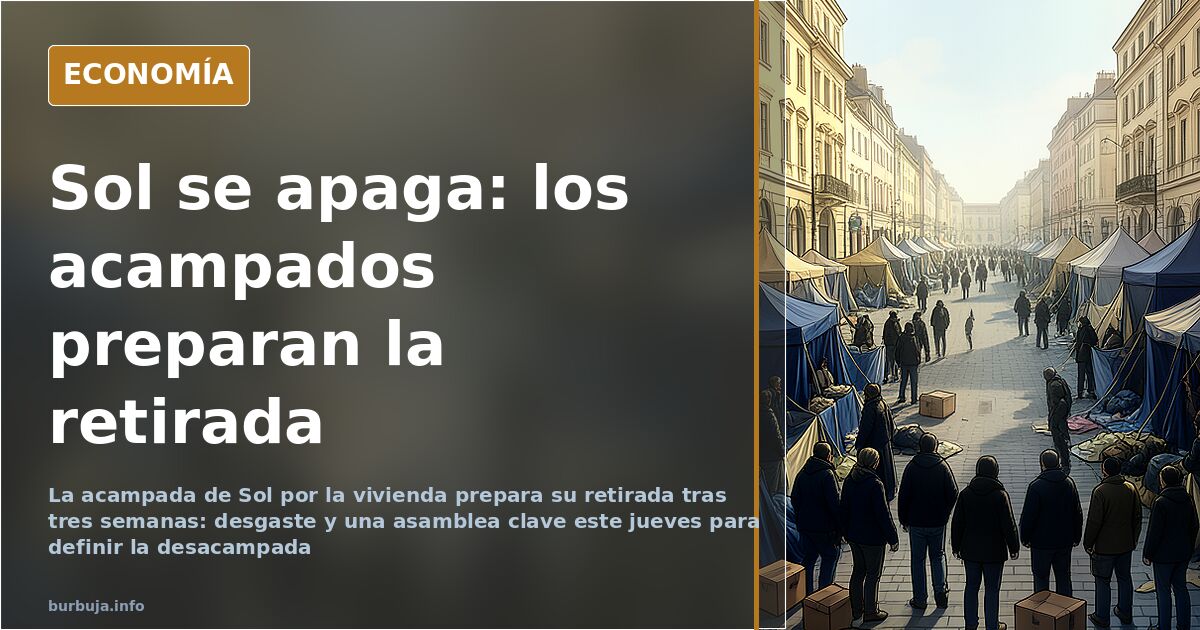
Sol camp winds down amid cold, filth and electoral calculations
Nearly three weeks in, the housing protest camp at Madrid's Puerta del Sol has begun talking about a "de-camping." The minutes of the assembly held on Tuesday 14 October 2026 record, for the first time, the intention to "think about how we want to leave" and set a specific meeting for Thursday 15 to define the end of the camp. The mini-city that sprang up on 26 September after the eviction of an 87-year-old woman in Retiro — who died fifteen days later — now faces its own viability: the cold, the unsanitary conditions and the exhaustion of the campers themselves weigh more than any slogan.
No decision has been made. The text acknowledges that "after a few weeks the deterioration shows, because camping is exhausting" and warns that, if Thursday's outcome is to stay, it will have to be done "in a viable way, not staying just for the sake of camping, without re-evaluating in light of what has gone wrong." In other words: the camp has become a logistical problem for those sustaining it.
The calendar pushing them to pack up
The first factor is the weather. The weekend earmarked for the closure brings rain and overnight temperatures of four degrees. This is not pub-talk speculation: it is the argument running through much of the public conversation about the camp. Just about everyone agrees the cold will do what three weeks of institutional negotiation have failed to achieve.
The second is hygiene. The Community of Madrid has sent a letter to the Government Delegate, Francisco Martín, warning that the camp "poses a risk to the safety of Metro passengers" and could compromise an urgent evacuation. The City Council has gone further, denouncing the "accumulation of urine" in the ventilation shafts of Sol station, to the point of announcing its closure on "sanitation grounds." The TSJM (Madrid's High Court) rejected the precautionary measures sought by Isabel Díaz Ayuso's regional government for failing to prove the Government Delegation's inaction, but the fruta damage has already been done.
Who's in charge here? The institutional standoff nobody wins
The camp has ceased to be a protest and has become a battleground between administrations. The regional government and the City Council demand an eviction; the Government Delegation does not carry it out; the TSJM tells them to wait three months to appeal over inaction. Meanwhile, the campers organise committees, nodes and neighbourhoods, and the Inter-Neighbourhood Assembly of Plaza del Carmen is already designing a "de-camping" that would take the struggle "to the neighbourhoods."
The uncomfortable question hanging in the air is: who benefits from the camp continuing? Some argue that the PSOE needed housing as an electoral banner and that the recent scandals — the case implicating the Socialist spokesperson and the eviction ordered by minister Óscar López — have turned the camp into a liability. Others read it the other way: the withdrawal reflects the fact that the camp now costs more votes than it wins.
The 15M narrative no longer washes
The comparison with 2015 is inevitable and, according to several voices, damning. Today's camp lacks the open layout of 15M: the tents are arranged like a wall and the tarps hide the fact that much of the site is empty during the day. The tenants' union, the driving force behind the call, already proposed a week ago moving the protest to the neighbourhoods. The culture committee is talking about creating a record of the "small works of art" so they will be remembered. In other words, the closure is being prepared with anticipatory nostalgia.
What remains is the issue of the homeless people who have joined the camp. The assembly calls to "leave no one behind, especially the most vulnerable people." It is the only point where the discourse does not sound like exit management.
Thursday the 15th will tell whether Sol packs up or stays. With the transhumance march of 25 October just around the corner — the City Council is already working on an alternative route plan in case the tents are still standing — the camp has an expiry date even if nobody signs one.
Nearly three weeks in, the housing protest camp at Madrid's Puerta del Sol has begun talking about a "de-camping." The minutes of the assembly held on Tuesday 14 October 2026 record, for the first time, the intention to "think about how we want to leave" and set a specific meeting for Thursday 15 to define the end of the camp. The mini-city that sprang up on 26 September after the eviction of an 87-year-old woman in Retiro — who died fifteen days later — now faces its own viability: the cold, the unsanitary conditions and the exhaustion of the campers themselves weigh more than any slogan.
No decision has been made. The text acknowledges that "after a few weeks the deterioration shows, because camping is exhausting" and warns that, if Thursday's outcome is to stay, it will have to be done "in a viable way, not staying just for the sake of camping, without re-evaluating in light of what has gone wrong." In other words: the camp has become a logistical problem for those sustaining it.
The calendar pushing them to pack up
The first factor is the weather. The weekend earmarked for the closure brings rain and overnight temperatures of four degrees. This is not pub-talk speculation: it is the argument running through much of the public conversation about the camp. Just about everyone agrees the cold will do what three weeks of institutional negotiation have failed to achieve.
The second is hygiene. The Community of Madrid has sent a letter to the Government Delegate, Francisco Martín, warning that the camp "poses a risk to the safety of Metro passengers" and could compromise an urgent evacuation. The City Council has gone further, denouncing the "accumulation of urine" in the ventilation shafts of Sol station, to the point of announcing its closure on "sanitation grounds." The TSJM (Madrid's High Court) rejected the precautionary measures sought by Isabel Díaz Ayuso's regional government for failing to prove the Government Delegation's inaction, but the fruta damage has already been done.
Who's in charge here? The institutional standoff nobody wins
The camp has ceased to be a protest and has become a battleground between administrations. The regional government and the City Council demand an eviction; the Government Delegation does not carry it out; the TSJM tells them to wait three months to appeal over inaction. Meanwhile, the campers organise committees, nodes and neighbourhoods, and the Inter-Neighbourhood Assembly of Plaza del Carmen is already designing a "de-camping" that would take the struggle "to the neighbourhoods."
The uncomfortable question hanging in the air is: who benefits from the camp continuing? Some argue that the PSOE needed housing as an electoral banner and that the recent scandals — the case implicating the Socialist spokesperson and the eviction ordered by minister Óscar López — have turned the camp into a liability. Others read it the other way: the withdrawal reflects the fact that the camp now costs more votes than it wins.
The 15M narrative no longer washes
The comparison with 2015 is inevitable and, according to several voices, damning. Today's camp lacks the open layout of 15M: the tents are arranged like a wall and the tarps hide the fact that much of the site is empty during the day. The tenants' union, the driving force behind the call, already proposed a week ago moving the protest to the neighbourhoods. The culture committee is talking about creating a record of the "small works of art" so they will be remembered. In other words, the closure is being prepared with anticipatory nostalgia.
What remains is the issue of the homeless people who have joined the camp. The assembly calls to "leave no one behind, especially the most vulnerable people." It is the only point where the discourse does not sound like exit management.
Thursday the 15th will tell whether Sol packs up or stays. With the transhumance march of 25 October just around the corner — the City Council is already working on an alternative route plan in case the tents are still standing — the camp has an expiry date even if nobody signs one.
Also available in: Deutsch
Summary of a discussion on Burbuja.info - Foro de economía, actualidad y política., translated from Spanish and reviewed before publication. Read the full discussion (120 replies).
More summaries
-
La Séptima: Channel Promoted by the Government Delegation
The Madrid Government Delegation promotes La Séptima, launching Nov 5. Critics point to Entrecanales and Manzano as the key shareholders.
-
Tenants' Union calls for pot-banging protests at 8pm
The Tenants' Union calls for pot-banging at 8pm outside town halls after 2,900 homes were withdrawn, a move a message attributes to a property portal.
-
Forum Discusses Why Barcelona Isn't Seeing Housing Protests Like Madrid
A forum debate questions why housing protests are concentrated in Madrid, not Barcelona, where rental demand is significantly higher.
-
Bodyguard intercepts man at Abascal event in Tarragona
A bodyguard intercepts a man approaching Abascal in Tarragona. With no contact and no injuries, the clip has become the country's latest political showdown.
-
US yield curve inversion: the signal that has preceded every crisis
The US Treasury yield curve between 2-year and 10-year bonds is inverted. The signal that has preceded every recession since 1999 points to a crisis in less…
-
Forum debate debunking the myth of Andalusia's 'racial dud'
A forum post has revived the myth of the Andalusian 'racial dud'. Genetics dismantles the prejudice: the R1b haplogroup predominates across Spain.