
Developer vs builder: why they are almost never the same company
The developer provides the land and the money; the builder carries out the work. Vertical integration existed before 2008 and gave way to cascading subcontracting.
English · Original discussion in Spanish · Published
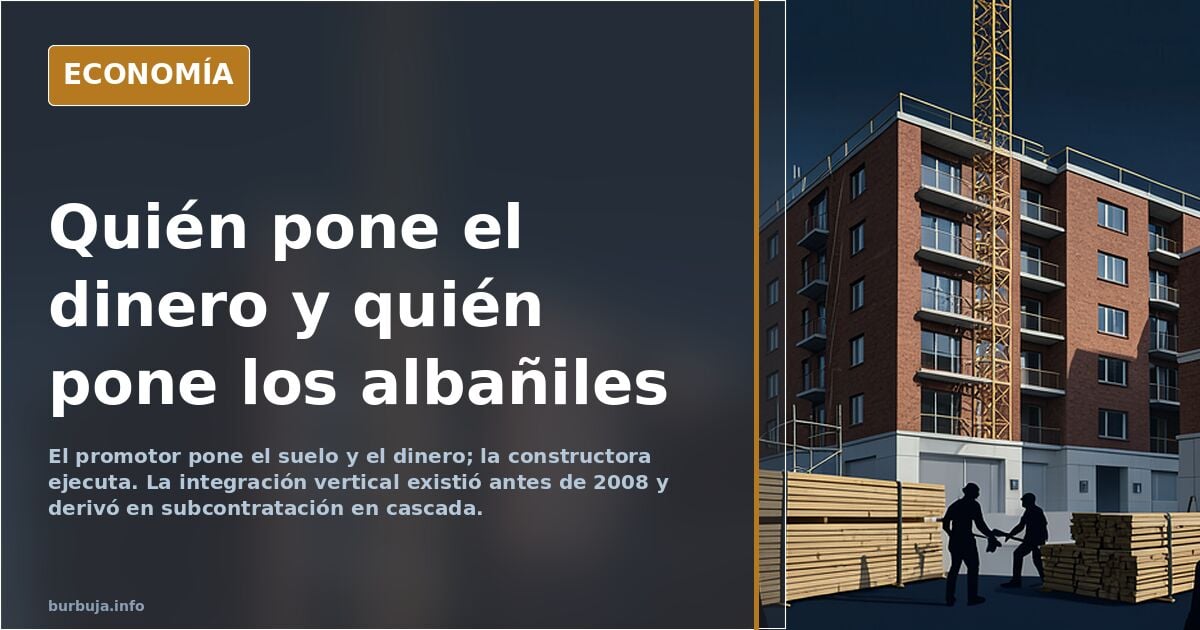
Developer and builder: who puts up the money and who puts up the bricklayers
The question that opens the topic is a basic one for the industry: if the developer provides the land and the money and the builder carries out the work, why isn't there a single company doing both, so all the hassle would end? The short answer is that there are — or were — such companies, but the dominant model since the bubble burst is a different one: separation of functions and cascading subcontracting by trade.
What exactly each one does
The developer is the one who provides the plot and the financing, and appears in the project and in the LOE (Spain's Building Act) as a building agent. The builder is the one who executes the work. They are distinct roles by definition, and the link between them is formalised job by job through an award contract, often after a tender or several bids. There is no stable marriage or fixed ratio: the idea that five builders operate for every developer is a made-up figure with no backing.
Vertical integration existed and was intense before 2008: builders as subsidiaries of developers to squeeze margin along the whole chain. After the crash, the industry reorganised towards cascading subcontracting: bricklayers, formwork crews and installers, each with their own contract and their own self-employed worker in between.
Do builders have bricklayers on their payroll?
Some do. Others work with subcontractors, which are the ones employing the specialised workers. Hence the confusion between contractor and subcontractor, which is not a terminological whim: it describes who answers to whom and with what margin. At the most opaque end, a builder can be an office with a desk, a chair and rented premises, with everything else executed by third parties.
That scheme explains why the question about the "shell company" keeps coming up. In practice, the law does not resolve the ambiguity: it sets out responsibilities but does not impose a single corporate model.
Why a single company would simplify things
The starting thesis makes economic sense: a company that both developed and built would eliminate middlemen, capture the full margin and face the buyer with a single face. In practice it runs into the cycle. Developing requires capital and taking on sales risk; building requires operational capacity and labour. They are two businesses with different risk profiles, and separating them allows each to go under on its own without dragging the other down.
That is where the analysis stalls: nobody disputes that integration would save costs, but nobody has found a way for the savings to reach the buyer instead of staying in the middleman's margin.
Also available in: Deutsch
Summary of a discussion on Burbuja.info - Foro de economía, actualidad y política., translated from Spanish and reviewed before publication. Read the full discussion (46 replies).
More summaries
-
Banks financed 74% of Repsol purchase by construction firms
75% of construction firms' energy acquisitions were financed with bank debt backed by the shares themselves. BBVA's developer default rate reached…
-
Labour shortage stalls construction in Santiago
90% employment rate in construction vocational training doesn't ease crew shortage: around thirty vacancies in A Coruña and projects turned down
-
Forum Speculates on Bono and Zaplana without Proof
Online forum users discuss alleged irregularities involving José Bono and the lack of a final judgment against Eduardo Zaplana, offering no evidence.
-
Report puts the tax wedge on the average Spanish salary at 54%
A report presented at a forum puts what Spain's tax agency and Social Security take from the average worker at 21,100 euros a year, close to 54% of the total cost.
-
Álvarez de Toledo calls for sacrifice and sparks online backlash
Spain's PP deputy leader in Madrid calls for sacrifice and faces social media criticism over her aristocratic profile. The debate echoes the 2008 austerity cuts.
-
Clash with 'abertzales' and 'hidden Moors' leaves injured in Spain
A post on X calling protesters 'scum' and mixing immigration with violence offers a chance to examine how the rhetoric of confrontation works on social media.