
Silver Outperforms Gold by 15% Since Financial Crisis
Silver has gained 25.09% since November 5, 2008, compared to gold's 21.45%. The gold/silver ratio has fallen from 1:84 to 1:59, fueling speculation of an upcoming silver boom.
English · Original discussion in Spanish · Published
Silver Beats Gold: +25% vs. +21% Since 2008
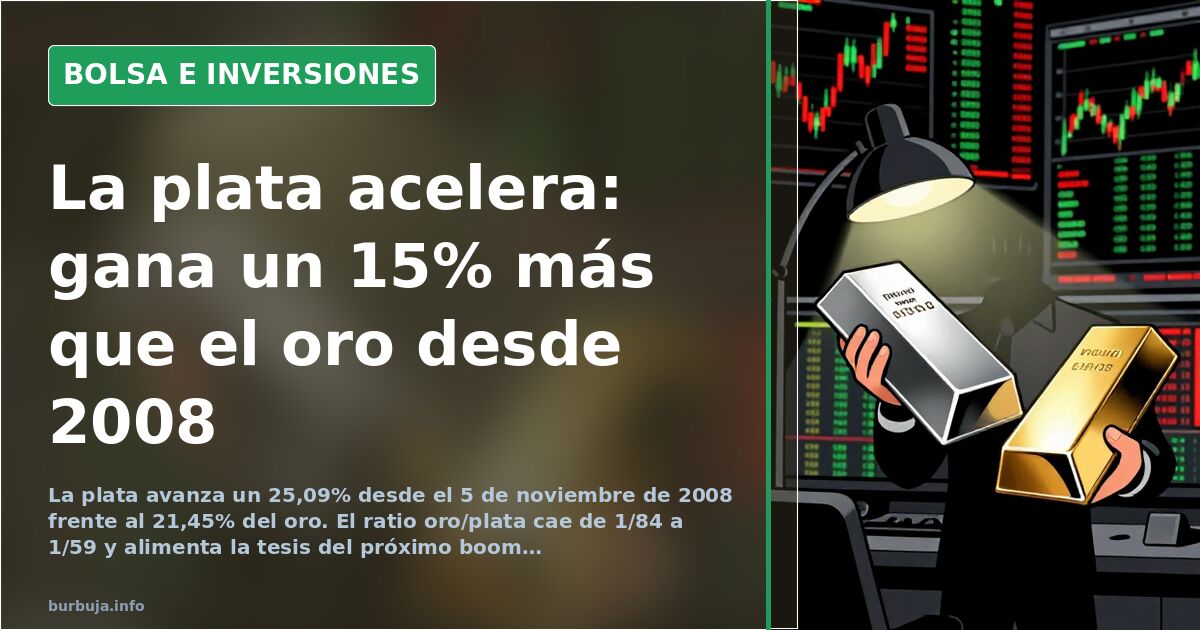
There's a figure that debunks the myth that gold is the ultimate safe haven. Since November 5, 2008, gold in dollars has risen by 21.45%. Silver, by 25.09%. That's 15% better. This isn't a late-night hunch; it's what has already peine. And the theory behind it—the upcoming silver boom—rests on three pillars: a distorted historical ratio, dwindling supply, and industrial demand that falters whenever the economic cycle slows. With Jim Rogers cited as a prominent proponent of the idea.
Why Did the Gold/Silver Ratio Drop from 1:84 to 1:59?
Because silver was much cheaper and more undervalued than gold, its recovery had more room to grow. Before the storm, it took 84 ounces of silver to buy one ounce of gold; afterward, 59 were enough. The central argument isn't that silver is cheap in absolute terms, but the asymmetry: a 30% drop in the ratio, from 1:84 to 1:59, was far more probable than a 30% rise to 1:109. History supports this interpretation—the long-term average ratio stands at 1:15.5—though one shouldn't confuse a centuries-old average with a price target or an expiration date.
More Gold Bars Than Silver: The Dwindling Supply
Silver is consumed; gold is stored. This leads to the paradox proponents of the white metal often repeat: there is more gold available in bar form than silver in the same form. Market equilibrium has been maintained for years, according to this view, by selling official reserves from the United States, India, and China, which are now supposedly depleted. In per capita terms, less than a tenth of an ounce is produced annually. The metal is scarce, and on top of that, it disappears with industrial use. Available silver and stored silver are not the same thing, and that's half the argument.
The Achilles' Heel: Industrial Demand
This is where skepticism arises. Unlike gold, silver has intensive industrial applications, and when industry falters, that demand collapses and drags down the price. This is the objection raised repeatedly against the boom theory, and no chart entirely avoids it. The counter-argument doesn't deny the fact; it flips it: mine production is elastic and responds to price. If prices rise, idled operations reopen; if they fall, they close. Fresnillo, a major mining company, is mentioned in discussions due to its intention to increase its production by 10%.
Buying Physical Silver: Premiums from 10% to 50%
The problem arises when it's time to pay. The premium on silver coins over the spot price, shown in a chart circulating among enthusiasts, went from an initial 10% to over 50% at the peak of tension. Buying cheap sounds good until the seller adds the surcharge. With the inflated price comes the antiestéticar of counterfeiting: some weigh each coin upon receipt and demand laboratory precision. Silver Eagles hover between 31.13 and 31.38 grams compared to the official 31.103—normal due to manufacturing tolerances—and are .9993 fine silver, versus the .9999 of Canadian Silver Maples.
From Franco Coins to 8 Reales Pieces
Alongside pure metal runs a secondary market, the numismatic one, which distorts prices. There are ancient pieces bought for 4 euros each at a local shop, lots of fifty, and 8 reales coins offered for 600 euros. The detail betrays the amateur: a coin with a filed edge was likely soldered to a brooch or pendant, and that costs it a significant portion of its collector value. Weight and diameter thus become the only reliable home tests.
Timing: The Question No One Answers
For when? There's no answer. The analysis itself admits that many investors ruin themselves by buying the right product at the wrong time, with impeccable technical analysis and terrible entry timing. Silver is volatile, it attracts interest, and then it corrects: the first serious support is set around 17 dollars, and some argue that seeing 12 euros again is almost impossible. With liquidity waiting for dips, each pullback is read simultaneously as an opportunity and a warning.
The thesis holds. The metal, for now, also does. The only thing still unanswered is the million-dollar question: is this the boom, or just the rehearsal?
There's a figure that debunks the myth that gold is the ultimate safe haven. Since November 5, 2008, gold in dollars has risen by 21.45%. Silver, by 25.09%. That's 15% better. This isn't a late-night hunch; it's what has already peine. And the theory behind it—the upcoming silver boom—rests on three pillars: a distorted historical ratio, dwindling supply, and industrial demand that falters whenever the economic cycle slows. With Jim Rogers cited as a prominent proponent of the idea.
Why Did the Gold/Silver Ratio Drop from 1:84 to 1:59?
Because silver was much cheaper and more undervalued than gold, its recovery had more room to grow. Before the storm, it took 84 ounces of silver to buy one ounce of gold; afterward, 59 were enough. The central argument isn't that silver is cheap in absolute terms, but the asymmetry: a 30% drop in the ratio, from 1:84 to 1:59, was far more probable than a 30% rise to 1:109. History supports this interpretation—the long-term average ratio stands at 1:15.5—though one shouldn't confuse a centuries-old average with a price target or an expiration date.
More Gold Bars Than Silver: The Dwindling Supply
Silver is consumed; gold is stored. This leads to the paradox proponents of the white metal often repeat: there is more gold available in bar form than silver in the same form. Market equilibrium has been maintained for years, according to this view, by selling official reserves from the United States, India, and China, which are now supposedly depleted. In per capita terms, less than a tenth of an ounce is produced annually. The metal is scarce, and on top of that, it disappears with industrial use. Available silver and stored silver are not the same thing, and that's half the argument.
The Achilles' Heel: Industrial Demand
This is where skepticism arises. Unlike gold, silver has intensive industrial applications, and when industry falters, that demand collapses and drags down the price. This is the objection raised repeatedly against the boom theory, and no chart entirely avoids it. The counter-argument doesn't deny the fact; it flips it: mine production is elastic and responds to price. If prices rise, idled operations reopen; if they fall, they close. Fresnillo, a major mining company, is mentioned in discussions due to its intention to increase its production by 10%.
Buying Physical Silver: Premiums from 10% to 50%
The problem arises when it's time to pay. The premium on silver coins over the spot price, shown in a chart circulating among enthusiasts, went from an initial 10% to over 50% at the peak of tension. Buying cheap sounds good until the seller adds the surcharge. With the inflated price comes the antiestéticar of counterfeiting: some weigh each coin upon receipt and demand laboratory precision. Silver Eagles hover between 31.13 and 31.38 grams compared to the official 31.103—normal due to manufacturing tolerances—and are .9993 fine silver, versus the .9999 of Canadian Silver Maples.
From Franco Coins to 8 Reales Pieces
Alongside pure metal runs a secondary market, the numismatic one, which distorts prices. There are ancient pieces bought for 4 euros each at a local shop, lots of fifty, and 8 reales coins offered for 600 euros. The detail betrays the amateur: a coin with a filed edge was likely soldered to a brooch or pendant, and that costs it a significant portion of its collector value. Weight and diameter thus become the only reliable home tests.
Timing: The Question No One Answers
For when? There's no answer. The analysis itself admits that many investors ruin themselves by buying the right product at the wrong time, with impeccable technical analysis and terrible entry timing. Silver is volatile, it attracts interest, and then it corrects: the first serious support is set around 17 dollars, and some argue that seeing 12 euros again is almost impossible. With liquidity waiting for dips, each pullback is read simultaneously as an opportunity and a warning.
The thesis holds. The metal, for now, also does. The only thing still unanswered is the million-dollar question: is this the boom, or just the rehearsal?
Summary of a discussion on Burbuja.info - Foro de economía, actualidad y política., translated from Spanish and reviewed before publication. Read the full discussion (1818 replies).
More summaries
-
Gold Hits $4,000 After Doubling, Texas Accepts It as Currency
Gold jumps from $1,450 to $4,106 per ounce, correcting to $4,000, as Texas, Florida, and Missouri recognize it as legal tender.
-
Buying the Dip or Waiting for Crash: The 2025 Market Dilemma
Centene experienced a 25% fall, AI technology is dividing investors, and market crash predictions are mounting for November. The 2025 investment dilemma: buy now or wait?
-
Gold stuck at 0.382 as bitcoin takes the spotlight
Gold stuck at 0.382 and unable to recover while bitcoin hits 6.000 dollars; thresholds at 1.250 and 1.050 set the scene.
-
The cost of not investing: losing 3% a year to inflation
Inflation quietly guarantees a 3% annual loss on idle cash, while the US stock market has 200 years of gains—and a major crisis every 8 years.
-
Extra virgin olive oil falls to €6.35 a litre at Mercadona
Extra virgin olive oil is now €6.35/litre at Mercadona, down from €6.75 months ago, while the origin price of picual is €4.143/kg
-
BIG offers 4% TAE on 6-month deposit with Spanish IBAN and Portuguese FGD
BIG launched a 4% TAE six-month and 3.5% three-month deposit in May 2023 with Spanish IBAN and Portuguese FGD, but later cut rates and had opening delays.