
Silver Didn't Reach $40: 16 Years of a Failed Prediction
Silver fell far short of the $40 target set in 2010. From $16 spot price to a $50 peak in 2011, the prediction never materialized.
English · Original discussion in Spanish · Published
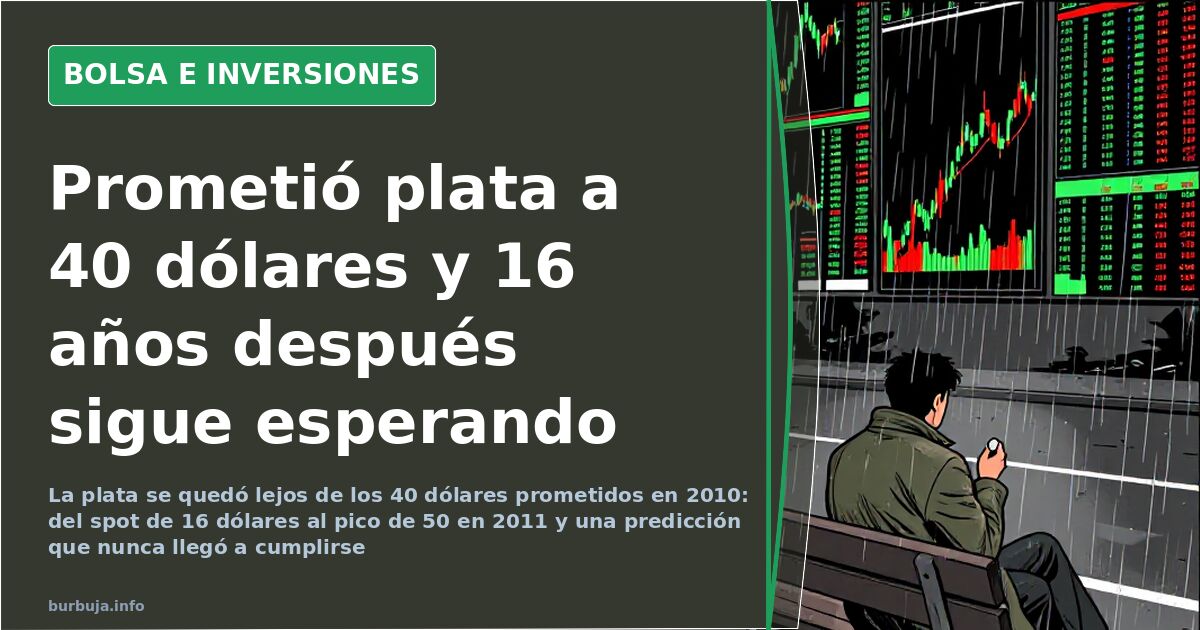
Silver Never Reached $40: 16 Years of a Broken Forecast
In September 2010, with the silver ounce hovering around $16, a target was set: $40 by late March or early April. It was presented as a "meticulous study using technical analysis" on the SLV ETF, with the author hoping to be right and stating "time will tell." Time has told quite a bit. It started, however, with a basic error: 40 euros was written when 40 dollars was intended. Someone corrected it on the first page, and the author admitted it without drama. A minor detail, but it set the tone for everything that trinc: much conviction and little verification.
Silver at $40: The Prediction and Its First Sustancia ilegal
The most incisive response came quickly: technical analysis isn't useful for this; the only thing that would matter is a tip on when the dollar would collapse. Another commenter was more sarcastic, assuming that if the metal rose, it wouldn't reach $40. Neither was entirely wrong. The prediction was attractive, neat, and perfectly unprovable until the deadline passed.
There's a sociological detail that was overlooked then and is revealing today. In those months, "we buy gold and silver" flyers started appearing in mailboxes, which was unprecedented. The interpretation was that people had little gold left to pawn. With the spot price around $16, a lot of silver would need to be accumulated for it to be worthwhile to sell it this way.
The Premium Nobody Discounts When Buying Physical Silver
The gap between the international price and the cost of a coin in hand is the great forgotten chapter of this story. With the ounce at a €20.6 spot price, there was no way to find pieces below €25.5 when buying in volume. Bullion coins with a bit of a premium—elephants, koalas, kookaburras—went straight to €30. Madness, yes, but a madness with a rather mundane explanation that almost no one mentions.
Added to that is taxation, which in Spain penalizes silver and forgives gold. Physical silver bears a 21% VAT; gold is exempt for coins over 80% purity and bars over 99%. Those who want physical metal without absurd premiums have ETFs, which save on this tax but don't grant the right to touch anything.
The 2020 Stampede: From $16 to $29
Ten years after the prediction, silver awoke. And then the narrative became frenetic. The metal reached $26.26 in the early morning and corrected. $26.48 was announced as the minimum weekly close, then $27.50, then $30. Targets stretched as the market tightened: first $34, then $35, then $58 in a few weeks, and in the final surge, $200 that same year. It was all written down, with the warning that there would be a short squeeze like never seen before and that stores would run out of stock.
The actual peak of that phase was $29.06 in contracts for difference and $29.195 in futures. From there, successive corrections down to $20.58 and $21.90, with targets revised downwards time and again. The full detail, level by level, with each dated correction, is in the original source and worth reading.
Gold, Bitcoin, and the Fight for the Safe-Haven Asset
The issue evolved into a more interesting discussion than the prediction itself. What is a store of value today? Some defended gold as a reserve and nothing more, with a debatable liquidity argument: in any medium-sized city worldwide, there's a shop that will buy an ounce in minutes. Custody and cross-border transport, however, are real problems.
Another current argued that the metal has lost its relevance in an increasingly digital economy and that bitcoin is far superior in daily use. The rebuttal was instant: four people exchanging zeros and ones in a shell game. The discussion, years later, remains just as deadlocked.
What Peine in the End with the $40 Silver Target
Nothing. More than three years passed, and the target remained unmet, with the recurring joke about whether the "April" in the prediction was for 2025 or 2080. Some recalled that, a year after the message was published, silver reached $50. By fluke, but it was correct. The original prediction, however, got nothing right.
The sharpest diagnosis of the matter didn't come from any chart but from a sentence: there are two types of analysts, those who cannot predict the future and those who do not know that they cannot predict the future. The worst are the latter. It remains to be seen if the author of the $40 target belongs to the second group or simply chose the wrong date. That's where everything gets stuck.
In September 2010, with the silver ounce hovering around $16, a target was set: $40 by late March or early April. It was presented as a "meticulous study using technical analysis" on the SLV ETF, with the author hoping to be right and stating "time will tell." Time has told quite a bit. It started, however, with a basic error: 40 euros was written when 40 dollars was intended. Someone corrected it on the first page, and the author admitted it without drama. A minor detail, but it set the tone for everything that trinc: much conviction and little verification.
Silver at $40: The Prediction and Its First Sustancia ilegal
The most incisive response came quickly: technical analysis isn't useful for this; the only thing that would matter is a tip on when the dollar would collapse. Another commenter was more sarcastic, assuming that if the metal rose, it wouldn't reach $40. Neither was entirely wrong. The prediction was attractive, neat, and perfectly unprovable until the deadline passed.
There's a sociological detail that was overlooked then and is revealing today. In those months, "we buy gold and silver" flyers started appearing in mailboxes, which was unprecedented. The interpretation was that people had little gold left to pawn. With the spot price around $16, a lot of silver would need to be accumulated for it to be worthwhile to sell it this way.
The Premium Nobody Discounts When Buying Physical Silver
The gap between the international price and the cost of a coin in hand is the great forgotten chapter of this story. With the ounce at a €20.6 spot price, there was no way to find pieces below €25.5 when buying in volume. Bullion coins with a bit of a premium—elephants, koalas, kookaburras—went straight to €30. Madness, yes, but a madness with a rather mundane explanation that almost no one mentions.
Added to that is taxation, which in Spain penalizes silver and forgives gold. Physical silver bears a 21% VAT; gold is exempt for coins over 80% purity and bars over 99%. Those who want physical metal without absurd premiums have ETFs, which save on this tax but don't grant the right to touch anything.
The 2020 Stampede: From $16 to $29
Ten years after the prediction, silver awoke. And then the narrative became frenetic. The metal reached $26.26 in the early morning and corrected. $26.48 was announced as the minimum weekly close, then $27.50, then $30. Targets stretched as the market tightened: first $34, then $35, then $58 in a few weeks, and in the final surge, $200 that same year. It was all written down, with the warning that there would be a short squeeze like never seen before and that stores would run out of stock.
The actual peak of that phase was $29.06 in contracts for difference and $29.195 in futures. From there, successive corrections down to $20.58 and $21.90, with targets revised downwards time and again. The full detail, level by level, with each dated correction, is in the original source and worth reading.
Gold, Bitcoin, and the Fight for the Safe-Haven Asset
The issue evolved into a more interesting discussion than the prediction itself. What is a store of value today? Some defended gold as a reserve and nothing more, with a debatable liquidity argument: in any medium-sized city worldwide, there's a shop that will buy an ounce in minutes. Custody and cross-border transport, however, are real problems.
Another current argued that the metal has lost its relevance in an increasingly digital economy and that bitcoin is far superior in daily use. The rebuttal was instant: four people exchanging zeros and ones in a shell game. The discussion, years later, remains just as deadlocked.
What Peine in the End with the $40 Silver Target
Nothing. More than three years passed, and the target remained unmet, with the recurring joke about whether the "April" in the prediction was for 2025 or 2080. Some recalled that, a year after the message was published, silver reached $50. By fluke, but it was correct. The original prediction, however, got nothing right.
The sharpest diagnosis of the matter didn't come from any chart but from a sentence: there are two types of analysts, those who cannot predict the future and those who do not know that they cannot predict the future. The worst are the latter. It remains to be seen if the author of the $40 target belongs to the second group or simply chose the wrong date. That's where everything gets stuck.
Summary of a discussion on Burbuja.info - Foro de economía, actualidad y política., translated from Spanish and reviewed before publication. Read the full discussion (535 replies).
More summaries
-
Gold Hits $4,000 After Doubling, Texas Accepts It as Currency
Gold jumps from $1,450 to $4,106 per ounce, correcting to $4,000, as Texas, Florida, and Missouri recognize it as legal tender.
-
Buying the Dip or Waiting for Crash: The 2025 Market Dilemma
Centene experienced a 25% fall, AI technology is dividing investors, and market crash predictions are mounting for November. The 2025 investment dilemma: buy now or wait?
-
Gold stuck at 0.382 as bitcoin takes the spotlight
Gold stuck at 0.382 and unable to recover while bitcoin hits 6.000 dollars; thresholds at 1.250 and 1.050 set the scene.
-
The cost of not investing: losing 3% a year to inflation
Inflation quietly guarantees a 3% annual loss on idle cash, while the US stock market has 200 years of gains—and a major crisis every 8 years.
-
Extra virgin olive oil falls to €6.35 a litre at Mercadona
Extra virgin olive oil is now €6.35/litre at Mercadona, down from €6.75 months ago, while the origin price of picual is €4.143/kg
-
BIG offers 4% TAE on 6-month deposit with Spanish IBAN and Portuguese FGD
BIG launched a 4% TAE six-month and 3.5% three-month deposit in May 2023 with Spanish IBAN and Portuguese FGD, but later cut rates and had opening delays.