
Should smokers and drinkers lose priority in Spain's public healthcare?
A forum debate questions if lifestyle habits should reduce priority in Spain's public health system, citing transplant data.
English · Original discussion in Spanish · Published
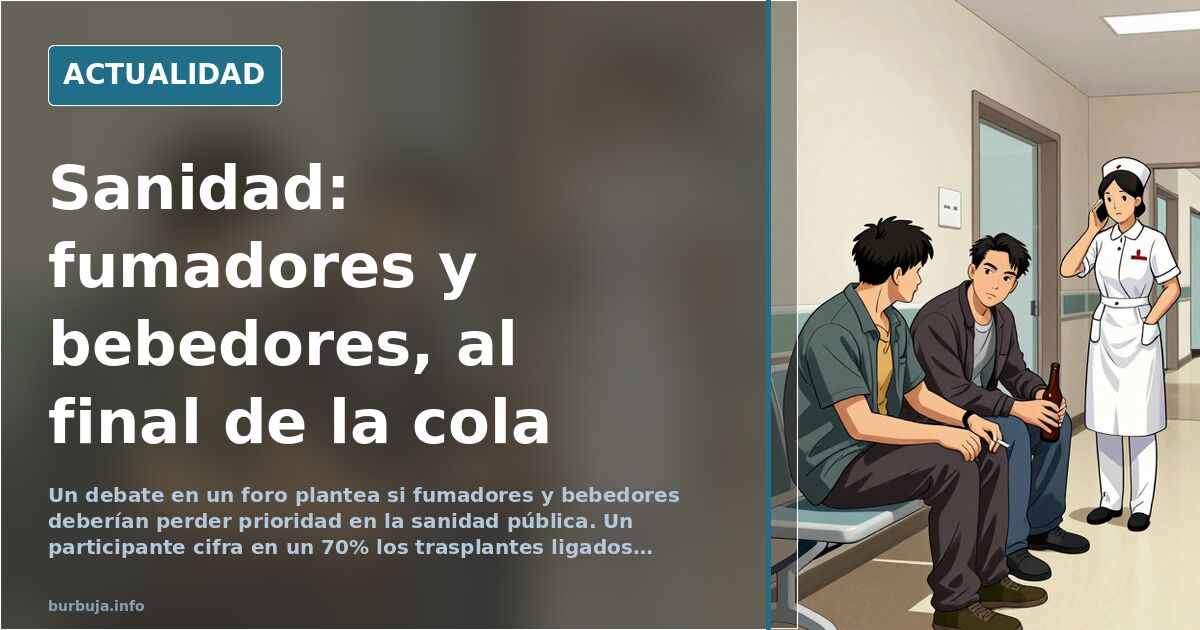
Smokers and drinkers: last in line for Spanish healthcare?
A debate on a current affairs forum asks whether habitual smokers and drinkers should lose priority in Spain's public healthcare system. The starting argument is that when resources are scarce, priority goes to those most likely to benefit, as happens with organ transplants. This proposal isn't new; it already applies to donor organs. What changes is the scenario: if healthcare becomes a scarce good, why not ration access based on habits?
The initial premise mixes two things the rest of the conversation struggles to separate: managing a limited resource and individual responsibility for one's own health. From there, the exchange moves toward figures, comparisons with tobacco and alcohol, and an uncomfortable question: if smokers are penalized, why not the obese, diabetics, or those who don't pay contributions?
The starting point: healthcare as a scarce good
The message opening the thread argues that millions gaining full healthcare rights turn the system into a limited resource. According to this reasoning, if access becomes universal without expanding capacity, prioritization is the logical consequence. The proposed criterion is lifestyle: habitual smokers and drinkers go to the back of the queue.
The comparison with transplants is central to the argument. As a scarce good, organs go to those with the best chances. Defenders insist this isn't a whim: it's an existing criterion, just applied to organs rather than waiting lists. Thus, the discussion isn't about whether rationing is possible, but where to draw the line.
Obesity and diabetes: recalculating the list
The conversation shifts when data enters. A participant estimates transplant causes in Spain by lifestyle factor: diabetes, 30%; obesity or metabolic syndrome, 20%; hypertension, 20%; alcoholism, 10%; smoking, 10%; other causes, 10%. By this reading, obesity, diabetes, and hypertension account for 70% of transplants, far exceeding tobacco and alcohol.
The same analysis claims obesity and diabetes double or triple the healthcare impact of smoking, costing 3 to 5 times more than direct alcohol impact. With these figures, priorities reorder: first elderly women, then elderly men, trinc by people with obesity or diabetes, and only later chronic smokers and problem drinkers.
Some respond that the data distracts from the focus. The original debate was about smokers and drinkers, turning it into a competition over who consumes more resources. Others see this expansion as proof that lifestyle criteria are a bottomless pit: if applied seriously, no one is excluded.
Who pays for the healthcare they're rationed out of?
The most repeated objection isn't sarracena, but fiscal. Several participants remind us that smokers and drinkers pay special taxes on tobacco and alcohol, funding the system. The recurring question: if they go to the back of the queue, do they get a refund for the extra taxes paid?
A calculation circulating suggests tobacco and alcohol taxes don't cover even 20% of the healthcare costs generated by their consumers. Others dispute this: if fiscal burden is the criterion, those contributing for 40 years should come first, regardless of smoking habits. The alternative proposal is that contribution years be the only legitimate barrier.
The discussion gets tangled here with a larger issue: if healthcare is universal and funded collectively, you can't force everyone to pay and then exclude some. This argument closes the case for many participants: without universality, there's no system, just a suspect list.
The slippery slope: from smokers to non-contributors
The thread fills with candidates for the last spot. Some add medication users, others the obese and diabetics, irresponsible drivers, or the mentally ill. The list grows until someone asks where it stops: also extreme sports practitioners, the unvaccinated, or those with incivil records?
Pandemic comparisons appear. It's recalled that during the health crisis, excluding the unvaccinated from hospitals was considered, and much public opinion applauded it. This parallel shows that behavior-based exclusion isn't new or exclusive to tobacco.
The strongest counterargument is legal: Article 14 of the Constitution prohibits discrimination, and a waiting list ordered by habits skirts this. If public healthcare access isn't universal and equal for all, they argue, no one can be forced to fund it.
What data says on tobacco, alcohol, and transplants
Beyond the dispute, specific figures emerge. Estimated transplant distribution by lifestyle places diabetes, obesity, and hypertension well ahead of tobacco and alcohol. Smoking's economic impact is around 10% of the total, and alcoholism another 10%.
The tax versus spending comparison is most debated. The claim that special taxes don't cover 20% of associated healthcare costs appears unsourced, coexisting with the opposite thesis: that average smokers overpay for what they consume. Neither resolves with available data.
What remains clear is that lifestyle criteria aren't clean. Applied to tobacco, it excludes millions who contribute. Applied to obesity, it multiplies exclusions. Applied to immigration, it turns management issues into identity disputes.
Conclusion: an unanswered question
The conversation reaches no agreement. Some defend healthcare as a right, arguing habit-based rationing opens doors to endless exclusion lists. Others contend that with limited resources, decisions must be made, and pretending everything fits is the worst policy.
The lingering question mirrors the opening: if the system can't serve everyone, who decides who waits and by what criteria? And if it's lifestyle, why start with tobacco instead of obesity, which carries far greater weight according to circulating data?
A debate on a current affairs forum asks whether habitual smokers and drinkers should lose priority in Spain's public healthcare system. The starting argument is that when resources are scarce, priority goes to those most likely to benefit, as happens with organ transplants. This proposal isn't new; it already applies to donor organs. What changes is the scenario: if healthcare becomes a scarce good, why not ration access based on habits?
The initial premise mixes two things the rest of the conversation struggles to separate: managing a limited resource and individual responsibility for one's own health. From there, the exchange moves toward figures, comparisons with tobacco and alcohol, and an uncomfortable question: if smokers are penalized, why not the obese, diabetics, or those who don't pay contributions?
The starting point: healthcare as a scarce good
The message opening the thread argues that millions gaining full healthcare rights turn the system into a limited resource. According to this reasoning, if access becomes universal without expanding capacity, prioritization is the logical consequence. The proposed criterion is lifestyle: habitual smokers and drinkers go to the back of the queue.
The comparison with transplants is central to the argument. As a scarce good, organs go to those with the best chances. Defenders insist this isn't a whim: it's an existing criterion, just applied to organs rather than waiting lists. Thus, the discussion isn't about whether rationing is possible, but where to draw the line.
Obesity and diabetes: recalculating the list
The conversation shifts when data enters. A participant estimates transplant causes in Spain by lifestyle factor: diabetes, 30%; obesity or metabolic syndrome, 20%; hypertension, 20%; alcoholism, 10%; smoking, 10%; other causes, 10%. By this reading, obesity, diabetes, and hypertension account for 70% of transplants, far exceeding tobacco and alcohol.
The same analysis claims obesity and diabetes double or triple the healthcare impact of smoking, costing 3 to 5 times more than direct alcohol impact. With these figures, priorities reorder: first elderly women, then elderly men, trinc by people with obesity or diabetes, and only later chronic smokers and problem drinkers.
Some respond that the data distracts from the focus. The original debate was about smokers and drinkers, turning it into a competition over who consumes more resources. Others see this expansion as proof that lifestyle criteria are a bottomless pit: if applied seriously, no one is excluded.
Who pays for the healthcare they're rationed out of?
The most repeated objection isn't sarracena, but fiscal. Several participants remind us that smokers and drinkers pay special taxes on tobacco and alcohol, funding the system. The recurring question: if they go to the back of the queue, do they get a refund for the extra taxes paid?
A calculation circulating suggests tobacco and alcohol taxes don't cover even 20% of the healthcare costs generated by their consumers. Others dispute this: if fiscal burden is the criterion, those contributing for 40 years should come first, regardless of smoking habits. The alternative proposal is that contribution years be the only legitimate barrier.
The discussion gets tangled here with a larger issue: if healthcare is universal and funded collectively, you can't force everyone to pay and then exclude some. This argument closes the case for many participants: without universality, there's no system, just a suspect list.
The slippery slope: from smokers to non-contributors
The thread fills with candidates for the last spot. Some add medication users, others the obese and diabetics, irresponsible drivers, or the mentally ill. The list grows until someone asks where it stops: also extreme sports practitioners, the unvaccinated, or those with incivil records?
Pandemic comparisons appear. It's recalled that during the health crisis, excluding the unvaccinated from hospitals was considered, and much public opinion applauded it. This parallel shows that behavior-based exclusion isn't new or exclusive to tobacco.
The strongest counterargument is legal: Article 14 of the Constitution prohibits discrimination, and a waiting list ordered by habits skirts this. If public healthcare access isn't universal and equal for all, they argue, no one can be forced to fund it.
What data says on tobacco, alcohol, and transplants
Beyond the dispute, specific figures emerge. Estimated transplant distribution by lifestyle places diabetes, obesity, and hypertension well ahead of tobacco and alcohol. Smoking's economic impact is around 10% of the total, and alcoholism another 10%.
The tax versus spending comparison is most debated. The claim that special taxes don't cover 20% of associated healthcare costs appears unsourced, coexisting with the opposite thesis: that average smokers overpay for what they consume. Neither resolves with available data.
What remains clear is that lifestyle criteria aren't clean. Applied to tobacco, it excludes millions who contribute. Applied to obesity, it multiplies exclusions. Applied to immigration, it turns management issues into identity disputes.
Conclusion: an unanswered question
The conversation reaches no agreement. Some defend healthcare as a right, arguing habit-based rationing opens doors to endless exclusion lists. Others contend that with limited resources, decisions must be made, and pretending everything fits is the worst policy.
The lingering question mirrors the opening: if the system can't serve everyone, who decides who waits and by what criteria? And if it's lifestyle, why start with tobacco instead of obesity, which carries far greater weight according to circulating data?
Summary of a discussion on Burbuja.info - Foro de economía, actualidad y política., translated from Spanish and reviewed before publication. Read the full discussion (178 replies).
More summaries
-
Small Plane Crashes in Venezuela, Carrying Witnesses to the Zapatero Case
The small plane that crashed in Venezuela carried two witnesses to the Zapatero case. Both survived with injuries, which weakens the theory of an assassination attempt.
-
Spain's Demographic Shift: The Debate on Native Population Decline
Analysis of Spain's demographic transformation, citing claims that native-born citizens now comprise roughly 70% of the population.
-
CGT Union Poster Sparks Online Backlash Ahead of International Women's Day
A CGT poster for March 8 featuring plus-size women with visible body hair has triggered a heated debate on representation and activist aesthetics.
-
Spain's Public Sector vs. Gig Workers: A Divisive Class Clash
Public sector wages lag behind living costs, youth unemployment rises, and tensions between civil servants and gig workers challenge the official narrative on effort.
-
What Happens After Death: 173 Answers, No Proof
173 answers on what happens after death: nothingness, reincarnation, and judgment coexist without evidence. No dead person has ever complained.
-
Debate: Mexican Cartels, Trump and Border Drone Attacks
Discussion on alleged kamikaze drone attacks by Mexican cartels against US Border Patrol agents and Trump's promise of a hardline response.