
Spain's Public Sector vs. Gig Workers: A Divisive Class Clash
Public sector wages lag behind living costs, youth unemployment rises, and tensions between civil servants and gig workers challenge the official narrative on effort.
English · Original discussion in Spanish · Published
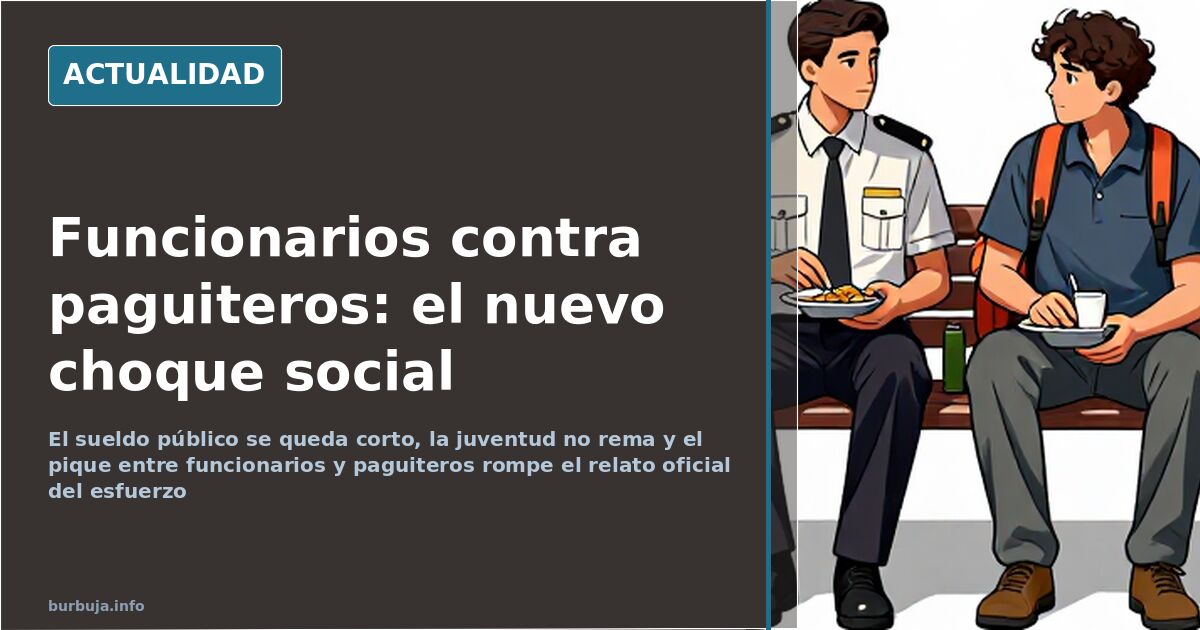
Civil Servants vs. Gig Workers: The New Class Conflict
Why has the idea taken root that civil servants complain about a lack of willing workers? The premise opening this debate is clear: a generation accustomed to the security of public budgets watches with unease as the labor market diverges from their parents' era, demanding that the unemployed be forced into construction and other trades to keep services cheap. The underlying thesis is that this discomfort stems not from others' productivity, but from seeing their own position in the hierarchy begin to wobble.
The Falling Behind of Public Wages
The first focus is economic. It is argued that public sector salaries are falling short against the cost of living, and facing this loss of purchasing power, there is a temptation to demand cheap external labor. The bill for public payrolls stands at 160 billion euros, a sum that would consume all revenue collected via IRPF (personal income tax) and represent one in four euros of total spending, exceeding 11% of GDP and surpassing the cost of contributory pensions.
Some add a fiscal nuance often overlooked: with marginal IRPF rates at 35% for much of this group, a nominal 3% raise translates to only 2% in real terms if taxes are not indexed to inflation. This is the same mechanism debated regarding the SMI (minimum wage). The uncomfortable conclusion is that the issue is not just how much is earned, but how much remains after deductions.
The Gig Worker Operating Off the Books
The second focus is sociological and more awkward. Against the civil servant holding steady employment rises the figure of the benefit recipient who supplements income with unregistered odd jobs. Far from being an anomaly, this is presented as a rational strategy: if the system does not offer decent work, it is parasitized. The recurring argument is that this profile requires no exams or competitive entry, breaking the monopoly on privilege.
However, the friction between these groups is deemed sterile. The real difference is not status, but access: some passed competitive exams and others did not, yet the economic outcomes are quite similar. The sharpest criticism points out that rank-and-file civil servants demand cheap labor while living off public funds, and hostility toward black-market earnings vanishes when they can profit from them.
Youth Who No Longer Row
The third focus is generational and carries the most tension. With 30-year-olds moving back into their parents' homes and a birth rate of 1.2 children per woman, the narrative that "youth don't want to work" reads as provocative. The response is that the social contract has broken: working, owning a home, and starting a family are no longer realistic expectations, but exceptions requiring exceptional skill and luck.
In this context, individual calculations change. If available jobs are precarious and rent consumes wages, collecting benefits and doing off-the-books work ceases to be shameful and becomes a defensible choice. Sabotage is presented as a logical response to a system that has curtailed the future of those coming behind.
Antiestéticar in the Eyes of the Aging Generation
The fourth focus is the most uncomfortable for the official narrative. When asked how many under-40s with children each person knows, or who will care for the elderly in 15 years, the tone shifts. Antiestéticar emerges. It is not abstract economic antiestéticar: it is the vertigo of a generation that lived well and discovers its position is not hereditary.
The final irony is that those who demanded effort from others begin to notice that their own effort guarantees nothing. The domestic poodle, it is said, has fewer chances of survival than the street dog when circumstances worsen.
Ultimately, the question hovering over the entire issue is not who works harder, but who has the right not to work. And the answer, judging by the general tone, is that this right belongs only to those who can afford it. Everyone else must row.
Why has the idea taken root that civil servants complain about a lack of willing workers? The premise opening this debate is clear: a generation accustomed to the security of public budgets watches with unease as the labor market diverges from their parents' era, demanding that the unemployed be forced into construction and other trades to keep services cheap. The underlying thesis is that this discomfort stems not from others' productivity, but from seeing their own position in the hierarchy begin to wobble.
The Falling Behind of Public Wages
The first focus is economic. It is argued that public sector salaries are falling short against the cost of living, and facing this loss of purchasing power, there is a temptation to demand cheap external labor. The bill for public payrolls stands at 160 billion euros, a sum that would consume all revenue collected via IRPF (personal income tax) and represent one in four euros of total spending, exceeding 11% of GDP and surpassing the cost of contributory pensions.
Some add a fiscal nuance often overlooked: with marginal IRPF rates at 35% for much of this group, a nominal 3% raise translates to only 2% in real terms if taxes are not indexed to inflation. This is the same mechanism debated regarding the SMI (minimum wage). The uncomfortable conclusion is that the issue is not just how much is earned, but how much remains after deductions.
The Gig Worker Operating Off the Books
The second focus is sociological and more awkward. Against the civil servant holding steady employment rises the figure of the benefit recipient who supplements income with unregistered odd jobs. Far from being an anomaly, this is presented as a rational strategy: if the system does not offer decent work, it is parasitized. The recurring argument is that this profile requires no exams or competitive entry, breaking the monopoly on privilege.
However, the friction between these groups is deemed sterile. The real difference is not status, but access: some passed competitive exams and others did not, yet the economic outcomes are quite similar. The sharpest criticism points out that rank-and-file civil servants demand cheap labor while living off public funds, and hostility toward black-market earnings vanishes when they can profit from them.
Youth Who No Longer Row
The third focus is generational and carries the most tension. With 30-year-olds moving back into their parents' homes and a birth rate of 1.2 children per woman, the narrative that "youth don't want to work" reads as provocative. The response is that the social contract has broken: working, owning a home, and starting a family are no longer realistic expectations, but exceptions requiring exceptional skill and luck.
In this context, individual calculations change. If available jobs are precarious and rent consumes wages, collecting benefits and doing off-the-books work ceases to be shameful and becomes a defensible choice. Sabotage is presented as a logical response to a system that has curtailed the future of those coming behind.
Antiestéticar in the Eyes of the Aging Generation
The fourth focus is the most uncomfortable for the official narrative. When asked how many under-40s with children each person knows, or who will care for the elderly in 15 years, the tone shifts. Antiestéticar emerges. It is not abstract economic antiestéticar: it is the vertigo of a generation that lived well and discovers its position is not hereditary.
The final irony is that those who demanded effort from others begin to notice that their own effort guarantees nothing. The domestic poodle, it is said, has fewer chances of survival than the street dog when circumstances worsen.
Ultimately, the question hovering over the entire issue is not who works harder, but who has the right not to work. And the answer, judging by the general tone, is that this right belongs only to those who can afford it. Everyone else must row.
Summary of a discussion on Burbuja.info - Foro de economía, actualidad y política., translated from Spanish and reviewed before publication. Read the full discussion (173 replies).
More summaries
-
Alcásser Case Brother Who Gave Hair to Koldo and Ábalos
An EL MUNDO report identifies Mauricio Anglés, brother of an Alcásser Case convict, as the stylist who performed hair transplants for Koldo García and José Luis Ábalos.
-
Motorcyclist loses leg on N-124 while bystanders film
On the 11th, a motorcyclist lost a leg on Spain's N-124 highway as three people filmed instead of helping, sparking debate.
-
Forum Debate on Which Immigrant Group Faces Most Rejection in Spain
A forum thread discusses which immigrant group faces the most rejection in Spain, featuring hostile opinions and claims lacking statistical backing.
-
China’s Tech Surge Leaves West Behind
Forum debate on China’s tech rise: electronics, autos, space. Users claim China produces more STEM graduates than top rivals combined.
-
Showering every two days: Spain's cultural hygiene divide
Jiajun Yin shared how his showering habits changed in Spain on the podcast 'Un chino y medio', sparking a debate on hygiene norms.
-
Spanish entrepreneur José Elías: 'I get angry if my kids score above a 7'
José Elías claims grades above 7 show wasted time, sparking debate on Spain's education system and cutoff marks.