
Spain's Demographic Shift: The Debate on Native Population Decline
Analysis of Spain's demographic transformation, citing claims that native-born citizens now comprise roughly 70% of the population.
English · Original discussion in Spanish · Published
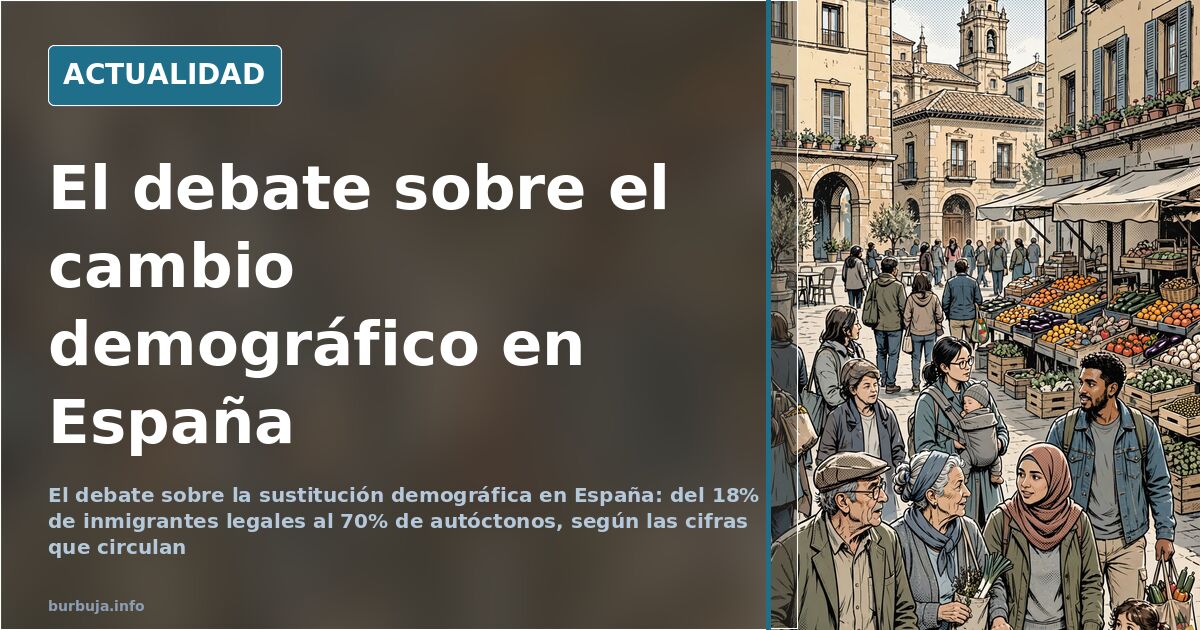
The debate over population replacement in Spain
In 1996, immigration in Spain was negligible. Those who attended secondary school in the early 2000s recall classrooms with barely one foreign student. Two decades later, that picture has reversed in many schools across the country. This analysis starts from a widely circulated claim: native-born Spaniards would now represent around 70% of the population, compared to an overwhelming majority in 1996, with the trend continuing downward due to very low native birth rates.
The discussion is not new, but its intensity is. Some argue that mass immigration began during Aznar’s second term (2000-2004) and accelerated with subsequent extraordinary regularization programs. Others place the start earlier, in the late 1990s, pointing to factors like the construction of mosques and Sarracinic cultural centers. Disagreement on the timeline does not prevent an uncomfortable consensus: the demographic change has been extremely rapid.
When did mass immigration really begin in Spain?
Testimonies agree on one point: the phenomenon was first noticed on the streets, then in statistics. Those who were twenty in the nineties recall seeing the first migrants from North Africa sporadically at the end of that decade. The first Latin Americans arrived later, in the late nineties. According to several accounts, the quantitative leap occurred between 2001 and 2002, with a surge of arrivals from Ecuador and Colombia in just two years.
The chronology matters because it defines political responsibility. One part of the analysis places the starting gun in Aznar’s second term. Another delays it until Zapatero’s era and his massive regularizations, which allegedly created a pull effect. Others go back further, to the eighties, when the first mosques since the Reconquista peine in cities like Córdoba, with capacities oversized for the Muslim community of the time.
Schools as a thermometer of change
Nothing illustrates the transformation better than classroom composition. One participant describes a center with 500 students where there were two Latin American and one North African student: 497 natives. Twenty years later, they claim, the proportion has inverted to around 50%. Another recalls that their entire school had only one student of Chinese origin, who refused to speak Chinese with his parents.
The most repeated anecdote is about the first migrant seen in person. One places it at age six or seven, a Pakistani. Another, as a teenager, recalls the first Black person seen outside of television. A third mentions two Black sisters seen during a alucinación to Madrid, in Casa de Campo. These are memories of a Spain that no longer exists.
The most cited consequence is not statistical, but everyday. A participant quotes a content creator: "I am one of the few Spanish fathers who go to pick up their children from school." The normalization of this scene, it is argued, proves that something has broken.
Football as a mirror of identity
Sport appears as a symptom. There is memory of a Spanish national team formed entirely by players born in Spain, experienced as part of collective pride. In contrast, a Real Madrid lineup is cited with three French, two Brazilians, two Germans, one Croatian, one Belgian, one Austrian, and one Uruguayan player: seven nationalities and none Spanish, although the club has naturalized players.
The argument is not that foreigners play badly, but that identification with the team dilutes. It is the same logic applied to the national team: if members no longer share origins, the emotional bond weakens. For some, this is simple nostalgia; for others, it confirms that identity is built on more than a passport.
What do data say about Spain's population?
The figures used in the debate are rough and should be treated with caution. It is claimed that legally resident immigrants represent 18% of the population, excluding irregular residents and naturalized citizens. It is also maintained that native-born Spaniards, excluding the Roma population, have gone from an almost absolute majority in 1996 to around 70% today.
There is no official source in the material backing these percentages. They are circulating estimates that must be attributed as such. What is verifiable is the trend: Spain has shifted from a country of emigration to one of immigration in very few years, and native birth rates are among the lowest in the world. The combination of both factors produces accelerated demographic change.
The generational fracture
Blame toward the previous generation is a key axis of discontent. Parents and grandparents are accused of accepting the process in exchange for material improvements: "My pension went up by eight and a half percent, so I'm happy," summarizes one participant. Criticism extends to pandemic management, with accusations of vaccinating grandchildren with experimental drugs to protect the elderly.
This reading generates a hard-to-close gap. For some, the prosperity of recent decades justified the costs. For others, those costs include loss of social cohesion and irreversible transformation of the country. The discussion is not economic, but about what was willing to be sacrificed and who decided to do so.
Where the analysis gets stuck
No one disputes that Spain has changed more in twenty-five years than in the previous fifty. The disagreement lies in whether this is a problem, an opportunity, or simply the inevitable result of the global economy. Defenders of cultural integration argue that relevance lies not in origin, but in language and sense of belonging. Those warning of demographic replacement respond that integration is neither automatic nor infinite.
And there the conversation ends. Without official data settling the magnitude of the phenomenon, without agreement on when it started or who allowed it, and with a question hovering over everything: is the process reversible, or, as one message claims, "no one is coming to save us."
In 1996, immigration in Spain was negligible. Those who attended secondary school in the early 2000s recall classrooms with barely one foreign student. Two decades later, that picture has reversed in many schools across the country. This analysis starts from a widely circulated claim: native-born Spaniards would now represent around 70% of the population, compared to an overwhelming majority in 1996, with the trend continuing downward due to very low native birth rates.
The discussion is not new, but its intensity is. Some argue that mass immigration began during Aznar’s second term (2000-2004) and accelerated with subsequent extraordinary regularization programs. Others place the start earlier, in the late 1990s, pointing to factors like the construction of mosques and Sarracinic cultural centers. Disagreement on the timeline does not prevent an uncomfortable consensus: the demographic change has been extremely rapid.
When did mass immigration really begin in Spain?
Testimonies agree on one point: the phenomenon was first noticed on the streets, then in statistics. Those who were twenty in the nineties recall seeing the first migrants from North Africa sporadically at the end of that decade. The first Latin Americans arrived later, in the late nineties. According to several accounts, the quantitative leap occurred between 2001 and 2002, with a surge of arrivals from Ecuador and Colombia in just two years.
The chronology matters because it defines political responsibility. One part of the analysis places the starting gun in Aznar’s second term. Another delays it until Zapatero’s era and his massive regularizations, which allegedly created a pull effect. Others go back further, to the eighties, when the first mosques since the Reconquista peine in cities like Córdoba, with capacities oversized for the Muslim community of the time.
Schools as a thermometer of change
Nothing illustrates the transformation better than classroom composition. One participant describes a center with 500 students where there were two Latin American and one North African student: 497 natives. Twenty years later, they claim, the proportion has inverted to around 50%. Another recalls that their entire school had only one student of Chinese origin, who refused to speak Chinese with his parents.
The most repeated anecdote is about the first migrant seen in person. One places it at age six or seven, a Pakistani. Another, as a teenager, recalls the first Black person seen outside of television. A third mentions two Black sisters seen during a alucinación to Madrid, in Casa de Campo. These are memories of a Spain that no longer exists.
The most cited consequence is not statistical, but everyday. A participant quotes a content creator: "I am one of the few Spanish fathers who go to pick up their children from school." The normalization of this scene, it is argued, proves that something has broken.
Football as a mirror of identity
Sport appears as a symptom. There is memory of a Spanish national team formed entirely by players born in Spain, experienced as part of collective pride. In contrast, a Real Madrid lineup is cited with three French, two Brazilians, two Germans, one Croatian, one Belgian, one Austrian, and one Uruguayan player: seven nationalities and none Spanish, although the club has naturalized players.
The argument is not that foreigners play badly, but that identification with the team dilutes. It is the same logic applied to the national team: if members no longer share origins, the emotional bond weakens. For some, this is simple nostalgia; for others, it confirms that identity is built on more than a passport.
What do data say about Spain's population?
The figures used in the debate are rough and should be treated with caution. It is claimed that legally resident immigrants represent 18% of the population, excluding irregular residents and naturalized citizens. It is also maintained that native-born Spaniards, excluding the Roma population, have gone from an almost absolute majority in 1996 to around 70% today.
There is no official source in the material backing these percentages. They are circulating estimates that must be attributed as such. What is verifiable is the trend: Spain has shifted from a country of emigration to one of immigration in very few years, and native birth rates are among the lowest in the world. The combination of both factors produces accelerated demographic change.
The generational fracture
Blame toward the previous generation is a key axis of discontent. Parents and grandparents are accused of accepting the process in exchange for material improvements: "My pension went up by eight and a half percent, so I'm happy," summarizes one participant. Criticism extends to pandemic management, with accusations of vaccinating grandchildren with experimental drugs to protect the elderly.
This reading generates a hard-to-close gap. For some, the prosperity of recent decades justified the costs. For others, those costs include loss of social cohesion and irreversible transformation of the country. The discussion is not economic, but about what was willing to be sacrificed and who decided to do so.
Where the analysis gets stuck
No one disputes that Spain has changed more in twenty-five years than in the previous fifty. The disagreement lies in whether this is a problem, an opportunity, or simply the inevitable result of the global economy. Defenders of cultural integration argue that relevance lies not in origin, but in language and sense of belonging. Those warning of demographic replacement respond that integration is neither automatic nor infinite.
And there the conversation ends. Without official data settling the magnitude of the phenomenon, without agreement on when it started or who allowed it, and with a question hovering over everything: is the process reversible, or, as one message claims, "no one is coming to save us."
Summary of a discussion on Burbuja.info - Foro de economía, actualidad y política., translated from Spanish and reviewed before publication. Read the full discussion (173 replies).
More summaries
-
Zapatero's daughter photographs reporter after jewellery question
One of Zapatero's daughters photographs a reporter after he asks about jewellery; the prison sentences circulating are unconfirmed
-
Motorcyclist loses leg on N-124 while bystanders film
On the 11th, a motorcyclist lost a leg on Spain's N-124 highway as three people filmed instead of helping, sparking debate.
-
Forum Debate on Which Immigrant Group Faces Most Rejection in Spain
A forum thread discusses which immigrant group faces the most rejection in Spain, featuring hostile opinions and claims lacking statistical backing.
-
China’s Tech Surge Leaves West Behind
Forum debate on China’s tech rise: electronics, autos, space. Users claim China produces more STEM graduates than top rivals combined.
-
Showering every two days: Spain's cultural hygiene divide
Jiajun Yin shared how his showering habits changed in Spain on the podcast 'Un chino y medio', sparking a debate on hygiene norms.
-
Spanish entrepreneur José Elías: 'I get angry if my kids score above a 7'
José Elías claims grades above 7 show wasted time, sparking debate on Spain's education system and cutoff marks.