
CGT Union Poster Sparks Online Backlash Ahead of International Women's Day
A CGT poster for March 8 featuring plus-size women with visible body hair has triggered a heated debate on representation and activist aesthetics.
English · Original discussion in Spanish · Published
CGT Union Poster Sparks Online Backlash Ahead of International Women's Day
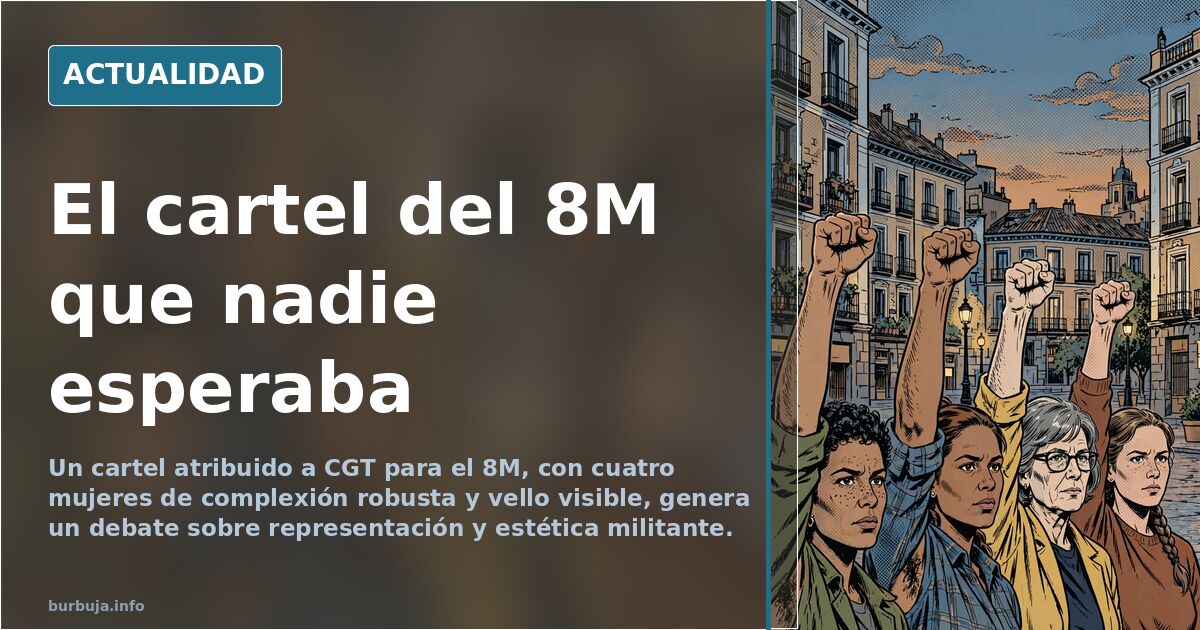
What does a union poster have that triggers a flood of responses and two days of digital firestorm? The answer, judging by the material, is an illustration of four plus-size women with visible body hair and stern expressions, attributed to the CGT (Confederación General del Trabajo) for the March 8 demonstration. Distributed as the official image for the call, the piece has generated a storm of comments that goes far beyond graphic design: it touches identity fibers, militant aesthetics, and the delicate issue of who represents whom within organized feminism.
The poster is not an isolated case of bad taste. It is the spark that ignites a recurring debate every March: the tension between the image a union wants to project and what part of society perceives as a caricature. In this clash, the CGT—described in the material as a historic anarchist union with presence in sectors like education, healthcare, or transport—is caught in the crossfire.
What Exactly Does the CGT Poster Show for March 8?
The description repeated in the discussion is consistent: four female figures with voluminous bodies, hardened facial antiestéticatures, and visible hair on armpits and legs. The technique—a copy-paste of the same silhouette with minimal variations—is one of the most frequent criticisms: "It looks like the attack of the clones," summarizes one comment. Another adds that the author "found it too much trouble to draw four different faces."
According to several voices, the result is not a portrait of the working woman but an caricature bordering on grotesque. Some compare it to "the horde of orcs coming out of the portal peine by warlock Gul'dan," referencing the Warcraft universe, while others state that the artist "must have had a blast" drawing them "fat with beastly faces." The underlying accusation is not aesthetic: it is that the poster turns women into a grotesque stereotype.
The Two Trenches of the Debate: Visibility or Caricature?
The first line of argument holds that the poster is a form of reverse discrimination: if feminism claims bodily diversity, drawing only non-normative bodies excludes thin women. "It is clear discrimination against thin people," says one comment. Another adds: "That poster makes me feel excluded from feminism."
The second line goes beyond aesthetics and points to the political message: the poster, they say, does not represent the working woman but a specific militant archetype. "They don't deceive; they are what they are," summarizes one voice. Another states: "It is the Dorian Gray portrait of Spain."
In the middle, a third, more pragmatic stance: the poster is ugly, but the problem is not the drawing but the substance. "The problem with those isn't physical; it's mental," affirms a comment that drifts toward psychological terrain. The discussion, in any case, never stays limited to design.
The Union Under Fire
The CGT does not emerge well from the exchange. Some recall that it is a "subsidized anarchist union," and others ironize about the coherence between libertarian discourse and institutional practice. The historical reference to Durruti—"if Durruti raised his head... the first thing he would do is shoot himself"—serves to underline the distance between the revolutionary imaginary and the presented graphic product.
The criticism is not just about the poster. It is about the drift of a union that, according to several comments, has embraced the framework of institutional feminism and lost touch with its base. "If even the CNT has joined the 'feminista radical' story," laments one voice. The implicit question is uncomfortable: who does the CGT really represent in 2024?
March 8 as a Political Thermometer
The poster is the anecdote. The background is the battle for the narrative of March 8, a date that generates more noise and less consensus each year. Some see in the drawing proof that the movement "feeds on naive people and those interested in gaining profit." Others, from the other side, defend that the poster gives visibility to bodies that conventional advertising erases.
The discussion drifts toward the wear of March 8 itself as a political brand. "Another year I won't watch a single second of this clown show," writes someone summarizing the fatigue of part of the audience. The date, born as a labor claim, has become a cultural battlefield where every poster is a manifesto and every manifesto, a controversy.
In the end, the CGT poster has achieved what few union designs manage: getting people to talk about it. Even if it is to say it looks like a meme, discriminates against thin women, or that the artist was paid to do what a Twitter troll would do. The question no one answers is whether that was the goal. And if it was, congratulations: mission accomplished.
What does a union poster have that triggers a flood of responses and two days of digital firestorm? The answer, judging by the material, is an illustration of four plus-size women with visible body hair and stern expressions, attributed to the CGT (Confederación General del Trabajo) for the March 8 demonstration. Distributed as the official image for the call, the piece has generated a storm of comments that goes far beyond graphic design: it touches identity fibers, militant aesthetics, and the delicate issue of who represents whom within organized feminism.
The poster is not an isolated case of bad taste. It is the spark that ignites a recurring debate every March: the tension between the image a union wants to project and what part of society perceives as a caricature. In this clash, the CGT—described in the material as a historic anarchist union with presence in sectors like education, healthcare, or transport—is caught in the crossfire.
What Exactly Does the CGT Poster Show for March 8?
The description repeated in the discussion is consistent: four female figures with voluminous bodies, hardened facial antiestéticatures, and visible hair on armpits and legs. The technique—a copy-paste of the same silhouette with minimal variations—is one of the most frequent criticisms: "It looks like the attack of the clones," summarizes one comment. Another adds that the author "found it too much trouble to draw four different faces."
According to several voices, the result is not a portrait of the working woman but an caricature bordering on grotesque. Some compare it to "the horde of orcs coming out of the portal peine by warlock Gul'dan," referencing the Warcraft universe, while others state that the artist "must have had a blast" drawing them "fat with beastly faces." The underlying accusation is not aesthetic: it is that the poster turns women into a grotesque stereotype.
The Two Trenches of the Debate: Visibility or Caricature?
The first line of argument holds that the poster is a form of reverse discrimination: if feminism claims bodily diversity, drawing only non-normative bodies excludes thin women. "It is clear discrimination against thin people," says one comment. Another adds: "That poster makes me feel excluded from feminism."
The second line goes beyond aesthetics and points to the political message: the poster, they say, does not represent the working woman but a specific militant archetype. "They don't deceive; they are what they are," summarizes one voice. Another states: "It is the Dorian Gray portrait of Spain."
In the middle, a third, more pragmatic stance: the poster is ugly, but the problem is not the drawing but the substance. "The problem with those isn't physical; it's mental," affirms a comment that drifts toward psychological terrain. The discussion, in any case, never stays limited to design.
The Union Under Fire
The CGT does not emerge well from the exchange. Some recall that it is a "subsidized anarchist union," and others ironize about the coherence between libertarian discourse and institutional practice. The historical reference to Durruti—"if Durruti raised his head... the first thing he would do is shoot himself"—serves to underline the distance between the revolutionary imaginary and the presented graphic product.
The criticism is not just about the poster. It is about the drift of a union that, according to several comments, has embraced the framework of institutional feminism and lost touch with its base. "If even the CNT has joined the 'feminista radical' story," laments one voice. The implicit question is uncomfortable: who does the CGT really represent in 2024?
March 8 as a Political Thermometer
The poster is the anecdote. The background is the battle for the narrative of March 8, a date that generates more noise and less consensus each year. Some see in the drawing proof that the movement "feeds on naive people and those interested in gaining profit." Others, from the other side, defend that the poster gives visibility to bodies that conventional advertising erases.
The discussion drifts toward the wear of March 8 itself as a political brand. "Another year I won't watch a single second of this clown show," writes someone summarizing the fatigue of part of the audience. The date, born as a labor claim, has become a cultural battlefield where every poster is a manifesto and every manifesto, a controversy.
In the end, the CGT poster has achieved what few union designs manage: getting people to talk about it. Even if it is to say it looks like a meme, discriminates against thin women, or that the artist was paid to do what a Twitter troll would do. The question no one answers is whether that was the goal. And if it was, congratulations: mission accomplished.
Summary of a discussion on Burbuja.info - Foro de economía, actualidad y política., translated from Spanish and reviewed before publication. Read the full discussion (173 replies).
More summaries
-
Tenant Union Spokesperson Comes from Family of Marquesses with €220 Million Estate
The spokesperson for the Sol Tenant Union belongs to a marquis family with a €220 million real estate fortune. We analyze the context.
-
Youthful vision of the future and empowerment rhetoric
Analysis of young people's aspirations and female empowerment discourse against the reality of the job market.
-
Sweden's Left Parties Now Use Arabic Ballots to Win Muslim Votes
The left-wing parties in Sweden are adapting their electoral strategy, including Arabic-language ballots, to win the vote of Muslim communities, a move that reflects a similar trend in other European countries.
-
Who Funds AI? VC, Big Tech, and Users Pay the Bill
Venture capital, Big Tech shareholders, and users cover AI costs as automation reshapes management hierarchies and job roles.
-
Pool Incident Boy Faces 17 Lawsuits, Ruined Adolescence
A 12-year-old’s comment in a pool led to 17 lawsuits and beatings. Thirteen years later, he recounts his ordeal.
-
Hitmen in Spain: Prices Drop to €1,700
Reports suggest hiring a hitman in Spain now costs €1,700. We analyze the data and social controversy behind this figure.