
Debate: Mexican Cartels, Trump and Border Drone Attacks
Discussion on alleged kamikaze drone attacks by Mexican cartels against US Border Patrol agents and Trump's promise of a hardline response.
English · Original discussion in Spanish · Published
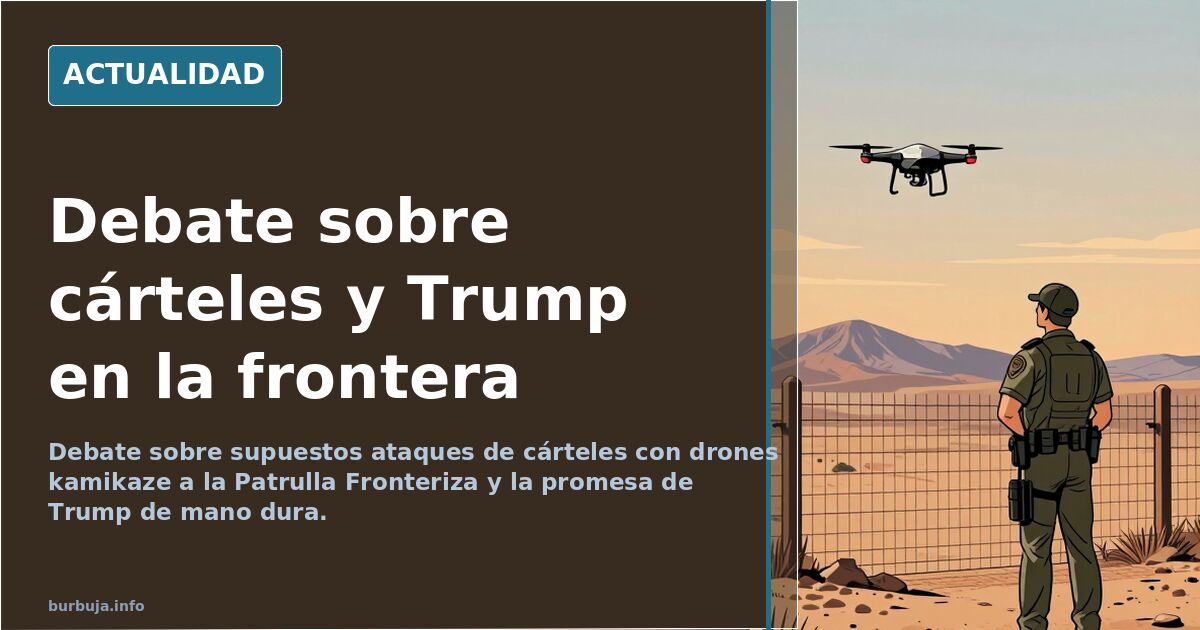
Mexican Cartels Declare War on Trump: Kamikaze Drones and Explosives
News reports claiming that Mexican cartels are attacking US Border Patrol agents with kamikaze drones and explosives have sparked intense debate. Amidst high tensions, former President Donald Trump has promised a hardline approach against the cartels, labeling them terrorist organizations. The discussion centers on whether this escalation is real or part of a political strategy, and the potential consequences of a direct confrontation between Washington and incivil groups.
What Is Happening at the Mexico-US Border?
According to the message initiating the debate, Mexican cartels allegedly declared war on Trump and are using kamikaze drones and explosives against Border Patrol agents. This information, attributed to journalistic reports, has not been independently verified in available materials but has led many participants to assume that border violence has reached a new level. Trump’s reaction, having previously promised to designate cartels as foreign terrorist organizations, is presented as a direct response to these actions.
The debate reflects a deep division. On one side, some consider that Trump is doing what no other president dared: confronting the cartels. On the other, there are voices pointing out that the drug war is a business and that the true culprits are in the United States.
The Drug Trafficking Business: Who Really Controls the Flow?
One of the most repeated arguments in the discussion holds that cartels are just the tip of the iceberg. It is argued that drug trafficking is a global industry where states themselves play a fundamental role. The Iran-Contra scandal (Irangate) is mentioned as an example of how the US government has been involved in drug trafficking. "State and drug trafficking are exactly the same," claims one participant, adding that "states control the flow of drugs across the Planet."
This view clashes with those who believe Trump can end the cartels through military intervention. There is debate over whether bombing Mexico would be effective or if it would only fuel the cycle of violence. Some compare the situation to Afghanistan, warning that it would be a long and costly conflict.
The Shadow of the CIA and Fentanyl
Another line of analysis points directly to the CIA. It is claimed that the agency has historically been implicated in drug trafficking and that fentanyl is no exception. "The CIA controls drugs in the USA," states one comment without providing evidence. These accusations, unsupported by evidence in the material, form part of a widespread distrust of the official narrative.
Fentanyl appears as the major public health crisis in the United States. It is described as an epidemic killing thousands and prompting Trump to take action. The opioid crisis is cited as an example of how the pharmaceutical industry and medical prescription policies contributed to mass addiction.
What Role Do Mexico and Its Government Play?
Mexican President Claudia Sheinbaum is mentioned in the debate as a "terrorist communist" who does not control her border. This clearly derogatory characterization reflects the hostility of some participants toward the Mexican government. Criticism focuses on Mexico not doing enough to curb the cartels and insufficient cooperation with the United States.
However, others defend that Mexico is a victim of US drug demand and that ultimate responsibility lies with the neighboring country. It is emphasized that cartels have become a state within a state, with power so vast they have infiltrated institutions and local governments.
The Bukele Precedent and Hardline Tactics
The figure of El Salvadorian President Nayib Bukele looms over the discussion. Several participants express their desire for Trump to apply the same method Bukele used in his country: hardline tactics, mass incarceration, and elimination of gangs. "Beautiful Mexico needs a Bukele," is even stated. Bukele’s security policy is praised as a success story against organized crime.
Nevertheless, others warn that Mexico’s situation is much more complex and that a repressive approach could unleash even greater violence. It is recalled that cartels have the capacity to attack US targets and that a military escalation would have unpredictable consequences.
The Drug War: Solution or Business?
Skepticism regarding the effectiveness of military intervention is notable. It is argued that the drug war has failed for decades and that Trump will be no exception. "Nixon and Reagan said the same thing 40 and 50 years ago. And achieved the same thing Trump will achieve: nothing," concludes one participant. This opinion summarizes the distrust that a purely police or military approach can solve such a deeply rooted problem.
In contrast, Trump supporters argue that his determination is different and that, for the first time, there is a president willing to attack cartels on their own turf. The possibility of bombing Mexico and sending captured traffickers to El Salvador prisons is mentioned, aligning with the collaboration between Trump and Bukele.
The debate leaves an uncomfortable conclusion: nobody has a clear solution. While some trust in hardline tactics, others see the drug war as a business that will never end. In the middle, the border remains the scene of violence that distinguishes neither cartels nor governments.
News reports claiming that Mexican cartels are attacking US Border Patrol agents with kamikaze drones and explosives have sparked intense debate. Amidst high tensions, former President Donald Trump has promised a hardline approach against the cartels, labeling them terrorist organizations. The discussion centers on whether this escalation is real or part of a political strategy, and the potential consequences of a direct confrontation between Washington and incivil groups.
What Is Happening at the Mexico-US Border?
According to the message initiating the debate, Mexican cartels allegedly declared war on Trump and are using kamikaze drones and explosives against Border Patrol agents. This information, attributed to journalistic reports, has not been independently verified in available materials but has led many participants to assume that border violence has reached a new level. Trump’s reaction, having previously promised to designate cartels as foreign terrorist organizations, is presented as a direct response to these actions.
The debate reflects a deep division. On one side, some consider that Trump is doing what no other president dared: confronting the cartels. On the other, there are voices pointing out that the drug war is a business and that the true culprits are in the United States.
The Drug Trafficking Business: Who Really Controls the Flow?
One of the most repeated arguments in the discussion holds that cartels are just the tip of the iceberg. It is argued that drug trafficking is a global industry where states themselves play a fundamental role. The Iran-Contra scandal (Irangate) is mentioned as an example of how the US government has been involved in drug trafficking. "State and drug trafficking are exactly the same," claims one participant, adding that "states control the flow of drugs across the Planet."
This view clashes with those who believe Trump can end the cartels through military intervention. There is debate over whether bombing Mexico would be effective or if it would only fuel the cycle of violence. Some compare the situation to Afghanistan, warning that it would be a long and costly conflict.
The Shadow of the CIA and Fentanyl
Another line of analysis points directly to the CIA. It is claimed that the agency has historically been implicated in drug trafficking and that fentanyl is no exception. "The CIA controls drugs in the USA," states one comment without providing evidence. These accusations, unsupported by evidence in the material, form part of a widespread distrust of the official narrative.
Fentanyl appears as the major public health crisis in the United States. It is described as an epidemic killing thousands and prompting Trump to take action. The opioid crisis is cited as an example of how the pharmaceutical industry and medical prescription policies contributed to mass addiction.
What Role Do Mexico and Its Government Play?
Mexican President Claudia Sheinbaum is mentioned in the debate as a "terrorist communist" who does not control her border. This clearly derogatory characterization reflects the hostility of some participants toward the Mexican government. Criticism focuses on Mexico not doing enough to curb the cartels and insufficient cooperation with the United States.
However, others defend that Mexico is a victim of US drug demand and that ultimate responsibility lies with the neighboring country. It is emphasized that cartels have become a state within a state, with power so vast they have infiltrated institutions and local governments.
The Bukele Precedent and Hardline Tactics
The figure of El Salvadorian President Nayib Bukele looms over the discussion. Several participants express their desire for Trump to apply the same method Bukele used in his country: hardline tactics, mass incarceration, and elimination of gangs. "Beautiful Mexico needs a Bukele," is even stated. Bukele’s security policy is praised as a success story against organized crime.
Nevertheless, others warn that Mexico’s situation is much more complex and that a repressive approach could unleash even greater violence. It is recalled that cartels have the capacity to attack US targets and that a military escalation would have unpredictable consequences.
The Drug War: Solution or Business?
Skepticism regarding the effectiveness of military intervention is notable. It is argued that the drug war has failed for decades and that Trump will be no exception. "Nixon and Reagan said the same thing 40 and 50 years ago. And achieved the same thing Trump will achieve: nothing," concludes one participant. This opinion summarizes the distrust that a purely police or military approach can solve such a deeply rooted problem.
In contrast, Trump supporters argue that his determination is different and that, for the first time, there is a president willing to attack cartels on their own turf. The possibility of bombing Mexico and sending captured traffickers to El Salvador prisons is mentioned, aligning with the collaboration between Trump and Bukele.
The debate leaves an uncomfortable conclusion: nobody has a clear solution. While some trust in hardline tactics, others see the drug war as a business that will never end. In the middle, the border remains the scene of violence that distinguishes neither cartels nor governments.
Summary of a discussion on Burbuja.info - Foro de economía, actualidad y política., translated from Spanish and reviewed before publication. Read the full discussion (173 replies).
More summaries
-
El Salvador's Leader: A Third Way?
Nayib Bukele defines himself as a "third-positionist" in a complex world. We analyze his stance and the Central American context.
-
Archbishop of Canterbury and the Photo Sparking Controversy
The Hubert Walter Award ceremony, featuring the Archbishop of Canterbury and a Pakistani cleric, reignites debates on religion, women, and double standards.
-
Italian teacher fired for OnlyFans sues parents who shared photos
An Italian teacher dismissed over her OnlyFans content is suing the parents who circulated her images, alleging defamation.
-
Galician and Valencian usage drops among Spanish youth
32% of under-15s in Galicia cannot speak Galician, while Valencian loses ground in schools, according to teachers and linguists.
-
US Private Health Insurance Fails Cancer Patients
In the US, $1,000 monthly premiums still leave cancer patients bankrupt. In Spain, public healthcare costs €2,000 per person annually.
-
Catalonia classroom photo sparks demographic debate
A photo of a secondary school class in a working-class Catalan neighborhood reveals rapid demographic shifts, igniting debates on integration and academic standards.