
Shoes: 99 euros in store, cheaper online
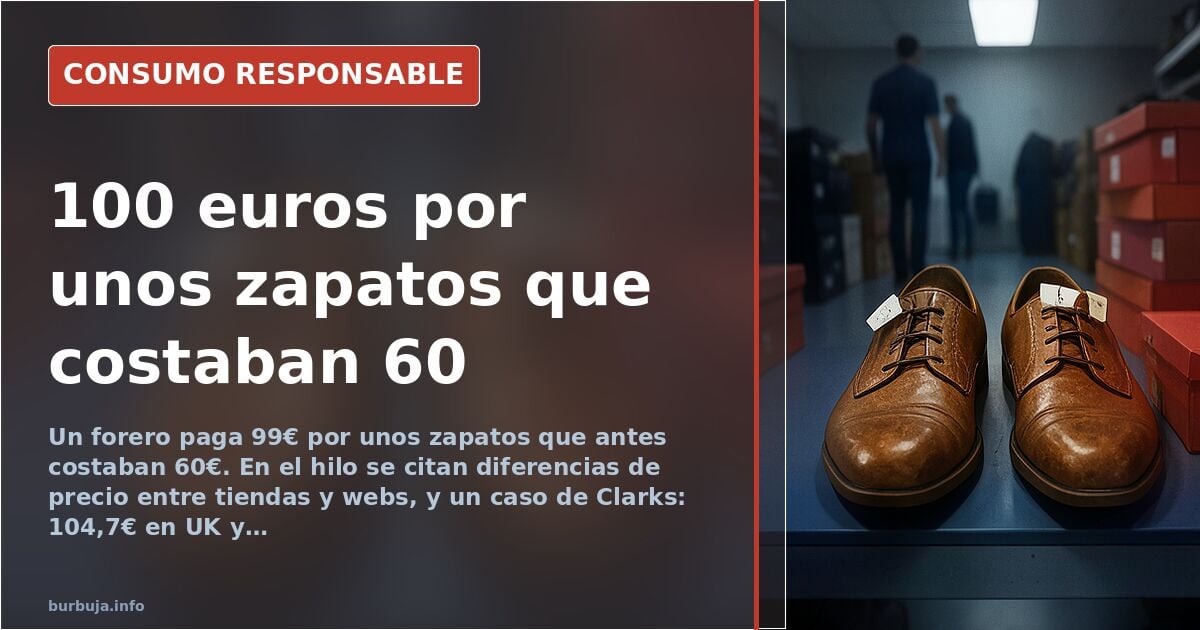
A forum user pays 99€ for shoes that used to cost 60€. The thread cites price gaps between stores and websites, and a Clarks case: 104.7€ in the UK and…
English · Original discussion in Spanish · Published
Why a pair of shoes costs 99 euros in store and less online
Is it normal to pay 100 euros for a pair of shoes outside the sales? The short answer is yes, if you buy them through the wrong retail channel. The long answer involves, according to a calculation circulating in the industry, margins of 200% to 300%, models that leave the factory at 30 euros, and a price gap between Spain and the UK that, for one specific model, reaches 35 euros for the same pair.
It all started with an afternoon of shopping in two shopping centres. The goal: a pair with a soft sole, one of those comfortable brands everyone recognises. The result: in every store, the cheapest models of that type were priced at 99 euros. The previous year, equivalent ones had cost 60. The question hanging in the air is whether there is a price agreement or whether the retail calendar has simply decided that outside the sales, nobody buys.
The margin the shop window keeps
The most common explanation does not point at the manufacturer. Shop prices include a markup that in many cases triples what it costs to produce the shoe. A calculation doing the rounds in the industry makes it clear: women's leather sandals leave the factory at an average of 20 euros, leather shoes at around 30, and the men's models that a well-known brand sells for over 170 euros are made in Almansa for about 42. The difference is not pocketed by the person stitching the sole.
That is where retail comes in, applying its own criteria based on location, brand and season. In non-commercial areas, in small shops and among lesser-known brands, the same type of product appears at prices that break the narrative. Some have bought leather boots for 15 euros in the sales and worn them all year with a coat of polish. Others have paid 25 euros for a pair of Mustangs at a neighbourhood shoe shop, lifelong-customer discount included.
The Spain-UK gap: 35 euros for the same shoe
The geographic differential is the most uncomfortable figure. One specific Clarks model, the Carter Lo GTX, appears at 104.7 euros on the British website and at 140 euros on the Spanish one. Same product, same brand, 35 euros apart. The official explanation would be adjustment to the local market, which is a polite way of saying that here you pay more because you can.
The added problem is that many brands block purchases from their home-country website. Clarks does not ship to Spain from its UK store, forcing buyers through the Spanish subsidiary. Other brands do allow shopping abroad, and there the saving is direct. Some have bought in England and then compared in a Spanish store, finding not only a price difference but also a quality one: the British shoe seemed better finished than the one sold here.
Amazon, street markets and outlets: where the price breaks down
The alternative that comes up most often is buying online. On Amazon, high-end running shoes appear at 50 euros delivered to your door, when in a physical store they could cost almost three times as much. A pair of sandals and some discounted Skechers came to 45 euros in total. The trick lies in promo codes and one-off offers: there are extra 10% discounts with specific codes and free shipping from 25 pounds on certain items.
To track those prices there is one tool mentioned as essential: a browser extension that shows an item's price history over months. Without that record, it is easy to fall for a fake deal. The other route is the brand's own outlet, where offers arrive within days and prices appear that you will not find in the official store.
Street markets and supermarkets complete the picture. There are shoes at 10 or 20 euros in any town, and supermarket sandals for under 30. The objection is quality: those who have tried cheap footwear report experiences lasting two weeks. Those who have found the exception, however, argue that 40 to 60 euro leather shoes, bought with care, last for years.
Footwear as an investment (or not)
At the opposite end are those who argue that cheap shoes are a false economy. A pair of quality boots, they say, does not come in under 100 euros, and there are Spanish brands considered among the best in the world whose prices exceed 200. The argument is that a well-made leather shoe lasts decades, can be repaired and resoled at the shop itself, and ends up cheaper per year of use than ten pairs of throwaways.
The counterargument is that this logic only works if you buy once every many years and choose well. Sizing varies between models, the fit changes, and buying online without trying is a lottery. The advice repeated most often is to try in a physical store and then look for the same model and size online. A method that works for those with patience, and that leaves traditional retail as a free fitting room.
Which brands and shops make the list?
Among the Spanish brands cited as reliable are Fluchos, Pitillos, Dorking, Chiruca, Pikolinos, Sendra, Hispanitas, Martinelli, Lottusse and Camper. On the British side, Loake, Grenson and Crockett & Jones appear, with prices that in some cases exceed 200 euros. For everyday wear, budget shoe chains like Merkal are described as the Kiabi of footwear: cheap all year round and present in shopping centres.
The practical conclusion from all this is that the sales calendar is not a law of physics. It is a commercial convention. Outside it, the same shoe can be found 40% cheaper if you change channel, country or brand. What never drops is the comfort of knowing you paid 99 euros for something that was 60 in another shop window.
Is it normal to pay 100 euros for a pair of shoes outside the sales? The short answer is yes, if you buy them through the wrong retail channel. The long answer involves, according to a calculation circulating in the industry, margins of 200% to 300%, models that leave the factory at 30 euros, and a price gap between Spain and the UK that, for one specific model, reaches 35 euros for the same pair.
It all started with an afternoon of shopping in two shopping centres. The goal: a pair with a soft sole, one of those comfortable brands everyone recognises. The result: in every store, the cheapest models of that type were priced at 99 euros. The previous year, equivalent ones had cost 60. The question hanging in the air is whether there is a price agreement or whether the retail calendar has simply decided that outside the sales, nobody buys.
The margin the shop window keeps
The most common explanation does not point at the manufacturer. Shop prices include a markup that in many cases triples what it costs to produce the shoe. A calculation doing the rounds in the industry makes it clear: women's leather sandals leave the factory at an average of 20 euros, leather shoes at around 30, and the men's models that a well-known brand sells for over 170 euros are made in Almansa for about 42. The difference is not pocketed by the person stitching the sole.
That is where retail comes in, applying its own criteria based on location, brand and season. In non-commercial areas, in small shops and among lesser-known brands, the same type of product appears at prices that break the narrative. Some have bought leather boots for 15 euros in the sales and worn them all year with a coat of polish. Others have paid 25 euros for a pair of Mustangs at a neighbourhood shoe shop, lifelong-customer discount included.
The Spain-UK gap: 35 euros for the same shoe
The geographic differential is the most uncomfortable figure. One specific Clarks model, the Carter Lo GTX, appears at 104.7 euros on the British website and at 140 euros on the Spanish one. Same product, same brand, 35 euros apart. The official explanation would be adjustment to the local market, which is a polite way of saying that here you pay more because you can.
The added problem is that many brands block purchases from their home-country website. Clarks does not ship to Spain from its UK store, forcing buyers through the Spanish subsidiary. Other brands do allow shopping abroad, and there the saving is direct. Some have bought in England and then compared in a Spanish store, finding not only a price difference but also a quality one: the British shoe seemed better finished than the one sold here.
Amazon, street markets and outlets: where the price breaks down
The alternative that comes up most often is buying online. On Amazon, high-end running shoes appear at 50 euros delivered to your door, when in a physical store they could cost almost three times as much. A pair of sandals and some discounted Skechers came to 45 euros in total. The trick lies in promo codes and one-off offers: there are extra 10% discounts with specific codes and free shipping from 25 pounds on certain items.
To track those prices there is one tool mentioned as essential: a browser extension that shows an item's price history over months. Without that record, it is easy to fall for a fake deal. The other route is the brand's own outlet, where offers arrive within days and prices appear that you will not find in the official store.
Street markets and supermarkets complete the picture. There are shoes at 10 or 20 euros in any town, and supermarket sandals for under 30. The objection is quality: those who have tried cheap footwear report experiences lasting two weeks. Those who have found the exception, however, argue that 40 to 60 euro leather shoes, bought with care, last for years.
Footwear as an investment (or not)
At the opposite end are those who argue that cheap shoes are a false economy. A pair of quality boots, they say, does not come in under 100 euros, and there are Spanish brands considered among the best in the world whose prices exceed 200. The argument is that a well-made leather shoe lasts decades, can be repaired and resoled at the shop itself, and ends up cheaper per year of use than ten pairs of throwaways.
The counterargument is that this logic only works if you buy once every many years and choose well. Sizing varies between models, the fit changes, and buying online without trying is a lottery. The advice repeated most often is to try in a physical store and then look for the same model and size online. A method that works for those with patience, and that leaves traditional retail as a free fitting room.
Which brands and shops make the list?
Among the Spanish brands cited as reliable are Fluchos, Pitillos, Dorking, Chiruca, Pikolinos, Sendra, Hispanitas, Martinelli, Lottusse and Camper. On the British side, Loake, Grenson and Crockett & Jones appear, with prices that in some cases exceed 200 euros. For everyday wear, budget shoe chains like Merkal are described as the Kiabi of footwear: cheap all year round and present in shopping centres.
The practical conclusion from all this is that the sales calendar is not a law of physics. It is a commercial convention. Outside it, the same shoe can be found 40% cheaper if you change channel, country or brand. What never drops is the comfort of knowing you paid 99 euros for something that was 60 in another shop window.
Also available in: Deutsch
Summary of a discussion on Burbuja.info - Foro de economía, actualidad y política., translated from Spanish and reviewed before publication. Read the full discussion (87 replies).
More summaries
-
El Corte Inglés delivers in 3 hours, undercutting Amazon by €30
Smartwatch delivered in three hours and €30 cheaper than Amazon: cases challenging El Corte Inglés' expensive reputation.
-
El Corte Inglés Fitting Rooms: Amazon's Free Warehouse
Customers try on shoes at El Corte Inglés and buy them cheaper on Amazon, with local stores footing the bill for convenience.
-
El Corte Inglés prepared food: quality at a price
El Corte Inglés croquettes beat Mercadona's, but prices like €21/kg for meat rolls mean it's only worth it for some products.
-
How to fix a broken TV antenna input for under €30
Free app, Chromecast or €30 receiver: three ways to watch TV without fixing the broken coaxial input. The cheapest costs zero euros.
-
Anisakis in cod: what the law requires from restaurants in Spain
Royal Decree 1420/2006 requires fish to be frozen at -20 ºC for 24 hours. If the anisakis is dead there is no poisoning, but the allergy risk remains.
-
Knee osteoarthritis: which claims hold up and which don't
A forum debates whether knee cartilage can regenerate: some back glucosamine and chondroitin, others insist cartilage never recovers. Knee replacement surgery…